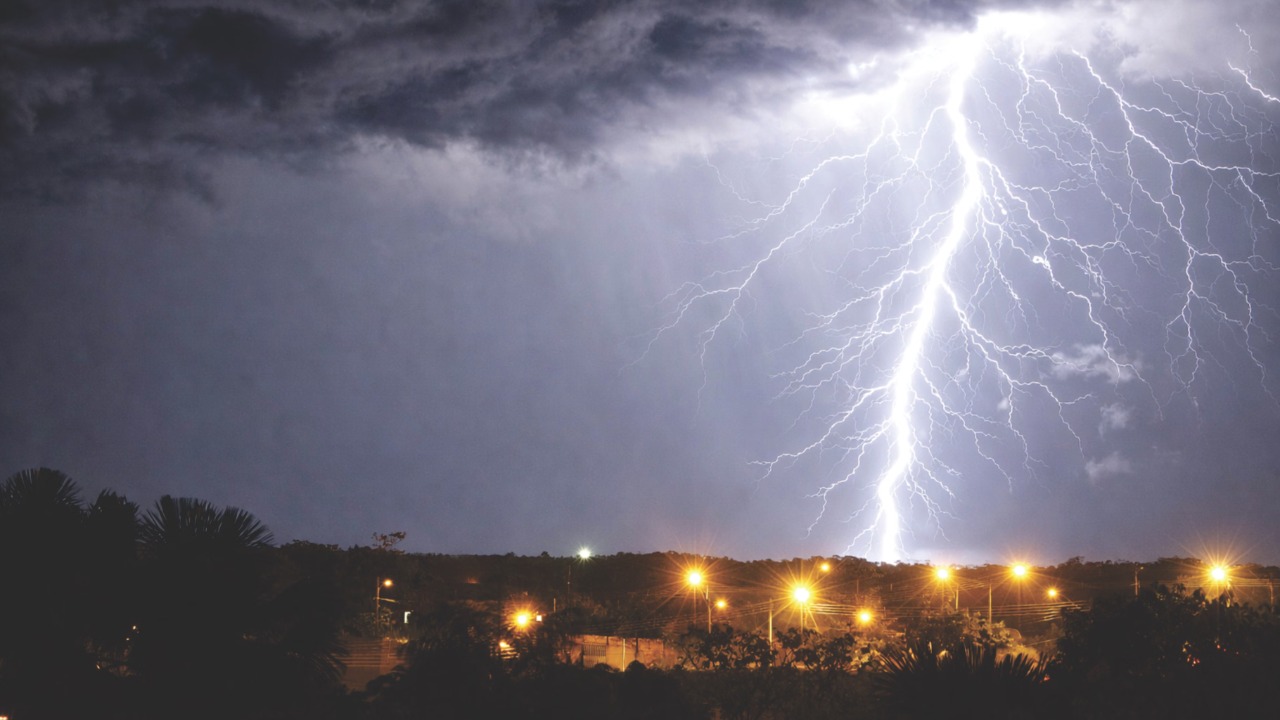

A single lightning stroke can heat the air around it to temperatures that leave the Sun’s visible surface behind. For a few fleeting microseconds, a narrow channel of sky becomes one of the hottest places in the solar system that humans can see from their own backyards. That comparison sounds like hype, yet it rests on careful measurements of both lightning and the outer layer of our star.
Recognizing how a jagged flash in a thunderstorm can briefly outmatch the solar photosphere reshapes how people think about energy, weather, and risk on Earth. It also shows how everyday experience can hide extreme physics in plain sight.
How scientists learned lightning can outheat the Sun’s surface
Laboratory measurements and field instruments have gradually revealed just how extreme a lightning channel is. When a bolt forms, a narrow path of air only a few centimeters wide is suddenly driven to around 30,000 Kelvin, which is roughly five times hotter than the Sun’s 5,500 Kelvin surface. That estimate comes from spectroscopic readings of the glowing plasma and from models of how quickly the air expands to create thunder, with studies showing that a single discharge can heat the air to this extreme level.
The comparison only makes sense once temperature is defined carefully. The Sun’s surface temperature is an equilibrium value that describes the intensity of radiation emitted by the photosphere. By contrast, lightning’s quoted temperature refers to the thermal energy of particles inside the channel, not to a broad glowing surface. Meteorologists and physicists use temperature in multiple ways, and they stress that context matters when someone hears that one thing is “hotter” than another. Explanations of concepts like absolute zero, kinetic energy, and thermal radiation help clarify why a small plasma filament can be hotter than a star’s surface without violating basic physics, a point that detailed guides to temperature differences emphasize.
When lightning forms, charge separation inside a storm cloud builds enormous electric fields. Once the field overcomes the insulating strength of air, a stepped leader of ionized gas descends, followed by a powerful return stroke racing upward. In that instant, current values can reach tens of thousands of amperes. The electrical energy dumped into a tiny volume of air strips electrons from atoms and creates plasma, which is what drives the temperature into the tens of thousands of degrees. Analyses of why lightning is so trace this chain from charge separation to plasma heating.
The Sun, by contrast, has a much cooler surface than its core. Nuclear fusion in the core pushes temperatures into the millions of degrees, but energy diffuses outward and eventually reaches the photosphere, where it has dropped to that roughly 5,500 Kelvin figure. Lightning never approaches the Sun’s core conditions. The comparison applies only to the outer visible layer, and only to the peak temperature inside the lightning channel, not the surrounding storm.
Why this extreme heat comparison matters right now
The idea that a lightning bolt can outheat the Sun’s surface has become a popular science soundbite, but it carries real stakes for safety and infrastructure. The same energy that drives those temperatures can vaporize materials, explode tree sap, and damage buildings in a fraction of a second. Broadcast meteorologists explaining why lightning can get hotter than the Sun’s surface often tie the physics back to practical advice, describing how the channel’s heat can melt metal, ignite roofs, and injure people even without a direct strike. One explainer on why lightning can than the Sun’s surface highlights how that energy translates into real-world damage.
Thunder itself is a direct consequence of the temperature spike. As the air in the channel jumps to tens of thousands of degrees, it expands explosively, creating a shock wave that travels outward and gradually becomes the rumbling sound people hear. The violent expansion of superheated air, described in studies of how a single bolt can heat and expand its surroundings, links the abstract idea of “hotter than the Sun” to a familiar sensory experience. Every thunderclap is an audible reminder of just how much energy was released above.
Climate trends and urban growth are also pushing lightning risk higher on the public agenda. Warmer air can hold more moisture and may support more intense thunderstorms in some regions, increasing the chances of lightning outbreaks over densely populated areas. As more people and more infrastructure lie in the path of storms, each extreme discharge becomes more consequential. The physics of a 30,000 Kelvin plasma channel helps explain why power grids, communications towers, and aviation systems invest heavily in lightning protection.
For engineers, the temperature comparison underscores the need for materials and designs that can survive brief but intense thermal and electrical stress. Lightning rods, surge arresters, and aircraft skins are all tested against conditions that mimic the current and heat of a return stroke. Knowing that the channel temperature rivals or exceeds the Sun’s surface helps translate laboratory test numbers into an intuitive sense of severity. It is not just a bright flash. It is a tiny, transient furnace touching a structure.
Education is another area where the comparison has impact. Teachers and science communicators use the “hotter than the Sun’s surface” line to capture attention, then unpack what temperature means in different contexts. That approach can correct common misconceptions, such as the belief that all parts of the Sun share the same temperature or that brightness always tracks heat. By walking through why a small, extremely hot region can exist in a cooler environment, educators build a more accurate mental model of both stars and storms.
What future research and technology could reveal about lightning heat
Even with decades of work, scientists still have open questions about exactly how energy flows inside a lightning channel. High speed cameras, field mills, and radio-frequency sensors have improved understanding of how leaders propagate and how return strokes climb, yet the peak temperatures and current profiles inside the narrowest parts of the discharge remain difficult to capture. New instruments that can sample spectra at microsecond scales may sharpen estimates of how often lightning reaches or exceeds that five-times-the-Sun threshold.
Satellites are also changing the picture. Space-based sensors that monitor global lightning activity can track storm patterns over oceans and remote regions, helping researchers see where the most energetic discharges occur. Combining those global maps with ground-based measurements of temperature and current could reveal whether certain storm types or geographic regions are more likely to produce the hottest channels. That information would feed back into risk models for aviation routes, offshore platforms, and rural communities that lack dense sensor networks.
On the technology side, better understanding of lightning’s brief but extreme heat is driving innovation in protection systems. Material scientists are exploring composites and coatings that can withstand rapid heating without cracking or spalling. Power utilities are experimenting with smarter grid components that can sense surges linked to lightning and isolate faults before they cascade. Each of these efforts relies on accurate models of the thermal and electrical load a strike delivers, which in turn depend on reliable temperature measurements of the channel.
There is also growing interest in whether lightning can be guided or triggered in ways that reduce damage. Experiments with laser-guided lightning, for example, attempt to create an easier path for the discharge to follow, steering it toward safe conductors. To design such systems, researchers must know how the plasma channel forms, how hot it becomes, and how quickly it cools. The comparison with the Sun’s surface is not just a curiosity. It is a boundary condition for any attempt to control or redirect nature’s own high energy electrical pulses.
Public communication will likely keep the “hotter than the Sun’s surface” line alive, but future explanations may get more precise. As measurements improve, scientists may refine the range of typical lightning temperatures and the circumstances that push some strokes to extreme values. They may distinguish more clearly between average channel temperatures and the hottest inner core. That refinement will help people appreciate both the power and the limits of the comparison.