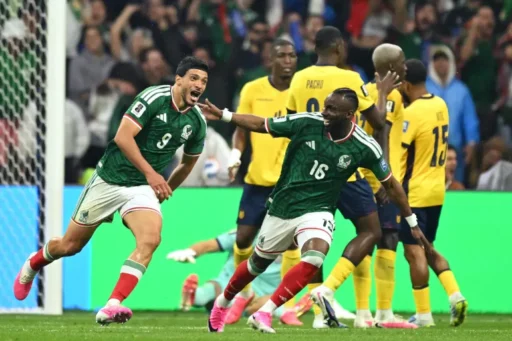
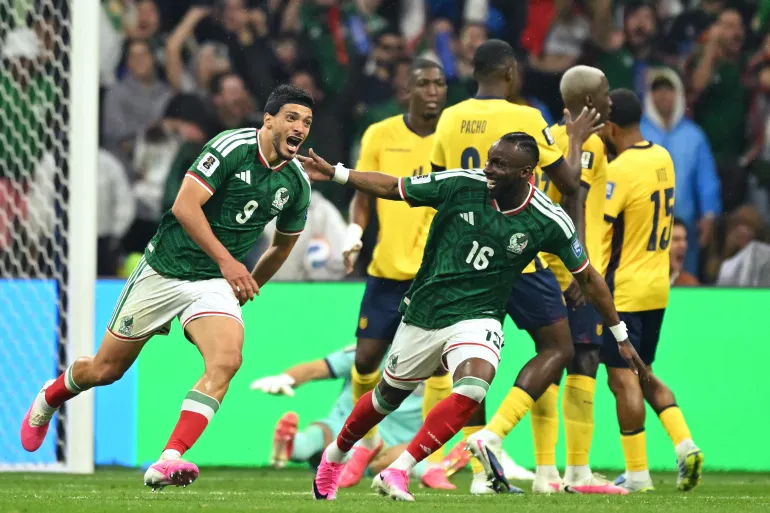

Mexico finally broke its World Cup knockout-stage curse with a controlled 2-0 victory over Ecuador in front of a charged crowd at Estadio Azteca, booking a place in the round of 16 on home soil. Goals from Raúl Jiménez and Julián Quiñones settled a tense group finale and ended four decades of frustration for a football-obsessed country that had grown weary of near misses.
The result not only sends the cohosts into the first knockout round, it also reshapes expectations for a team that entered the tournament under scrutiny and skepticism. Mexico now carries momentum, a clear identity, and a sense that the pressure of playing at home might finally be turning into a genuine advantage.
Key shifts in Mexico’s breakthrough win over Ecuador
Mexico’s path into the last 16 hinged on this match, and the performance against Ecuador showed a tactical clarity that had often been missing in earlier tournaments. The team combined a compact defensive block with quick transitions that allowed Raúl Jiménez to strike from the penalty spot and Julián Quiñones to add a decisive second, a pattern that matched the pre-tournament analysis of Mexico as a side built on balance rather than star power in several early team rankings.
Much of the match narrative turned on Ecuador’s inability to cope with Mexico’s pressing in wide areas. The Ecuadorian back line struggled to play out under pressure, creating turnovers that fed directly into Mexican attacks. That pressure told again when defender Piero Hincapié was dismissed for a second yellow card, a moment that left Ecuador with ten men and shifted the contest decisively toward the hosts, as detailed in multiple match reports that highlighted how the red card removed Ecuador’s ability to press high themselves.
The tactical adjustment from Mexico’s coaching staff was equally significant. Instead of chasing the game with reckless numbers forward, they dropped the defensive line slightly after going ahead and invited Ecuador to commit players. That approach created space for Quiñones to exploit on the counterattack, which is how the second goal arrived. Analysts had questioned whether Mexico could manage game states with maturity after previous tournaments ended in chaotic final group matches, yet the controlled way they closed out Ecuador contrasted sharply with the nervous endings that had defined earlier World Cups, including the collapses that fed the narrative of a 40-year knockout-stage drought in coverage from outlets such as India-based reports.
Conditions at Estadio Azteca also shaped the contest. Heavy rain and a weather interruption disrupted rhythm for both sides, yet Mexico’s familiarity with the altitude and the stadium’s energy appeared to give them an edge once play resumed, according to detailed descriptions from a weather-hit match account. The hosts used the stoppage to reset their pressing triggers, and when the match restarted they immediately forced Ecuador deeper, setting up the sequence that led to Jiménez’s penalty.
Why Mexico’s end to a 40-year hoodoo matters now
For Mexico, reaching the round of 16 on home soil carries weight far beyond a single result. The national team had not won a World Cup knockout match in 40 years, a drought that had turned into a psychological barrier referenced in virtually every major preview. That long wait is now over, as multiple outlets from Latin America to Asia framed the 2-0 win as the night Mexico finally ended its World Cup knockout.
The timing is especially significant because Mexico is not just a participant but also a cohost of this expanded tournament. Organizers and local officials have invested heavily in infrastructure, security, and stadium upgrades, and they needed a deep run from the home side to justify both the financial outlay and the emotional energy poured into the event. Regional news coverage has stressed how Mexican authorities view the World Cup as a showcase for tourism and soft power, with government representatives in earlier briefings pointing to the tournament as a key driver of visitor numbers and spending, themes echoed in broader World Cup economic.
On the pitch, the victory also reshapes how Mexico fits into the competitive hierarchy of this World Cup. Pre-tournament power rankings had placed the team in a crowded middle tier, behind traditional favorites and several rising European and South American sides. The controlled win over Ecuador, combined with earlier group performances, strengthens the case that Mexico belongs among the tournament’s most dangerous second-tier contenders, a status reflected in updated round-of-32 analyses that highlight their defensive organization and home advantage.
There is also a generational dimension. Veterans such as Jiménez have carried the burden of past failures, while younger players like Quiñones and a refreshed back line are experiencing their first World Cup on home soil. Breaking the hoodoo now gives this blend of experience and youth a different psychological platform. Instead of fearing another round-of-16 exit, Mexico can approach the next phase with proof that it can manage high-pressure games, a point emphasized in South American and European coverage that framed the Ecuador match as a test of nerve more than talent, including detailed breakdowns of Mexico’s mentality in post-match analysis.
How this win reshapes Mexico’s immediate World Cup future
With the group stage complete, attention now turns to Mexico’s path through the knockout bracket. The 2-0 result against Ecuador locked in a specific route that has already been mapped out in several bracket projections, which show Mexico likely facing a European opponent in the round of 16 and potentially running into a traditional powerhouse in the quarterfinals, as outlined in updated bracket forecasts. Unverified based on available sources whether that exact opponent has already been confirmed.
From a tactical perspective, the Ecuador match offered a blueprint for how Mexico might approach stronger opposition. The team’s compact mid-block, disciplined fullbacks, and reliance on quick combinations through midfield give it a style that can frustrate possession-heavy teams. At the same time, the reliance on Jiménez as a focal point raises questions about depth at center forward if injuries or suspensions hit later in the tournament. Some analysts have suggested that Mexico’s ceiling will depend on whether it can diversify its goal sources beyond penalties and transition moments, a theme that appears in various route-to-the-final discussions.
There are also broader implications for the other cohosts and for the tournament as a whole. Mexico’s progression adds to the narrative of host-nation performance, especially in a World Cup shared between multiple countries. If the hosts collectively advance deep into the knockout rounds, it will fuel arguments that familiar conditions and crowd support still provide a measurable edge, even in an era of highly globalized club football. That pattern has been tracked closely in global tournament coverage that notes how home advantage has historically lifted teams beyond their pre-tournament ranking.
For Ecuador, the loss prompts its own set of questions. The red card for Piero Hincapié and the failure to create sustained chances against a disciplined Mexican defense will likely trigger a review of tactical choices and squad balance. South American analysis has already pointed to Ecuador’s difficulty in breaking down compact defenses and its reliance on individual moments rather than structured attacking patterns, concerns that were exposed again in this decisive fixture, as reflected in detailed statistical breakdowns of the match.
For Mexico, however, the story is far more optimistic. The team has turned a long-running narrative of failure into a launchpad, energizing a home crowd that had grown wary of grand promises. The round of 16 will present a different level of challenge, and the margin for error will shrink. Yet by dispatching Ecuador 2-0 and finally stepping beyond the shadow of that 40-year knockout drought, Mexico has given itself something it has lacked at recent World Cups: a sense that the story is no longer prewritten. It now enters the next phase with a clear identity, a favorable bracket, and a belief that this time the tournament might last a little longer.