
Erling Haaland’s rise from a quiet kid in a small Norwegian town to one of the most feared strikers in world football did not happen by accident. Long before the goals in major stadiums, his youth coaches were trying to make sense of a teenager whose size, speed, and hunger did not fit the usual development curve. Their early decisions, and the moments when they understood what they had on their hands, shaped the player the world sees now.
The first hints in Bryne that Haaland was different
In Bryne, a modest community on Norway’s south-west coast, Haaland entered a club that prided itself on continuity and local identity. At Bryne FK, coaches remember a boy who was not immediately the standout technician but who already moved and thought like a centre-forward. One long-time staff member described how the club’s philosophy, summed up in the phrase “one life, one club,” kept Haaland in the same environment from early childhood through his teenage years, giving coaches a long runway to understand his potential, as detailed in an account of Bryne FK’s 21-year.
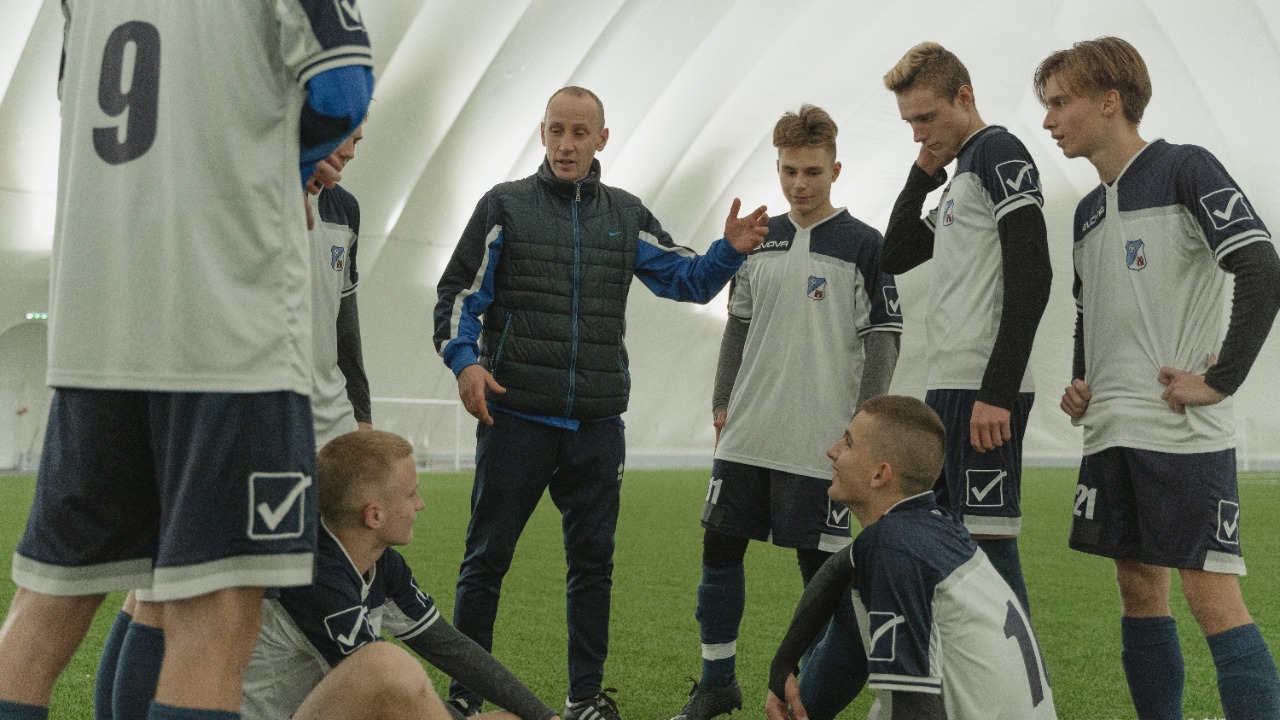
Those who worked with him recall that the first clear sign of something unusual was not a spectacular goal but how quickly he adapted when pushed up age groups. Against older boys, his acceleration over short distances and his willingness to attack space behind the defensive line stood out. Coaches at Bryne describe reshaping youth teams so that Haaland could play centrally, even if it meant moving more technically polished teammates into wider roles, because his knack for finding scoring positions was already too valuable to ignore.
As he grew, the physical gap widened. Training sessions became a balancing act: staff wanted him challenged, not bored, but also needed to protect smaller peers from a forward who could overpower them in duels. That tension, handled carefully, accelerated his learning. He was often asked to finish with his weaker foot or to make specific runs rather than simply overpowering opponents, a pattern that later analysts would see echoed in his senior performances for Norway, where his off-ball movement is now central to tactical breakdowns of how he combines.
The moment youth coaches knew he was special
The tipping point for Bryne’s staff came when Haaland started to dominate not just physically but mentally. In one widely recounted phase of his youth career, he began to treat training drills like competitive matches, keeping a running tally of goals against his own teammates. Coaches who had worked with hundreds of local prospects suddenly saw a teenager who demanded video feedback, asked detailed questions about timing his runs, and reacted to missed chances with visible frustration rather than shrugging them off. That shift in mentality, more than any single match, convinced them he was operating on a different level.
Several of those voices later shared how they restructured his pathway, fast-tracking him into Bryne’s second team and then into senior football while he was still in his mid-teens. They have described that period as the point when they stopped thinking of him as a promising academy player and started planning for a future transfer, a theme that runs through retrospective pieces on how his youth. The language shifted too: instead of talking about “if” he would make it, they began discussing “where” he might go.
Those early mentors also recall how Haaland responded when things did not go his way. In matches where he was tightly marked or starved of service, he did not drift out of the game. He started dropping deeper to link play or dragging defenders wide to open channels for teammates. That willingness to adapt, rather than simply waiting for chances, reassured coaches that he was more than a pure finisher. It suggested a player who would be able to adjust to different leagues, tactical systems, and levels of pressure.
Connecting Bryne’s training ground to Norway’s national ambitions
The decisions made in Bryne now echo on the international stage, where Norway’s hopes are built around Haaland and his long-time teammate Martin Ødegaard. Analysts who study the national team have pointed out that Haaland’s instinctive movement in the penalty area, honed in those early years, is central to how Norway tries to break down compact defenses. Detailed breakdowns of the national side’s structure explain how Ødegaard’s passing lanes are often designed to feed Haaland’s runs between, a pattern that traces directly back to his youth coaches’ emphasis on timing and positioning.
Norway’s coaching staff now speak about him in the same breath as the game’s elite. In an interview about the country’s World Cup ambitions, one senior figure described Haaland as potentially the best player in the world and framed qualification hopes around his ability to decide matches on his own, a point made explicitly when discussing Norway’s route to. That level of expectation would be impossible without the foundation laid in Bryne, where he learned to shoulder responsibility for results from a young age.
At the same time, Norway’s staff understand that building around a single superstar can be risky. The national team’s tactical evolution, with Ødegaard as a creative hub and Haaland as the finisher, reflects a broader lesson from his youth days: extraordinary talent needs a structure that amplifies its strengths rather than leaving it isolated. Bryne’s coaches learned that surrounding Haaland with teammates who could read his movement made him far more effective, and Norway now applies the same principle at international level.
What Haaland’s youth story reveals about talent identification
The way Haaland’s early coaches responded to his development has become a reference point in discussions about how clubs should handle precocious talent. His case suggests that raw physical advantages are only the starting point. Bryne’s staff had to look beyond his height and speed and focus on his mentality, his appetite for repetition, and his ability to absorb tactical detail. Those qualities convinced them to accelerate his pathway instead of keeping him in age-group comfort zones.
The story also fits into a broader pattern seen with other global stars. When Mike Phelan recalled working with a teenage Cristiano Ronaldo at Manchester United, he described how staff quickly realized that Ronaldo’s work ethic and obsession with improvement separated him from other youngsters, a memory he shared when talking about early days of. Haaland’s youth coaches tell similar stories about extra finishing drills and an unusual willingness to accept criticism, which helped them justify giving him responsibilities usually reserved for older players.
For academies across Europe, those examples highlight a key question: how early is it safe to treat a teenager like a future star without distorting their development? Bryne’s approach, grounded in a stable club culture and a long-term relationship with his family, offered one answer. They raised the bar for Haaland while keeping him rooted in a familiar environment, which reduced the risk of burnout or ego inflation. That balance is now studied by clubs that hope to replicate his trajectory with their own prospects.
How early insights into Haaland’s talent shape what comes next
The moments when Bryne’s coaches first recognized Haaland’s special qualities still influence decisions around his career. Agents, national-team staff, and club managers all reference his comfort with being the focal point of a project, a trait that emerged when he was a teenager asked to carry older teams. As he enters what should be his peak years, that history informs how teams build around him tactically and psychologically.
Norway’s leadership, for example, continues to design game plans that maximize his touches in dangerous zones rather than asking him to roam widely. That approach reflects the early conclusion that he is most effective when his energy is concentrated in and around the penalty area. Analysts who track his performances for club and country frequently trace his efficiency back to the repetition of specific patterns in Bryne, a continuity that helps explain why he adapted so quickly to higher levels of competition.