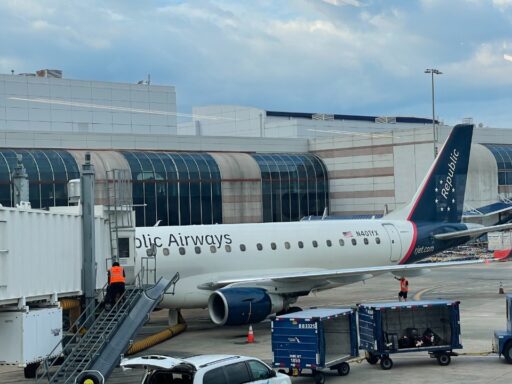

An American Airlines jet racing down a runway at Miami International Airport had to slam on the brakes after a private jet crossed directly into its path, forcing pilots to abort takeoff at high speed. No one was injured, but the close call instantly joined a growing list of runway incursions that have raised serious questions about how the United States manages crowded skies and busy airports.
The Miami incident shows how a single breakdown in communication or situational awareness can turn a routine departure into a near disaster. It also comes at a moment when regulators, airlines, and air traffic controllers are already under pressure to improve safety after a string of similar near misses in the United States and abroad.
How the Miami runway scare unfolded and what changed
According to preliminary accounts from aviation officials, the American Airlines jet had been cleared for takeoff on a main runway at Miami International Airport when a private aircraft crossed the same runway without proper separation. As the American crew accelerated for departure, they initiated a high speed rejected takeoff, a maneuver that demands rapid decision making and precise braking to keep the aircraft under control.
High speed aborts are rare because they put heavy stress on brakes, tires, and flight crews. Pilots are trained to continue takeoff after a certain speed except for the most serious problems, such as engine failure or a clear threat of collision. In this case, the sight of another aircraft crossing ahead left the crew with little choice. Their decision to stop rather than lift off reflected how quickly the situation deteriorated once the private jet entered the runway environment.
The Miami event fits a broader pattern seen in other recent runway incursions. At Los Angeles International Airport, an American Airlines flight had to abort takeoff after a cargo aircraft was cleared to cross its runway, prompting a rejected takeoff that scattered debris from overheated brakes and disrupted operations across multiple gates. That earlier case, which involved a packed passenger jet and a fully loaded freighter, showed how a single clearance error can ripple through an entire airport and highlighted the strain on controllers working complex traffic flows, as described in coverage of the LAX aborted takeoff.
Abroad, similar patterns have emerged. At Mexico City International Airport, two planes narrowly avoided colliding when one aircraft began its takeoff roll while another lined up on the same runway, prompting an urgent go around and a flurry of safety reviews. That incident, detailed in reports on planes avoiding collision in Mexico City, led to calls for better staffing and upgraded surface radar systems to track aircraft movements on the ground.
What happened in Miami is not just another line in a safety database. The aborted takeoff there underscores that even at heavily regulated, well equipped airports, the system remains vulnerable when traffic is dense, runway layouts are complex, and private operators share space with large commercial jets. The presence of a private aircraft crossing the path of a departing airliner adds another layer of complexity, since private crews may have less frequent exposure to the specific procedures and local quirks of a major hub than airline pilots who fly there daily.
Why the Miami near miss matters in a tense safety climate
The Miami scare matters now because it lands in the middle of an intense debate over whether the United States is experiencing a warning phase before a major accident. Federal officials have repeatedly pointed to a strong record of preventing fatal crashes on large commercial jets, yet the number of serious runway incursions and close calls has alarmed front line pilots and air traffic controllers.
Coverage of the Miami event and other near collisions has focused on systemic pressures: busy schedules, growing passenger demand, and the challenge of integrating everything from large commercial jets to smaller private aircraft and cargo planes on the same runways. Reports on Miami’s aborted takeoff emphasize that the American jet had already committed to takeoff when the private aircraft crossed, which meant the safety margin shrank to seconds.
Runway safety is uniquely unforgiving. Unlike en route conflicts, where altitude changes and lateral separation can buy time, two aircraft on the same strip of pavement have almost no room to maneuver. That is why regulators treat incursions as high priority events even when no one is hurt. The Miami incident reinforces that logic: a few hundred meters of extra stopping distance or a few seconds of earlier radio coordination likely made the difference between a frightening story and a catastrophe.
The episode also matters for how the public perceives air travel risk. Passengers on the American flight experienced a violent deceleration, the smell of hot brakes, and the confusion that often follows when a takeoff is suddenly abandoned. Social media posts from similar events at other airports show that such experiences linger in travelers’ minds long after the flight, even when airlines and regulators stress that the system worked as designed.
For pilots and controllers, Miami adds weight to arguments for more staffing, better ground surveillance, and clearer procedures when private and commercial traffic mix. The Mexico City near collision prompted reviews of runway use and controller workload at that airport. The LAX cargo crossing case raised questions about how tower teams handle complex sequences when multiple aircraft need the same runway in quick succession. Miami now becomes another data point in that conversation, pointing to the need for consistent safeguards across very different airports.
There is also a regulatory angle. Each serious incursion triggers investigations that may lead to new guidance, training, or technology mandates. If investigators find that the private jet in Miami misinterpreted a clearance or entered the runway without authorization, that could spur tighter rules for general aviation operations at large hubs. If the issue traces back to controller workload or ambiguous instructions, the focus may shift toward staffing and phraseology.
What comes next for runway safety after the Miami scare
In the short term, investigators will reconstruct the Miami event in detail. They will review cockpit voice recordings, radar tracks, and tower communications to determine exactly when the private jet began to cross the runway and when the American crew initiated the rejected takeoff. That timeline will shape any recommendations about procedures or technology.
One likely area of scrutiny is how surface movement guidance systems are being used. Many large airports now rely on ground radar and automated alerts that warn controllers when an aircraft enters a protected area. If those tools were in place in Miami, investigators will ask whether alarms sounded and, if so, how quickly controllers and crews responded. If the systems were not available or not configured to catch this particular movement, that may strengthen calls for upgrades.
Another question is how to handle private aircraft at major hubs. Some safety advocates argue for stricter slot controls, dedicated taxi routes, or even separate runway use where feasible, so that smaller jets do not cross the paths of large airliners during peak periods. Others caution that such segregation is impractical at airports with limited space and that the real solution lies in better training and clearer communication rather than structural separation.
Airlines are also likely to revisit their own procedures for high speed aborts. The American crew in Miami faced a split second decision: continue the takeoff and hope to climb over a crossing aircraft, or stop and risk an overrun. Training programs already emphasize that crews should reject only for specific, serious threats once they pass a certain speed. Miami may prompt fresh simulator scenarios that mirror the sight of an unexpected aircraft on the runway, giving crews more practice in recognizing and reacting to such situations.