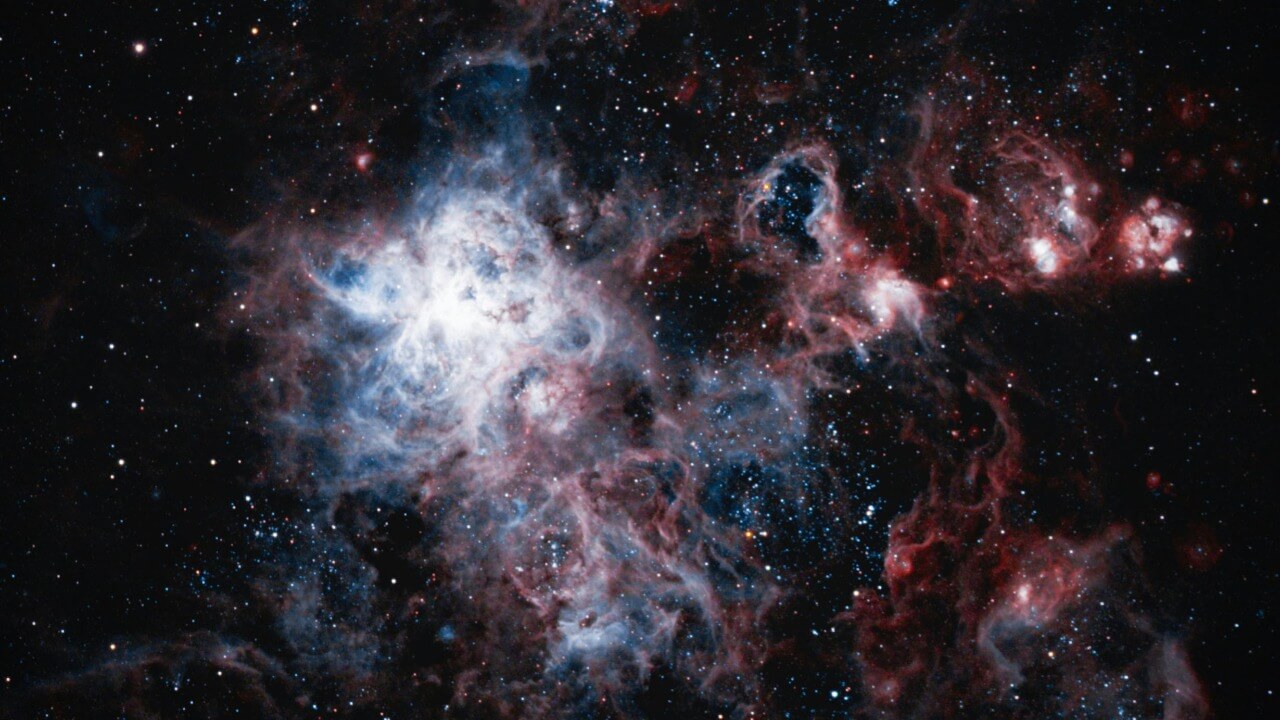

The James Webb Space Telescope has spotted a faint, dust-shrouded galaxy more than 12 billion light-years away and found its heart glowing with complex organic molecules. The detection pushes chemical astronomy into an earlier era of cosmic history, showing that intricate carbon-based compounds were already forming when the universe was less than two billion years old.
For researchers tracing how raw cosmic material turns into planets and, eventually, biology, this distant galaxy offers a rare laboratory. Its infrared fingerprints reveal that the building blocks of organic chemistry did not wait for the modern Milky Way, but were already thriving inside a hidden “factory” of star formation.
New details from Webb’s view of the hidden galaxy SPT0418-47
The galaxy at the center of the new result is SPT0418-47, a compact star-forming system first flagged as a bright source of millimeter-wave emission. It lies behind a closer foreground galaxy that acts as a gravitational lens, magnifying SPT0418-47 into a distorted ring and making it accessible to Webb’s sensitive infrared instruments. That lensing effect, combined with Webb’s resolution, lets astronomers separate light from different regions inside the distant galaxy and read their chemical signatures.
Using the Mid-Infrared Instrument, a team targeted specific wavelengths associated with polycyclic aromatic hydrocarbons, or PAHs, flat, ring-shaped molecules built from carbon and hydrogen. These compounds, common in soot and smoke on Earth, produce distinct mid-infrared emission features when excited by ultraviolet light from young stars. In SPT0418-47, Webb recorded strong PAH features that trace a sprawling reservoir of organic material across the galaxy’s dusty disk. The spectral data show that these molecules are not confined to a single bright knot, but spread through regions where stars are rapidly forming.
Because SPT0418-47 is so distant, the light now reaching Webb left the galaxy when the universe was only about 1.5 billion years old. That timing makes the PAH detection one of the earliest examples of complex organic molecules yet seen. Researchers describe the system as an “organic chemistry factory,” since the same dust and gas that host PAHs can also nurture more elaborate carbon-based species. A detailed analysis of the lensed galaxy finds that the organic emission aligns closely with dense, rotating gas that resembles a settled disk rather than a chaotic merger, suggesting that ordered structures and rich chemistry emerged surprisingly early in cosmic history. Those conclusions are supported by imaging and spectroscopy reported in a study of the hidden galaxy.
The Webb observations also refine earlier measurements of SPT0418-47 made with radio and submillimeter telescopes. High-resolution reconstructions indicate that the galaxy’s disk is relatively calm, with gas and dust orbiting in a pattern not unlike that of the Milky Way. The new mid-infrared view shows that PAH emission follows that disk structure, strengthening the case that the galaxy is already chemically mature. Reporting on the Webb campaign notes that SPT0418-47 is not an outlier in isolation, but part of a growing sample of early galaxies where complex molecules are starting to appear in the data.
Why early-universe organic chemistry is a big deal now
For decades, astronomers suspected that PAHs and related molecules must exist in young galaxies, but the light from those systems is stretched by cosmic expansion into infrared wavelengths that ground-based telescopes struggle to capture. Webb was built to probe exactly that range, and its first full year of science produced a cascade of discoveries about very distant galaxies, including unexpectedly bright objects and mature structures near the cosmic dawn. Reviews of Webb’s early work on distant galaxies pointed toward a universe that assembled complexity faster than many models assumed.
The new detection in SPT0418-47 extends that pattern from stars and galaxies to chemistry. By catching PAHs glowing in a system so far away, Webb shows that carbon had already been forged in massive stars, spread by stellar explosions, and recycled into new molecular clouds. That cycle must have run through several generations in less than two billion years, pressing theorists to revisit how quickly heavy elements and complex molecules can accumulate. The finding also adds weight to earlier Webb results that spotted organic signatures in other high-redshift galaxies, including a report of the oldest organic molecules yet identified, about 12 billion light-years from Earth.
PAHs themselves are not life, and they can be produced in many environments that have nothing to do with biology. Their importance lies in what they reveal about the underlying conditions. These molecules are part of a broader network of carbon chemistry that can lead, under the right circumstances, to amino acids, sugars, and other prebiotic compounds. Seeing PAHs in a galaxy that is still in the early universe suggests that the raw materials for such chemistry were widespread long before the Sun formed.
The detection also matters for how astronomers read the light from distant objects. PAHs influence the way dust absorbs and re-emits energy, which affects estimates of star-formation rates and total stellar mass. If PAHs are abundant earlier than expected, some previous measurements of young galaxies may need to be recalibrated. Studies of the lensed galaxy SPT0418-47 argue that including PAH emission in models yields a more accurate picture of how vigorously stars are forming and how quickly galaxies grow.
Webb’s ability to map PAHs across SPT0418-47 also reveals how star formation and chemistry are linked spatially. Regions with the strongest organic emission line up with bright pockets of young, massive stars, while quieter zones show weaker signatures. That pattern supports the idea that ultraviolet radiation from new stars both excites and gradually erodes PAH molecules, creating a feedback loop between star formation and the surrounding molecular environment. By comparing SPT0418-47 to nearer galaxies where PAHs have been studied in detail, astronomers can test whether that loop operated in the same way across billions of years.
Next steps for Webb and the search for cosmic organic factories
The SPT0418-47 result offers an early glimpse of what Webb can do with large samples of distant galaxies. Survey programs are already targeting dozens of strongly lensed systems and hundreds of unlensed ones, aiming to build a statistical catalog of PAH emission and other organic features across cosmic time. As more objects are added, researchers will be able to trace when complex molecules first appear, how quickly their abundance rises, and whether their distribution depends on galaxy mass or environment. Plans for follow-up observations include deeper integrations that can pick out weaker spectral lines and distinguish between different PAH families.
Further work on SPT0418-47 itself will likely combine Webb data with observations from radio facilities such as ALMA. By matching PAH maps to distributions of cold molecular gas and dust, astronomers can test whether organic-rich regions correspond to the densest star-forming clumps or to more diffuse structures. The detailed reconstruction of the lensed disk already shows that the galaxy’s rotation is surprisingly ordered, so tying that kinematic picture to chemical tracers could reveal how early disks assemble and enrich themselves.
Webb’s mid-infrared instruments will also push beyond PAHs to hunt for other signatures, such as simple hydrocarbons, oxygen-bearing organics, and possibly nitrogen-containing species. Detecting those in high-redshift galaxies is challenging, but even upper limits can constrain models of interstellar chemistry. The SPT0418-47 observations, described in a recent analysis, already hint that the galaxy’s dust and gas conditions resemble those in local starburst galaxies, suggesting that similar reaction networks might be at work.
On longer timescales, the SPT0418-47 discovery feeds into a broader agenda for Webb and its eventual successors. By showing that complex organic molecules are present in ordinary-looking galaxies so early, the telescope strengthens the case that chemically rich environments are common across the universe. That, in turn, informs strategies for searching for habitable planets and biosignatures around other stars. If the ingredients for prebiotic chemistry have been widespread for most of cosmic history, then rocky planets that form around later generations of stars may inherit a head start.