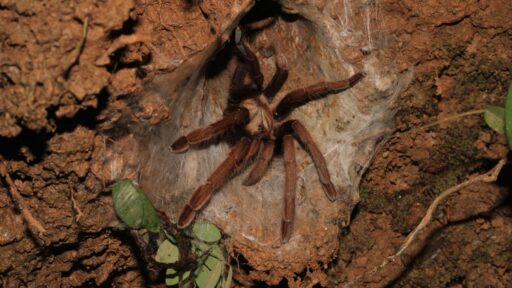
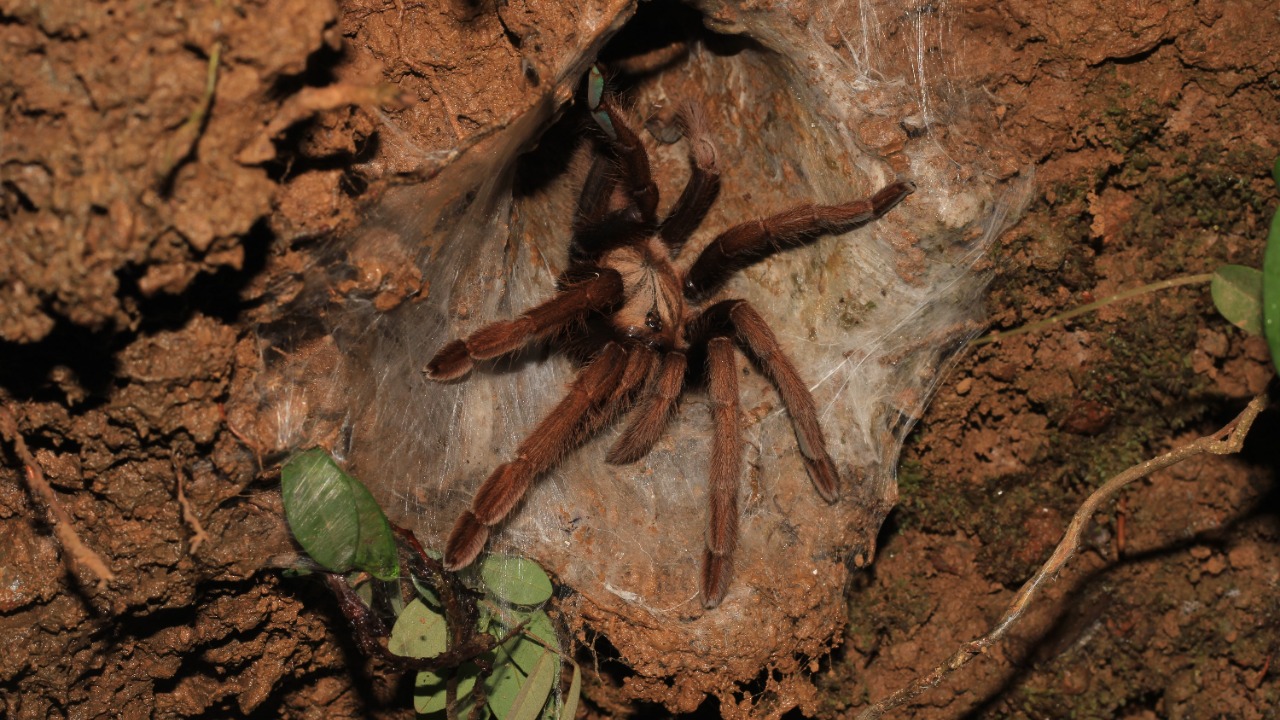

A newly described wishbone spider from Thailand spends almost its entire life sealed inside a silk-lined burrow, waiting to ambush unsuspecting insects that stray too close to its hidden entrance. The discovery adds an elusive predator to Southeast Asia’s forests and underscores how much of the region’s subterranean biodiversity still escapes human notice. Living just centimeters below the surface, the species offers a striking reminder that major scientific finds can still be hiding in plain sight.
New wishbone spider, hidden burrow and an unusual Thai context
Wishbone spiders are named for the forked tunnels they dig, with one main shaft and a side branch that gives the burrow a Y-shaped profile. The Thai species follows that pattern, building a silk-reinforced tube in the soil that opens at the surface through a narrow, camouflaged slit. From inside, the spider can sense vibrations from footsteps and wingbeats above, then rush up to seize prey at the entrance before retreating out of sight. This sit-and-wait strategy keeps the animal protected from its own predators while turning the burrow mouth into a lethal trap for beetles, ants and other ground-dwelling arthropods.
The discovery fits into a broader burst of arachnological work in Thailand, where researchers have been documenting unusual spiders that challenge expectations about how these animals look and live. One striking example is a half-male half-female spider collected in the country, whose body is split down the middle between male and female traits. That specimen, known as a gynandromorph, revealed how developmental quirks can produce a single individual that is both sexes at once. The new wishbone spider adds a different kind of surprise, not in its body plan but in its extreme reliance on a concealed underground home.
Unlike conspicuous orb weavers that hang in open webs, wishbone spiders belong to a group of primitive, ground-dwelling mygalomorphs that are more closely related to tarantulas than to house spiders. Their heavy bodies, powerful fangs and slow, deliberate movements are adapted to life in tight tunnels rather than on exposed branches or walls. In Thailand, where dense leaf litter and seasonal rains create a dynamic forest floor, a reinforced burrow offers stability and a permanent base from which the spider can hunt year after year.
How the Thai wishbone spider changes the picture of hidden predators
The formal description of a wishbone spider that hunts from a sealed burrow in Thailand challenges several assumptions about where these animals live and how they fit into local ecosystems. Until now, most well documented wishbone species have come from other continents, which left Southeast Asia looking relatively sparse on the family tree. The Thai find shows that these spiders are not absent from the region; they are simply hard to detect because they rarely leave their tunnels and their entrances blend into the soil and leaf litter.
That invisibility has practical consequences for field biology. Standard survey methods, which often rely on sweeping vegetation or spotlighting eye shine at night, tend to miss animals that stay underground. To locate wishbone spiders, researchers must instead scan the forest floor for tiny cracks or silk-fringed slits, then carefully excavate the underlying tunnel without destroying the occupant. The Thai specimen demonstrates that when scientists adjust their techniques to focus on hidden microhabitats, they can uncover predators that have been present all along but never recorded.
The new species also sharpens understanding of how ambush predators structure food webs in tropical soils. By occupying permanent burrows, wishbone spiders create fixed points of predation that insects must navigate around. In areas where burrows are dense, they can form a gauntlet that shapes the movement and behavior of ants, termites and small beetles. The Thai discovery suggests that such networks of subterranean hunters may be more widespread in the region than species lists currently indicate.
At the same time, the species highlights a contrast between different kinds of spider rarity. The half-male half-female individual from Thailand is likely a one-off developmental anomaly, fascinating but not representative of a broader population. By contrast, the wishbone spider’s rarity in collections reflects how seldom people look in the right place. Once the appropriate habitat is targeted, similar burrows may turn up in multiple forest patches, revealing that the spider has quietly occupied a stable niche for a long time.
Why this ambush hunter matters for science and conservation now
The timing of the Thai wishbone spider’s description matters because it comes during a period of rapid land-use change across Southeast Asia. Forests that shelter burrowing species are being fragmented by agriculture, roads and urban expansion. A spider that spends its life in one tunnel is especially vulnerable to bulldozers and soil compaction, since it cannot simply relocate when its patch of ground is disturbed. Documenting its existence is the first step toward assessing how development projects might affect its survival.
From a scientific perspective, the species strengthens the case that Southeast Asia remains under-sampled for cryptic invertebrates. The same country that produced a documented gynandromorph spider is now yielding an elusive wishbone hunter, which suggests that both developmental oddities and hidden lifestyles are being overlooked. For evolutionary biologists, that combination is especially valuable, since it offers a living laboratory for studying how body plans and behaviors evolve in tandem under specific environmental pressures.
The discovery also resonates with debates over how to prioritize conservation for invertebrates that receive little public attention. Charismatic mammals and birds often drive protected-area decisions, yet animals like wishbone spiders can act as sensitive indicators of soil health and microclimate stability. Their dependence on intact leaf litter, consistent moisture and undisturbed substrates means that their presence signals a relatively healthy forest floor. Losing them would hint at deeper degradation that might not be obvious from tree cover alone.
At a broader level, the Thai burrow hunter adds weight to arguments that biodiversity counts should reach beyond easily observed species. Environmental impact assessments, for example, often list vertebrates and a handful of conspicuous insects but skip cryptic predators that require specialized search methods. The new spider shows that such omissions are not just academic gaps; they can erase entire functional groups from planning documents, which in turn shapes how projects are approved and mitigated.
Next steps for research, protection and public engagement
The immediate scientific priority is to determine how widespread the Thai wishbone spider is and whether related species occupy similar habitats across the region. Doing so will require targeted surveys in comparable forest types, using careful excavation and night-time observation around suspected burrow entrances. Genetic analysis can then place the species within the broader wishbone family, clarifying whether it represents a unique lineage or part of a larger Southeast Asian cluster that has simply gone unrecognized.
Conservation planning will depend on what those surveys reveal. If the spider turns out to be restricted to a narrow band of habitat, such as a particular soil type or elevation, then small reserves or microprotected zones could be enough to secure its future. If it occupies a patchwork of sites already threatened by development, researchers may need to advocate for changes in land-use plans or for mitigation measures that preserve pockets of undisturbed ground within larger projects.
There is also an opportunity to use the spider’s unusual lifestyle to engage the public with less visible aspects of biodiversity. Educational programs can highlight how an animal that never builds a web in the open still plays a key role in controlling insect populations. Citizen science projects might train local communities and students to recognize potential burrow entrances, photograph them and share coordinates with researchers, which could dramatically expand the known range of the species at relatively low cost.