
The U.S. Navy’s long-planned F/A‑XX fighter is finally moving from concept art and PowerPoint slides into the teeth of a real acquisition decision. After years of studies and budget skirmishes, the service is closing in on a contract award that will shape carrier aviation for decades. The next few budget cycles will determine not only who builds the jet, but also how the Navy balances stealth, range, and cost against growing threats in the Pacific.
How Pentagon backing and industry moves reshaped the F/A‑XX path
The most significant shift for F/A‑XX came when Pentagon leadership approved the Navy’s next-generation fighter effort, clearing a key internal hurdle that had slowed progress. According to reporting on internal deliberations, Defense Secretary Pete Hegseth signed off on the Navy’s plan for a new carrier-based aircraft after a review that weighed cost, risk, and overlap with Air Force programs, effectively giving the green light for a formal competition for the next generation fighter.
That decision unlocked work that had been sitting in a holding pattern. The Navy had already been refining requirements for a sixth-generation aircraft to replace the F/A‑18E/F Super Hornet and complement the F‑35C, but without top-level approval the program risked being trimmed or folded into other initiatives. Budget uncertainty had led lawmakers to question whether F/A‑XX would repeat the turbulence of earlier advanced fighter efforts, and some in the Pentagon reportedly explored shifting funding toward Air Force priorities such as the F‑47 program described in separate reporting on proposed funding shifts.
Industry has moved quickly to align with the Navy’s clearer direction. Northrop Grumman, which has deep experience in stealth design, recently released a stylized glimpse of a notional carrier fighter that observers widely interpreted as its vision for F/A‑XX. The company’s teaser, highlighted in coverage of a next gen navy, showed a tailless, diamond-shaped aircraft with blended wings and a large internal volume that suggests an emphasis on range and payload. While explicitly labeled as conceptual, the image signaled that Northrop intends to compete aggressively.
Additional reporting on the same artwork, including analysis of the notional F/A‑XX design, noted details such as the lack of vertical tails, a smoothed canopy line, and possible provisions for conformal sensors. Those features track closely with broader sixth-generation trends: very low observable shaping, integrated apertures, and a design that can host advanced sensors and potentially directed energy systems. The teaser also hinted at compatibility with unmanned wingmen, reinforcing the Navy’s interest in teaming manned fighters with carrier-based drones.
On the funding side, Congress has now put real money behind the program. A recent defense funding bill, described in coverage of the Navy’s FY26 funding, provided dedicated resources for F/A‑XX development after earlier cycles that only supported analysis and risk reduction. Another report on how the future fighter program was revived with new described lawmakers restoring money that had previously been cut, a sign that key committees now see the aircraft as central to carrier relevance in contested airspace.
Why a contract decision on F/A‑XX carries new urgency
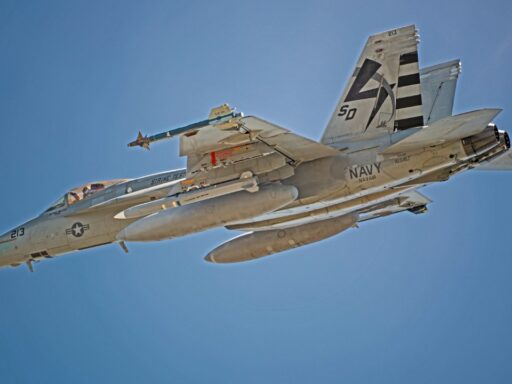
Pressure to move from studies to a contract stems from a simple calendar problem. The Navy’s F/A‑18E/F Super Hornets are aging, and even with service life extensions they will begin to leave the fleet in significant numbers in the 2030s. At the same time, potential adversaries are fielding long-range anti-ship missiles and advanced fighters that can threaten carriers from far outside the comfortable radius of current air wings. Analysts warn that without a long-range, survivable replacement, the Navy could face a “fighter gap” that limits how close carriers can operate to a fight.
One detailed assessment described the program as a “stealth fighter headache” that the service has struggled to solve, pointing to unresolved questions about cost, industrial capacity, and how many jets the Navy can realistically buy. That analysis of the F/A‑XX stealth fighter highlighted the tension between ambitious performance goals and finite budgets. The Navy wants a platform with much greater range than the Super Hornet, advanced stealth against modern radars, and the ability to coordinate with unmanned systems, all without crowding out other priorities such as submarines and air defense destroyers.
The strategic environment is also driving urgency. Chinese anti-ship systems, including long-range ballistic and cruise missiles, are designed to hold carriers at risk across large parts of the Western Pacific. To keep carriers relevant in that environment, the air wing needs aircraft that can launch from farther away, penetrate defended airspace, and still deliver meaningful payloads or direct stand-off weapons. F/A‑XX is expected to anchor that future air wing, working alongside F‑35Cs and carrier-based drones that handle refueling, surveillance, and potentially strike missions.
Budget politics add another layer. Reports on internal debates over shifting money from F/A‑XX to other programs, including the Air Force’s F‑47, show that the Navy must continually justify the fighter’s cost relative to joint priorities. At the same time, the service has argued that carrier air power remains a unique tool for crisis response and deterrence, which depends on fielding aircraft that can survive and operate in the most contested theaters. The move to secure a contract award is partly about locking in that argument before another budget cycle reopens the question.
There is also an industrial base dimension. The United States has only a small number of companies capable of designing and building a sixth-generation fighter. A clear path to contract award signals to those firms that it is worth investing in design teams, test infrastructure, and advanced manufacturing methods. Without that signal, there is a risk that talent and capacity drift away, which would make future programs slower and more expensive.
Key milestones and open questions on the road to an award
Reporting focused on the acquisition timeline indicates that the Navy is aiming for a contract award around the late 2020s, with some coverage pointing specifically to an internal target for a decision by August 2026. One detailed account of the program’s schedule described planning for a Navy F/A‑XX contract in that window, although it also noted that the date could slip if technical or budget issues arise. That target reflects the time needed to mature designs, conduct competitive prototyping, and align the program with multi-year budget plans.
Between now and a contract award, several big questions remain. One is how aggressively the Navy will push for range and stealth, which drive size, complexity, and cost. The notional designs highlighted in industry teasers suggest a large, tailless aircraft with ample internal fuel and weapons capacity, which would likely come with a higher unit price than current fighters. Analysts have debated whether the service can afford a fleet of such aircraft in large numbers or whether F/A‑XX will be a relatively small, high-end portion of the air wing complemented by more numerous drones and upgraded F‑35Cs.
Another question is the role of manned-unmanned teaming. Several reports on the broader program, including discussions of the secret sixth gen, describe concepts in which F/A‑XX would operate as a “quarterback” for a formation of unmanned systems. Those drones could extend sensors, carry extra weapons, or perform dangerous stand-in jamming. The Navy’s parallel work on carrier-based unmanned aircraft, such as the MQ‑25 refueler, will influence how far it can push that teaming concept in the first operational F/A‑XX variants.
Program governance and cost oversight will also shape what comes next. The Pentagon’s history with major aircraft programs has left lawmakers wary of open-ended development. To keep support, the Navy will need to show that it can control requirements growth and avoid constant redesigns. That likely means locking in a baseline configuration for the initial production lot, then planning spiral upgrades as technologies mature, rather than trying to field every advanced feature on day one.