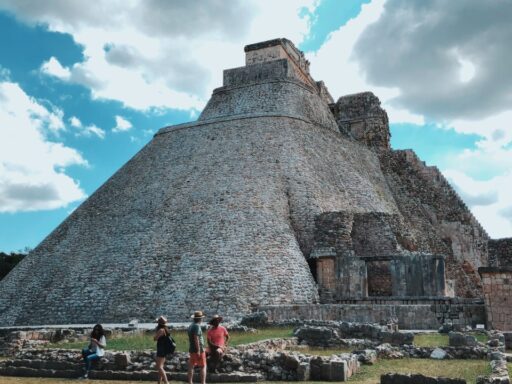
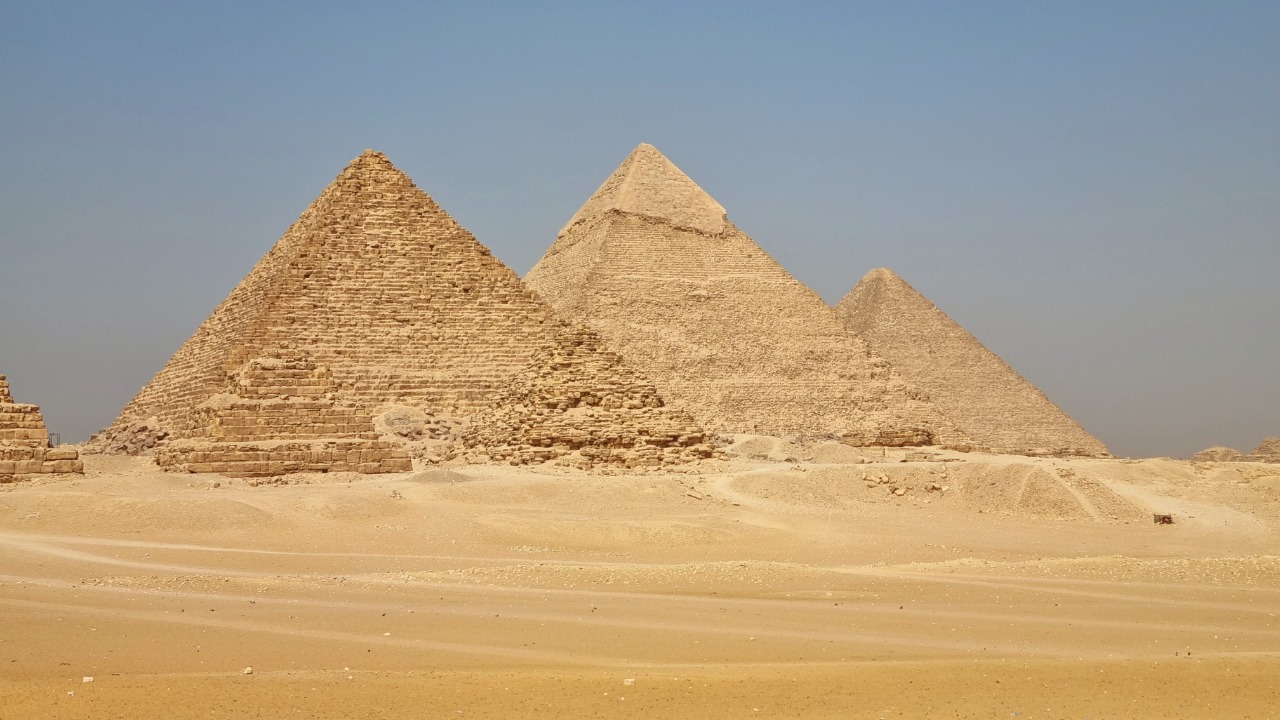

The Great Pyramid of Khufu has stood on the Giza Plateau for more than 4,500 years, yet it is still revealing new secrets. Using advanced scanning technology, researchers have now identified a hidden corridor roughly 30 meters long that ends at what appears to be a sealed stone blocking.
The newly mapped passage lies behind the pyramid’s northern face, above the main entrance, and had never been accessed in modern times. Its discovery reshapes understanding of how Khufu’s monument was engineered and raises fresh questions about what, if anything, lies beyond the closed end of the corridor.
How cutting-edge scans redrew the map of Khufu’s pyramid
The new corridor emerged from a long-running project that uses particle detectors to look inside massive stone structures without drilling or excavation. The ScanPyramids team relied on muon tomography, which tracks subatomic particles that constantly rain through Earth’s atmosphere and are subtly absorbed by dense material. Variations in muon counts can reveal hidden cavities, and it was this technique that first hinted at an unexplained void above the northern entrance of the Great Pyramid.
Once initial muon readings suggested a linear cavity, researchers combined the data with endoscopic cameras and traditional structural analysis to confirm an enclosed corridor behind the outer chevron blocks. A detailed report described a space about 9 meters long in the first phase of scanning, which later work extended to a total length of around 30 meters as the void was mapped further into the masonry. The hidden structure runs horizontally from the entrance area toward the interior, parallel to ground level, in a zone previously assumed to be solid stone.
Egypt’s Ministry of Tourism and Antiquities presented the find as part of a broader effort to apply noninvasive methods to the Giza plateau. Officials emphasized that the corridor was detected without cutting into decorated chambers or destabilizing the pyramid’s casing. The approach reflects a shift in Egyptian archaeology that favors remote sensing and precision drilling over the large-scale clearances that defined earlier generations of excavation.
The existence of this void was later echoed in independent coverage of a hidden corridor discovered behind the northern face, which highlighted how the passage sits in a structural zone framed by large gabled limestone blocks. Additional discussion of the project described the feature as a “gabled corridor” that likely played a role in distributing weight away from the original entrance and nearby chambers.
What changed in the understanding of the Great Pyramid’s internal layout
Before the scans, most reconstructions of Khufu’s pyramid showed a relatively straightforward interior: a descending passage, an ascending passage, the Queen’s Chamber, the Grand Gallery, and the King’s Chamber with its granite relieving spaces above. The new corridor forces a revision of that schematic. It confirms that the northern side contains a previously unknown void that is neither a simple crack nor a minor construction gap, but a deliberate architectural feature.
Reporting on the project described the newly revealed space as a hidden void that extends deeper into the pyramid than early models suggested. Its geometry, with a triangular roof formed by large blocks, closely resembles the known relieving chambers above the King’s Chamber. That similarity has led several Egyptologists to argue that the corridor is part of a sophisticated system of weight redistribution designed to protect vulnerable passages and chambers from the immense mass of the superstructure.
At the inner end of the corridor, scans and endoscopic images show what appears to be a sealed stone blocking, often described as a “door” or plug. The feature recalls the granite blocking stones that close the so-called air shafts from the King’s Chamber, which also terminate in sealed doors with carved handles. In this case, the blocking seems to cap the end of the passage, suggesting that the corridor was not meant for ongoing access once construction finished.
An archaeologist cited in a detailed account of the scanning work described how the technology revealed an unknown structure running deep into the pyramid’s core. The same report stressed that the void’s dimensions and alignment do not match any previously mapped passage, which reinforces the conclusion that modern surveys had missed a major element of the internal design.
Some specialists have suggested that the corridor might connect, directly or indirectly, to the much larger “Big Void” detected above the Grand Gallery by earlier muon measurements. Others caution that, based on current data, the two cavities cannot yet be linked with confidence. The only secure conclusion is that Khufu’s architects used a more intricate system of internal spaces than the visible rooms alone would suggest.
Why the hidden corridor and sealed end matter now
The discovery has immediate implications for debates about how the Great Pyramid was built and what symbolic program guided its internal layout. If the corridor is primarily structural, it strengthens the view that Old Kingdom engineers relied on stacked gabled spaces to channel weight around critical voids. That reading aligns with the known relieving chambers above the King’s Chamber and suggests a consistent engineering logic across the monument.
Yet the presence of a sealed end has also fueled speculation that the corridor could conceal ritual features or even small caches of objects. Archaeologists quoted in coverage of the find have been careful to avoid claims of hidden treasure, but they acknowledge that the builders often combined structural and symbolic functions within the same architectural element. A blocked passage that was never meant for human traffic could still have carried religious meaning, perhaps related to the king’s journey to the afterlife.
One detailed archaeology report framed the corridor as a rare chance to study an untouched Old Kingdom space without the contamination that comes from centuries of looting and re-use. Because the passage has remained sealed, any material inside, even small chips of mortar or traces of pigment, could offer pristine data on construction sequences and work crews.
Public interest has been intense, not only because of the romance of a “secret passage,” but also because the project showcases how modern physics can illuminate ancient monuments. Coverage of the original announcement highlighted how a hidden corridor was found using muon detectors installed in and around the pyramid, a technique more often associated with particle physics labs than with desert archaeology. The collaboration between Egyptian authorities, international universities, and engineering firms has become a case study in cross-disciplinary research.
The find also arrives at a moment when Egypt is investing heavily in cultural tourism, including the long-awaited opening of the Grand Egyptian Museum near Giza. Officials have already used the corridor discovery in promotional campaigns that emphasize ongoing research at the pyramids, portraying Giza as a living laboratory rather than a static backdrop for photographs.
What comes next for the sealed corridor inside Khufu’s pyramid
The central question now is how, and whether, to open the sealed end of the corridor. Egyptian authorities have signaled that any intervention will be gradual and guided by structural safety assessments. The pyramid is a UNESCO World Heritage site, and any drilling into original blocks carries risks for both stability and conservation.
Archaeologists involved in the project have outlined a cautious plan that prioritizes more data before any physical breach. Additional muon detectors may be installed to refine the three-dimensional model of the corridor and the stone blocking. Ground-penetrating radar and ultrasound could help determine whether there is a void, chamber, or solid masonry beyond the sealed end. Only if these readings suggest a significant space would a small endoscopic borehole be considered.
Previous work on the so-called air shafts in the Queen’s Chamber offers a precedent. In that case, tiny robotic devices were sent up narrow channels to drill pinhole openings in blocking stones and insert cameras. The same approach could be adapted to the new corridor, with a micro-robot introduced through a minimal opening in a joint or mortar line. Any such move would likely be accompanied by extensive monitoring of vibrations and microcracks in the surrounding blocks.