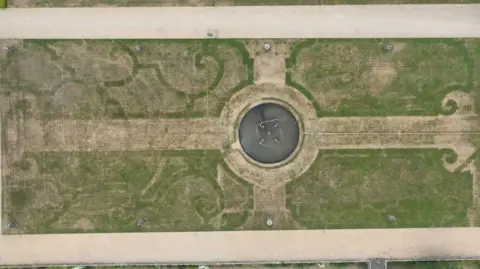

Prolonged heat and unusually dry conditions have revealed the outline of an elaborate 17th-century garden beneath the South Lawn at Chatsworth House in Derbyshire.
The design, known as the Great Parterre, once consisted of symmetrical flower beds, decorative scrolls and carefully arranged paths. It was created around 1699 for William Cavendish, the 1st Duke of Devonshire, to complement the newly constructed south façade of Chatsworth House. The garden measured approximately 473 feet long and 227 feet wide, making it a substantial feature of the estate rather than a small ornamental display.
The parterre survived for only about three decades. Around 1730, the 3rd Duke of Devonshire introduced a different garden design, and the original beds and paths were covered with soil and grass. The arrangement then remained largely invisible for nearly 300 years.
Recent dry weather has transformed the normally green lawn into a temporary historical map. The official Chatsworth House account of the rediscovery shows how the lost pattern has returned as pale and dark lines across the grass.
The Garden Was Hidden, Not Completely Unknown
The Great Parterre has often been described as a lost or secret garden, but estate historians already knew that it had existed. Historic engravings, records and earlier appearances during dry summers had preserved evidence of its design.
What makes the latest event remarkable is the level of detail visible across the lawn. Curved beds and winding paths can be recognised from the ground, while aerial and drone photography reveal the wider symmetry far more clearly.
The outline also appeared during the hot summer of 2018 and became particularly noticeable during the record-breaking heat of 2022. Chatsworth recorded a temperature of 38.1°C on 26 July 2022, the highest measured at the estate in recent years. The patterns later faded as rainfall returned and the grass recovered.
The 2026 appearance is therefore better described as a re-emergence than a completely new archaeological discovery. The garden repeatedly becomes visible when the right combination of heat, low rainfall and dry soil develops.
Why Dry Grass Reveals a Buried Design
The pattern appears because grass does not grow uniformly over every part of the former garden.
The grass planted above the old flower beds and paths has relatively shallow roots. During prolonged dry weather, sections with less access to moisture become stressed and turn brown more quickly. Other areas retain moisture for longer and remain greener, producing visible contrasts that follow the historical layout beneath the surface.
The result is similar to the parch marks and crop marks used by aerial archaeologists to identify buried buildings, roads, ditches and settlements. Historic England explains that plants growing above buried features can develop at different rates because walls, compacted surfaces and filled ditches change the amount of soil and moisture available to their roots. These differences become more pronounced during dry weather.
The Historic England guide to aerial investigation describes how crop marks, soil marks and parch marks allow researchers to map features that may be difficult or impossible to recognise at ground level.
At Chatsworth, the grass is effectively tracing the footprint of the former paths and ornamental beds. No excavation is required for the overall pattern to become visible.
What a Great Parterre Looked Like
A parterre is a level garden area containing ornamental flower beds, usually arranged in a formal geometric pattern. Historic England defines it as a level space occupied by decorative beds, although the most ambitious European examples also incorporated gravel paths, clipped plants, coloured materials and complex symmetrical shapes.
These gardens were designed to be viewed from above, particularly from the upper floors and principal rooms of a grand residence. The arrangement at Chatsworth would have created a highly controlled transition between the architecture of the house and the surrounding landscape.
The Great Parterre followed European garden fashions popular among aristocratic families in the late 17th century. Its carefully balanced scrolls and paths communicated order, wealth and human control over nature.
An engraving by Leonard Knyff and Johannes Kip from 1709 records Chatsworth with the formal garden extending from the south façade. That image provides an important comparison with the markings now appearing across the lawn.
Why the Garden Was Removed So Quickly
Formal gardens required significant maintenance. Beds had to be planted, edged and kept symmetrical, while paths needed regular attention. Garden fashions also changed rapidly during the 18th century.
British estates increasingly moved away from tightly controlled arrangements towards broader lawns, lakes, tree groupings and landscapes intended to appear more natural. Many earlier formal gardens were simplified, remodelled or removed as landowners adopted newer styles.
At Chatsworth, the Great Parterre was covered around 1730 as part of changes introduced by the 3rd Duke. Its short visible life illustrates how even expensive and elaborate landscapes could disappear when ownership priorities and aesthetic preferences changed.
Covering the garden rather than removing every buried feature helped preserve enough variation in the ground for its design to reappear centuries later.
An Extraordinary Discovery With a Serious Cause
The reappearance creates an impressive connection with the past, but the conditions responsible for it are causing wider difficulties for gardens, farms and water systems.
Chatsworth’s monitoring equipment recorded temperatures above 30°C during May, June and July 2026. The estate reported approximately 33% more sunshine and 32% less rainfall than the relevant Derbyshire and East Midlands averages during spring and early summer.
The broader national picture was also unusually dry. The Met Office’s spring 2026 assessment found that England experienced its warmest spring on record and received only 65% of its average rainfall. England also recorded its third-sunniest spring in a series beginning in 1910.
High pressure continued to bring extended sunshine and limited rainfall during the summer. Met Office data showed that the UK received only 21.3 millimetres of rain between 1 and 26 July 2026.
The conditions that make historic patterns visible can also damage lawns, weaken plants, reduce river levels and increase pressure on water supplies. The Great Parterre is therefore both a historical spectacle and an indicator of environmental stress.
Chatsworth Is Changing How It Manages Water
The Chatsworth garden team is introducing measures intended to make the landscape more resilient to increasingly sunny springs, prolonged dry periods and episodes of heavy rainfall.
One area of focus is the soil. Adding organic matter can improve soil structure, water absorption and moisture retention. Better infiltration also reduces the amount of water that runs across the surface during intense rain instead of entering the ground.
These changes must be introduced without damaging the historic character of the estate. Chatsworth is not simply maintaining a modern public garden; it is caring for a landscape shaped by several centuries of design decisions.
The challenge is to preserve important lawns, plants and historical features while reducing dependence on intensive watering. The reappearing parterre shows why understanding what lies beneath the surface is essential before drainage, irrigation or soil-management systems are altered.
Could the Great Parterre Be Restored?
A complete restoration does not appear to be planned. Reconstructing the garden would require substantial historical research, investment and continuing maintenance. It would also remove or transform the South Lawn, which has developed its own role within the present Chatsworth landscape.
Steve Porter, Chatsworth’s head of gardens and landscape, has discussed the possibility of temporarily recreating parts of the pattern with gravel after the grass recovers. Such an interpretation could help visitors understand the scale of the design without permanently rebuilding the entire garden.
For now, the dry lawn provides a rare natural reconstruction. As rainfall returns, the contrasts will fade and the South Lawn will gradually become green again.
A Brief Window Into Chatsworth’s Past
The temporary appearance of the Great Parterre demonstrates how landscapes can preserve their history even after visible structures disappear.
The beds have gone, the paths are no longer in use and the original planting scheme has been absent since the early 18th century. Yet differences beneath the soil continue to influence how the modern grass responds to heat and drought.
For visitors, the markings offer an unusual opportunity to see the scale and precision of a garden created more than three centuries ago. For historians and estate managers, they provide valuable evidence about the location and arrangement of its features.
The heatwave has not physically uncovered the Great Parterre or brought the original plants back to life. It has briefly allowed the ground itself to redraw the design, turning an apparently ordinary lawn into a visible record of Chatsworth’s changing history.