
Antarctica may be giving governments something rarely associated with climate change: a clearer period in which to prepare.
A new study suggests that the current rate of Antarctic ice loss can provide a reliable indication of how much the continent will contribute to sea-level rise over the next 30 to 50 years. That near-term predictability could help coastal communities make better decisions about flood defenses, infrastructure, land use and possible relocation.
The finding does not mean Antarctica will delay sea-level rise or that the danger has become less serious. Instead, it suggests that scientists may be able to forecast the continent’s contribution with greater confidence through the middle of the century. After that point, unstable ice-sheet processes could accelerate retreat and make projections much less certain.
The research, titled “Emergent Decadal Predictability in Antarctic Contribution to Sea-Level Rise”, was published in Nature in June 2026. It was led by Felicity McCormack of Monash University with researchers from Dartmouth College, Université libre de Bruxelles and the Georgia Institute of Technology.
Today’s Ice Loss Could Predict the Next Several Decades
Antarctica has long been one of the largest sources of uncertainty in sea-level projections. Different ice-sheet models can produce dramatically different results by the end of the century, particularly when they include processes capable of triggering rapid retreat.
The researchers found far more agreement over shorter periods. Across the models assessed for the Intergovernmental Panel on Climate Change’s Sixth Assessment Report, the rate of sea-level rise caused by Antarctic ice loss in 2025 was strongly connected to the projected rate over the following several decades.
That relationship remained visible across different emissions pathways, model designs and even low-probability scenarios involving severe ice loss. Models reproducing the present rate accurately could therefore provide a dependable foundation for estimates extending to approximately mid-century.
The Monash University explanation of the research describes the next three to five decades as a critical planning window rather than a period of safety.
Why Antarctic Sea-Level Forecasts Are So Difficult
The Antarctic Ice Sheet contains enough frozen water to raise global mean sea level by approximately 58 meters if it disappeared entirely. Such a complete loss would take far longer than the current century, but the figure illustrates why even a small percentage change can have major global consequences.
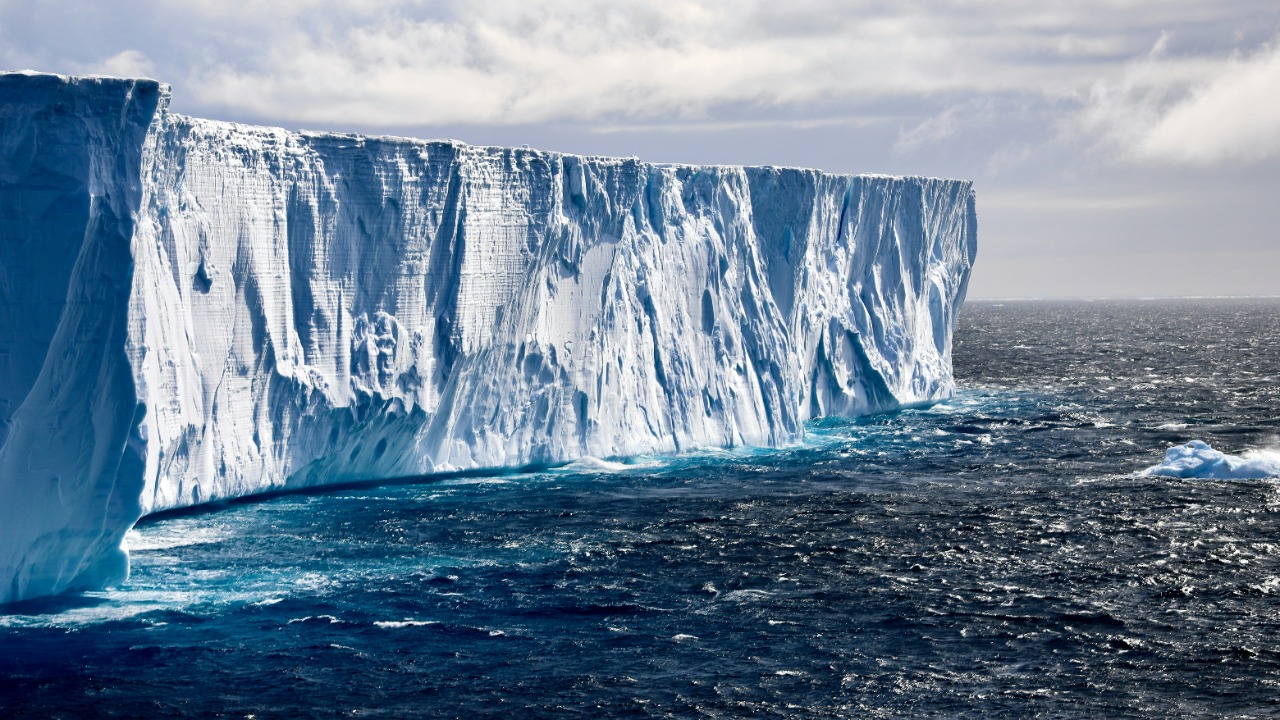
Unlike ordinary mountain glaciers, large parts of Antarctica rest on land below sea level. Their edges extend into the ocean as floating ice shelves, which help slow the movement of grounded ice toward the sea.
When warmer ocean water thins or weakens an ice shelf, the grounded ice behind it can begin moving more quickly. Once the grounding line—the point where ice leaves the bedrock and starts floating—retreats into a deeper basin, the process may become self-sustaining.
NASA’s guide to Antarctic ice-shelf loss explains that floating shelves do not directly raise sea levels when they melt. Their disappearance matters because it can remove the resistance holding back enormous volumes of land-based ice.
Predictability Weakens Later in the Century
The models become less closely connected toward the end of the 21st century. By then, differences in the way they represent ocean warming, grounding-line retreat, ice-shelf collapse, subglacial water and other feedbacks can lead to sharply different outcomes.
Marine ice-sheet instability is one of the most important concerns. When ice resting on submerged bedrock retreats into increasingly deep terrain, more ice becomes exposed to ocean water. The retreat can then continue even without a proportionate increase in atmospheric warming.
Other debated processes include the collapse of tall ice cliffs after the protective shelf in front of them disappears. Researchers are still determining how quickly these failures could occur and how accurately they are represented in continental-scale simulations.
The Nature study found that these feedback-driven differences have a limited influence on near-term projections but become much more important later. That is why the next several decades may be comparatively predictable even though projections for 2100 and beyond remain deeply uncertain.
The Finding Does Not Mean Sea-Level Rise Is Paused
The phrase “decades to prepare” could easily be misunderstood as suggesting that coastal communities have 30 years before serious impacts begin. That is not what the research shows.
Sea levels are already rising as oceans expand with warming and land-based ice melts. Higher average water levels also allow storm surges and high tides to reach farther inland, meaning damaging flooding can increase before an area becomes permanently submerged.
The study concerns the predictability of Antarctica’s additional contribution. It does not suggest that sea-level rise will wait until mid-century or that existing flood risks can be ignored.
NASA’s sea-level projection overview notes that contributions from Greenland and Antarctica will continue for centuries or millennia, with the final amount strongly influenced by future warming.
What Governments Can Do With a 30-Year Window
Coastal infrastructure is often designed to remain in service for decades. Roads, railways, ports, airports, wastewater systems, hospitals and electricity networks built today may still be operating when sea levels are substantially higher.
More reliable mid-century forecasts can help planners determine how high to build flood barriers, where new development should be restricted and which structures can be elevated, protected or relocated.
The research also supports adaptive planning. Instead of selecting one fixed sea-level estimate and assuming it will remain correct, governments can establish thresholds that trigger additional action as observations change. A defense system might be designed for expansion, while land-use policies could preserve space for wetlands and shorelines to move inland.
NOAA’s coastal inundation resources already encourage communities to combine sea-level scenarios with local conditions such as subsidence, erosion, storm exposure and drainage capacity. Better Antarctic forecasts could strengthen that planning without eliminating the need to account for uncertainty.
Pacific Islands Face Especially Urgent Decisions
For low-lying island nations, several decades can represent the entire planning period for housing, freshwater systems, roads and public facilities.
Sea-level rise can affect these communities before permanent inundation occurs. Saltwater may enter groundwater, waves can erode shorelines and extreme tides can damage crops, homes and infrastructure. Governments may need to decide which areas can be defended and where communities may eventually need to move.
The Monash research team argues that reliable near-term projections are particularly important for Pacific governments making decisions about infrastructure, land use and relocation. Australia and other regional partners could play an important role by improving observations and translating global sea-level science into local projections.
Better Observations Will Improve the Warning
The study’s predictive relationship depends on knowing Antarctica’s present rate of ice loss accurately. That makes continued observation essential.
Satellites can measure changes in ice-sheet mass, surface elevation and glacier speed. Aircraft, autonomous instruments and ocean sensors help researchers understand the shape of the bedrock and the movement of warm water beneath ice shelves.
These observations can identify whether real-world changes remain within the range expected by current models. When observed loss begins moving away from those projections, the models and coastal plans based on them may need to be updated.
The researchers also released the study’s underlying data and figure-reproduction code through Zenodo, allowing other scientists to examine and extend the analysis.
Emissions Still Determine the Longer-Term Outcome
Near-term predictability does not make emissions pathways irrelevant. The ice sheet responds slowly, so differences between lower- and higher-emissions futures may not become fully visible in Antarctic sea-level contributions for several decades.
Later in the century and beyond, those pathways can produce much larger differences. Continued warming increases the likelihood of sustained ice-shelf thinning, grounding-line retreat and other feedbacks that are difficult to reverse once established.
The planning window therefore serves two purposes. It gives communities time to adapt to changes that are already becoming unavoidable, and it gives governments time to reduce emissions before the most severe long-term outcomes become more likely.
Antarctica is not offering protection from rising seas. It may be offering a measurable warning period before its behavior becomes substantially harder to predict. Whether that period becomes an opportunity or a missed warning will depend on how quickly countries improve monitoring, strengthen coastal resilience and limit further warming.