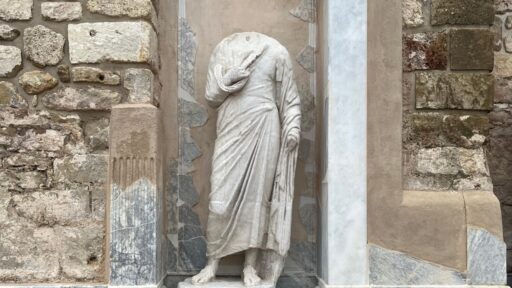
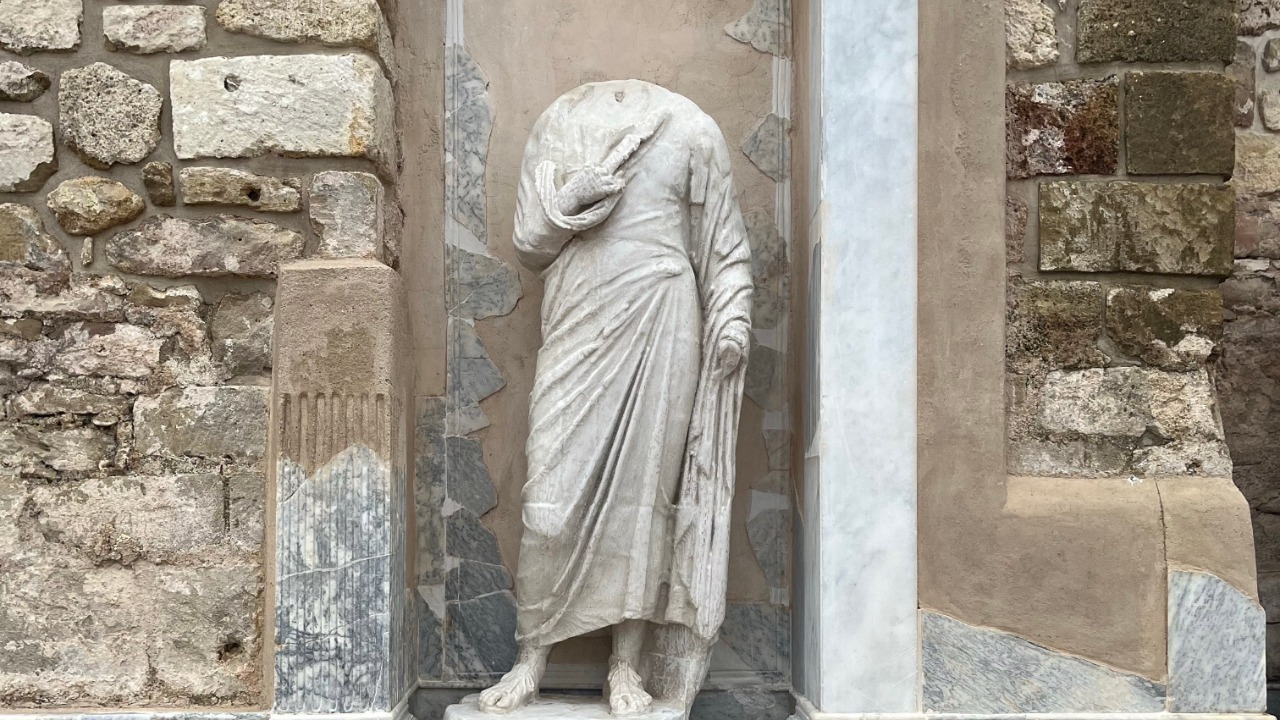

Archaeologists working in the ruins of an ancient theater in western Turkey have uncovered a headless marble statue of Athena, the Greek goddess of wisdom and war, preserved in the collapsed seating of a 2,000‑year‑old performance space. The figure, still clad in detailed armor and drapery, lay buried where spectators once watched plays and political assemblies, linking a modern excavation trench to the public life of a long‑vanished city.
The discovery adds a striking new piece to the archaeological picture of the region’s Roman era, when Greek deities, imperial power, and local identity intersected on the stone stages of Anatolia’s cities.
How a buried theater yielded a headless Athena in armor
The statue surfaced during ongoing excavations of an ancient theater in western Turkey, as archaeologists cleared rubble that had filled the building after its abandonment. According to project reports, the marble figure stood roughly life‑size, carved in high relief from a single block and toppled into the fill when the theater’s upper structures collapsed. The head and parts of the arms were missing, but the torso remained largely intact, protected under layers of stone and earth that sealed it off for nearly two millennia.
Researchers identified the goddess by her characteristic military dress. The sculptor depicted a long, belted chiton under a heavy cloak, with a muscular cuirass across the chest. At the center of that armor sits a gorgoneion, the stylized head of Medusa that Athena was believed to wear as a protective emblem. The preserved carving shows curling snakes and a contorted face, details that helped confirm the identification as the goddess of war and strategy rather than a generic female figure. The presence of this Medusa relief, which appears clearly in documentation of the find, matches known iconography from other Roman statues of Athena and supports the dating to roughly 2,000 years ago, in the early imperial period described in excavation reports.
Archaeologists note that the statue was not discovered standing in a formal niche or on a surviving pedestal. Instead, it lay amid broken architectural blocks and fallen seats, suggesting that an earthquake, later construction, or systematic spoliation brought down the theater’s upper tiers and sent sculptures tumbling into the void. That context matters: a statue found in secondary collapse can still reveal where and how it was originally displayed, but it also carries clues about the disasters and urban changes that ended the building’s active life.
The theater itself, part of a once‑thriving Roman city in Anatolia, would have been a focal point for civic ritual and entertainment. Inscriptions and architectural fragments from the site indicate that local elites financed renovations and statues as public benefactions. The Athena figure likely formed part of this program, installed where audiences could see it as they entered or took their seats. Its survival in the rubble, rather than in later lime kilns or reuse walls, marks a rare stroke of preservation luck in a region where ancient marble was often recycled.
What this Athena reveals about power, culture, and religion in Roman Anatolia
The theater find matters because it compresses several layers of cultural meaning into a single object. Athena, a Greek goddess, appears here in a Roman provincial city in what is now Turkey, carved in a style that blends classical Greek prototypes with local workshop habits. The statue’s armor and Medusa device echo well known Athenian and Roman images of the goddess, yet the proportions and drapery folds align with regional trends described in surveys of Anatolian sculpture. That blend reflects how civic elites in the eastern provinces used shared mythological figures to express loyalty to Rome while also signaling Greek cultural heritage.
The choice to place Athena in a theater is also telling. In the Roman world, theaters were not only entertainment venues but stages for political announcements, imperial cult ceremonies, and displays of civic identity. A martial goddess in armor, visible to crowds gathered for drama or public meetings, would have signaled protection, order, and educated sophistication. The Medusa on her breastplate added a layer of apotropaic power, a carved warning to enemies and misfortune at the heart of the city’s public life.
The statue’s head is missing, which removes the most individualized part of the image, yet the loss itself speaks to the region’s turbulent history. Head removal could result from random breakage in a collapse, targeted iconoclasm during religious change, or later quarrying for reusable stone. Archaeologists at the site have not identified clear tool marks that would point to deliberate decapitation, so the current interpretation leans toward structural failure and subsequent looting rather than a focused attack on the goddess image. That cautious reading aligns with the broader pattern of damaged but not systematically defaced pagan statuary cataloged in reports on Roman provincial sites.
Beyond religious history, the find adds data to debates about the scale and quality of local sculpture production. The Athena figure displays careful attention to anatomical detail in the armor and a confident treatment of drapery, suggesting a skilled workshop with access to good marble and classical models. At the same time, some proportions, such as the thickness of the torso relative to the legs, appear slightly compressed compared with statues from major metropolitan centers. That mix supports the view that provincial cities in western Anatolia employed trained sculptors who adapted prestigious styles to local tastes and budgets rather than simply importing finished works from Athens or Rome.
The context inside a theater also informs how scholars reconstruct the building’s decorative program. The presence of a single Athena raises the possibility of a larger ensemble of deities, personifications, and imperial portraits that framed the stage and seating. Even without those missing figures, the new statue gives conservators a reference point for the scale and visual impact of such a display, helping them model how audiences experienced performances surrounded by stone images of power and protection.
Future research, conservation, and public life for the theater’s new guardian
With the statue now lifted from the rubble, the next phase involves careful cleaning, stabilization, and detailed study. Conservators will remove soil and mineral accretions with controlled tools and chemicals, paying close attention to the remaining pigment traces that sometimes survive in shield rims or garment folds. Any surviving paint could clarify whether the Medusa emblem or armor details were originally highlighted in color, a feature that would have made the goddess even more striking under Mediterranean sunlight.
Researchers are also expected to conduct a full 3D scan of the statue. Digital modeling can help reconstruct missing parts, test how different head types might have looked on the torso, and simulate original placement within the theater. By aligning the scan with architectural measurements from the cavea and stage building, archaeologists can explore whether Athena originally stood in a niche above the main entrance, along a colonnade, or beside an honorific inscription. Those virtual experiments will inform both academic publications and potential on‑site displays.
On the archaeological side, the find will likely shape excavation priorities around the theater. Teams may expand trenches in the zones where the statue lay, in search of its base or associated inscriptions that could name the donor who commissioned it. A dedicatory text would be a major breakthrough, tying a real historical individual to the goddess image and to the political life of the city. Even without such an inscription, stratigraphic analysis of the collapse layers around the statue can refine the timeline for when the theater fell out of use, whether through earthquake, economic decline, or shifting urban patterns.
Local heritage authorities face decisions about how and where to present the statue to the public. One option is to house the original in a regional museum, where climate control and security are easier to guarantee, while installing a high‑quality replica in the theater itself so visitors can appreciate the sculpture in its architectural context. Another approach would keep the statue on site in a protective shelter, turning the excavation area into an open‑air gallery that links the standing ruins with the newly uncovered art.