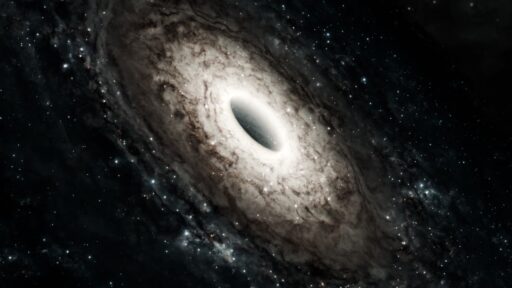
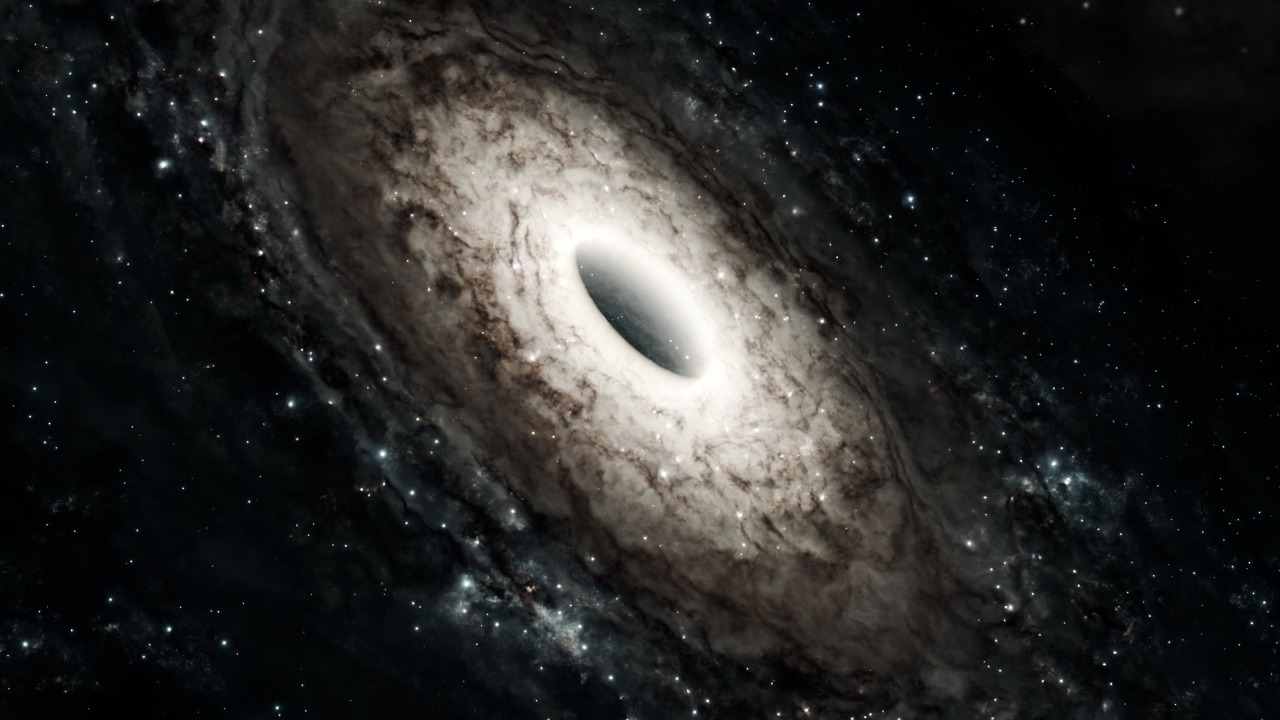

A mid-size black hole has been caught in the act of tearing apart a dead star, providing some of the clearest evidence yet that these elusive “missing link” objects really exist. The violent encounter, recorded in X-rays as the star was stretched and shredded, offers a rare laboratory for watching gravity at its most extreme.
The event, known as a tidal disruption, did not involve a bright, living star but a compact stellar corpse that had already burned through its fuel. That twist makes the discovery especially valuable because it reveals how intermediate-mass black holes hide in quiet corners of space and only briefly light up when an unlucky object strays too close.
Fresh evidence that a hidden mid-size black hole is out there
The new observations center on a black hole that appears to sit between the well-known categories of stellar-mass and supermassive black holes. Astronomers have long suspected that such intermediate-mass black holes exist, but they are difficult to spot because they are usually dark and isolated. In this case, the object betrayed itself when it ripped into a compact stellar remnant, producing a short-lived flare of high-energy radiation that could be tracked over time.
Key to the discovery was a space-based X-ray observatory that recorded a sudden spike in emission from a distant galaxy. A similar process was captured when the Chinese satellite Insight-HXMT observed a black hole swallowing, revealing how these events unfold in real time. In the new case, the pattern of brightening and fading matched what theory predicts when a compact star is torn apart and its debris spirals inward.
Unlike supermassive black holes that sit in galactic centers and feed on gas and stars over long periods, this mid-size object appears to reside in a more modest environment, possibly a dense star cluster. Similar tidal disruption events have previously exposed hidden black holes by revealing a star shredded to death in the outskirts of a galaxy, far from any central supermassive black hole. The new detection fits that pattern and strengthens the case that a population of intermediate-mass black holes is scattered throughout the universe.
The victim in this encounter was not a typical main-sequence star. Instead, the evidence points to a compact remnant, likely the core left behind after a star shed its outer layers. That kind of target can survive closer passes before being destroyed, which helps constrain the mass of the black hole. If the black hole were too massive, the remnant would have been swallowed whole without producing a visible flare. The fact that it was torn apart instead suggests a mass in the intermediate range.
Why this violent encounter matters for black hole science now
Intermediate-mass black holes have been one of the most stubborn gaps in astrophysics. Stellar-mass black holes, which form from collapsing massive stars, typically weigh a few to a few dozen times the mass of the Sun. Supermassive black holes, which anchor galaxies, can reach millions or billions of solar masses. This new event offers rare, concrete evidence of something in between, caught in the act of feeding.
Watching a star get pulled apart also gives researchers a clean test of extreme gravity. As matter falls toward the event horizon, it heats up and emits X-rays that encode information about the black hole’s mass and spin. Earlier observations of a star being stretched into a long, thin filament, a process often called spaghettification, showed how material behaves in that intense tidal field. The new event extends that insight to a different kind of victim and a different mass scale, helping refine models of how black holes grow.
The timing is important. Over the past few years, gravitational-wave detectors have started to pick up mergers that hint at black holes heavier than typical stellar remnants. At the same time, X-ray and optical surveys have flagged off-center flares that look like tidal disruptions outside galactic nuclei. Each new example helps fill in the population statistics. A mid-size black hole ripping apart a dead star provides a bridge between these lines of evidence and ties them to a specific, observable system.
The event also touches on a broader question: how supermassive black holes become so large. One leading idea suggests that smaller black holes merge and accrete matter over cosmic time, stepping through an intermediate regime. Directly identifying an intermediate-mass black hole that is actively feeding supports that growth pathway. It shows that such objects do not just exist in theory; they can capture and consume nearby stars or remnants, adding to their mass.
There are practical benefits as well. Tidal disruption events act as natural flashlights that briefly illuminate otherwise dark regions. By analyzing the flare’s spectrum and evolution, astronomers can probe the gas, dust, and star distribution around the black hole. When the victim is a compact remnant, the disruption can also shed light on the internal structure of stellar cores and how they respond to tidal forces that are impossible to reproduce in any laboratory.
How this discovery reshapes the hunt for intermediate-mass black holes
The new observations change how researchers think about where and how to look for mid-size black holes. Rather than focusing only on bright galactic centers, surveys are increasingly scanning the outskirts of galaxies and dense star clusters for sudden, transient flares. The fact that a dead star, not a bright main-sequence star, served as the trigger suggests that many more such events could be hiding in archival data, overlooked because they do not match familiar patterns.
Future searches are likely to combine wide-field optical surveys with rapid X-ray follow-up. Facilities that scan large portions of the sky every few nights can flag new flares, which space-based observatories can then monitor in high-energy bands. The detection of a compact remnant being torn apart hints that astronomers should expand their templates to include shorter, harder X-ray signatures that might signal similar encounters.
At the same time, gravitational-wave observatories are improving their sensitivity to mergers involving intermediate-mass black holes. If an object like the one in this event later merges with another black hole, the resulting ripples in spacetime could be detected and linked back to a known system. That combination of electromagnetic and gravitational-wave data would provide an exceptionally detailed view of black hole evolution.
Theoretical work will also accelerate. Models of tidal disruption have traditionally focused on solar-type stars. Researchers now need to refine simulations that involve compact remnants with different densities and compositions. The way debris spreads into an accretion disk, the efficiency of energy release, and the resulting light curve all depend on those details. The new event gives theorists a concrete target to match, which should sharpen predictions for future observations.
On longer timescales, the discovery feeds into efforts to map the full family tree of black holes. If intermediate-mass objects can be found in multiple environments, from star clusters to dwarf galaxies, it will clarify whether they form primarily through runaway collisions of stars, direct collapse of massive gas clouds, or repeated mergers of smaller black holes. Each pathway leaves a different imprint on the surrounding stellar population and on the rate of tidal disruption events.
For now, the mid-size black hole that shredded a dead star stands as one of the clearest signposts that the missing middle of the black hole mass spectrum is real. It shows that even long-quiet stellar corpses can trigger spectacular fireworks when they wander too close to an invisible gravitational giant. As surveys grow more sensitive and data archives are mined with fresh eyes, more such fleeting catastrophes are likely to appear, turning rare cosmic accidents into a powerful tool for mapping some of the universe’s darkest objects.