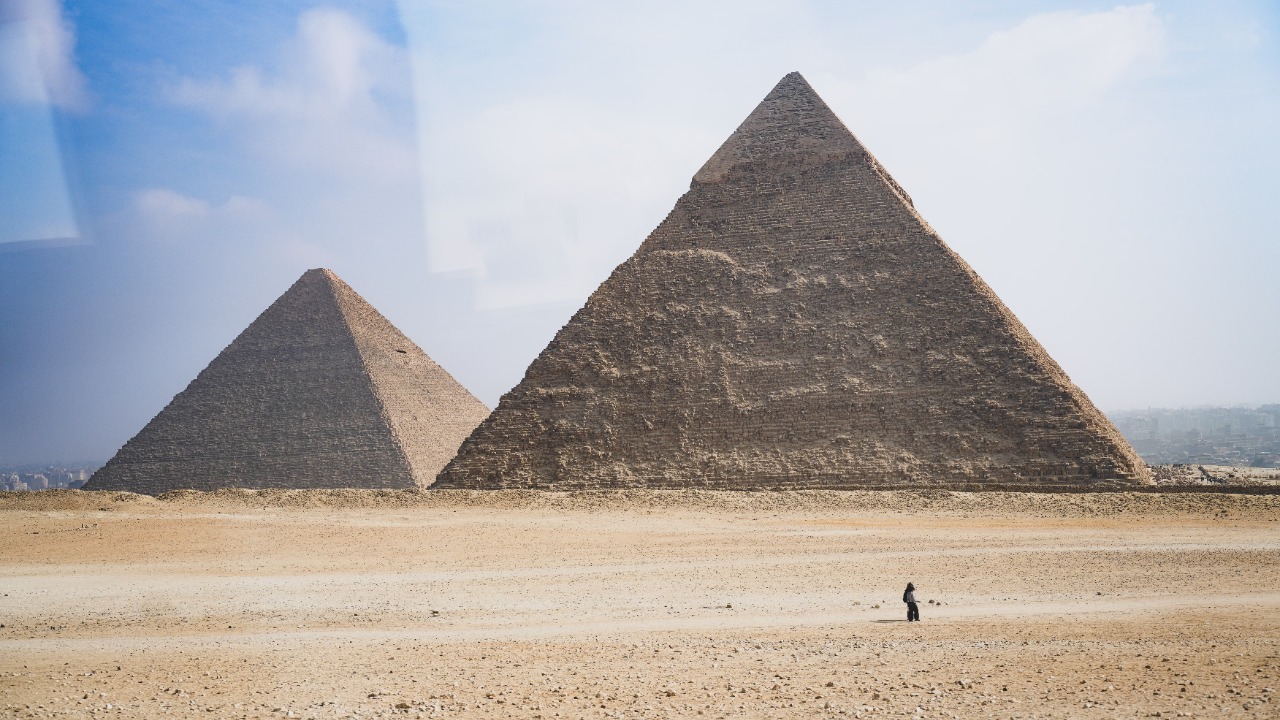

Fresh scans of the Pyramid of Menkaure at Giza have revealed hidden voids inside its lower structure that do not match any known passages or chambers. The anomalies are large enough to suggest a significant architectural feature, yet no one can say with confidence whether they represent a lost entrance, a construction gap, or something entirely unexpected. For a monument studied for more than a century, the discovery has reopened basic questions about how the smallest of Giza’s three main pyramids was planned, built, and used.
New scanning technology reshapes what is known about Menkaure
The latest findings come from a project that used electrical resistance tomography, a method that sends weak currents through stone and measures how easily they pass. Variations in resistance reveal differences in density, which in turn can indicate hidden spaces. When researchers applied this approach to the lower courses of Menkaure, they detected two distinct anomalies that behaved like voids inside the masonry, according to electrical resistance data.
The voids appear near the pyramid’s base, close to the modern ground level, where previous excavations had already exposed damage and unfinished stonework. Earlier surveys had documented irregularities in this area, but the new imaging shows shapes that are more coherent than random cracks or erosion pockets. One of the cavities runs horizontally behind the outer casing blocks, while another sits slightly deeper in the core, forming a pattern that suggests a deliberate structural feature rather than a natural flaw.
Researchers involved in the work describe the anomalies as large enough to accommodate human movement, although the precise dimensions remain uncertain. The electrical resistance contrasts are sharp, which implies a clear boundary between solid stone and empty space. That contrast is similar to signatures seen in other monuments where known corridors and chambers have been mapped with the same method, so the team treats the Menkaure readings as strong evidence of real voids rather than instrumental noise.
Additional analysis has come from teams using ground-penetrating radar and related techniques around the same zone of the pyramid. These methods, which respond to changes in material and moisture content, have also indicated discontinuities behind the lower facade. Taken together, the overlapping datasets strengthen the case that Menkaure’s lower courses conceal more than the visible masonry would suggest.
How the newly detected voids differ from earlier Giza discoveries
The Menkaure anomalies follow a decade in which noninvasive scanning has repeatedly changed what archaeologists thought they knew about the Giza plateau. Muon tomography, which tracks cosmic-ray particles as they pass through stone, famously revealed a large void high inside the Great Pyramid of Khufu. That discovery showed how advanced physics can uncover hidden architecture and helped pave the way for expanded surveys of neighboring monuments, including Menkaure, using cosmic-ray scans and other tools.
What sets Menkaure apart is the location of the voids. While Khufu’s hidden cavity sits deep within the superstructure, far above the original entrance, Menkaure’s anomalies cluster in the lower third of the pyramid, close to where an access route might logically begin. Archaeologists have long debated whether Menkaure’s current entrance, cut into the north face, reflects the original design or a later modification. The new data revive the possibility that the pyramid once had a different entry system that has since been sealed or obscured.
Reporting on the project describes the two cavities as potentially linked, forming a stepped or sloping feature that could align with a corridor. One interpretation is that they mark the remains of a blocked passage that was abandoned during construction, perhaps when the internal layout was redesigned. Another is that they represent a relieving structure, a kind of hollowed zone intended to reduce pressure on a vulnerable part of the core. Both ideas would fit known Egyptian engineering practices, yet the exact geometry of the Menkaure voids does not match standard patterns seen in other pyramids.
Accounts of the findings emphasize that the anomalies lie in an area previously disturbed by stone robbing and early excavations, which complicates the picture. The outer casing blocks around the base suffered heavy damage in antiquity, and later work to clear debris may have altered the local structure. Even so, the electrical signatures are too regular to be explained solely by random gaps left by missing stones, according to the scan-based interpretation of the pyramid’s lower courses.
Why the hidden cavities matter for Egyptology now
For specialists in Old Kingdom architecture, the Menkaure voids touch directly on unresolved questions about how royal tombs evolved at the end of the Fourth Dynasty. Menkaure is smaller than the pyramids of Khufu and Khafre, yet its internal arrangement, with a descending passage, antechambers, and a burial room, already shows signs of experimentation. If the new anomalies do represent a concealed entrance or an abandoned corridor, they could reveal a transitional phase in design that bridges the monumental simplicity of Khufu and the more complex layouts of later dynasties.
The discovery also challenges assumptions about how thoroughly Giza has been studied. For generations, archaeologists have treated the plateau as one of the best documented archaeological zones on Earth. The idea that a major pyramid still hides unexplored voids at ground level illustrates how much can remain unseen without modern imaging. Commentators on the project argue that the Menkaure data justify a broader push to rescan familiar monuments with newer tools, as described in recent coverage of in Egypt.
There are also cultural and political stakes. Egypt’s Ministry of Tourism and Antiquities has promoted high-profile discoveries as a way to boost visitor numbers and global interest. New findings at Giza carry particular weight because the plateau anchors the country’s international image. A credible hint of a lost entrance inside a royal pyramid, supported by repeatable measurements, offers a rare blend of scientific intrigue and public appeal that can feed both academic debate and heritage promotion.
Experts, however, caution against rushing to sensational conclusions. The phrase “hidden chamber” evokes images of untouched burials and caches of artifacts, yet most internal voids in pyramids serve structural purposes. Several Egyptologists quoted in analyses of the scans stress that any interpretation must wait for higher resolution imaging and, if permitted, targeted exploration. Until then, the Menkaure voids remain a puzzle that highlights the limits of remote sensing as much as its power.
Tourism, storytelling, and the pull of unexplained spaces
Beyond scholarly circles, the Menkaure findings are already feeding a new wave of fascination with Giza. Travel guides and tour operators have begun to reference the scans when describing the pyramid complex, framing Menkaure not just as the “small” pyramid beside Khufu and Khafre but as the site of an ongoing mystery. One overview of visitor experiences at Giza notes that archaeologists continue to detect hidden chambers in, a narrative that encourages tourists to see the plateau as a living research site rather than a static ruin.
The promise of undiscovered architecture supports a broader shift in how heritage destinations present themselves. Instead of focusing only on what is already on display, sites like Giza now highlight the process of investigation, from drone mapping to underground imaging. The Menkaure voids fit neatly into that story. Visitors who stand at the base of the pyramid can now imagine not just the visible entrance but also a second, unseen route somewhere behind the battered stones.
Media coverage has sometimes leaned into speculation about secret rooms and hidden treasures, which worries some researchers who fear that expectations may outpace what the data can deliver. The electrical resistance patterns are clear, but they do not reveal what fills the voids, whether empty air, rubble, or carefully laid blocks with small gaps between them. A balanced narrative has to acknowledge both the excitement of the discovery and the real possibility that the cavities may prove to be engineering features with limited visual drama once explored.