
California’s driverless transportation map is getting bigger again.
Waymo has received regulatory authority covering Sacramento and San Diego, clearing an important hurdle toward eventually offering its fully autonomous ride-hailing service in both cities. California Public Utilities Commission documents show Waymo’s approved service territory now includes Sacramento County and San Diego County, alongside a much larger portion of Northern and Southern California.
That sounds like Sacramento and San Diego residents should be able to pull out their phones and summon a driverless Jaguar immediately.
They cannot—at least not yet.
Waymo currently lists Sacramento and San Diego as “Up Next,” rather than among the cities where public riders can already hail its vehicles.
That distinction is important.
Regulatory approval gives Waymo the ability to move toward commercial service. Actually opening the app to everyone requires additional operational preparation, mapping, testing, fleet deployment and local validation.
Still, the approval removes one of the biggest barriers standing between two major California cities and widespread robotaxi service.
Sacramento Has Already Been Seeing Waymos
Sacramento’s relationship with Waymo did not begin with commercial authorization.
The company announced its arrival in the California capital in February 2026.
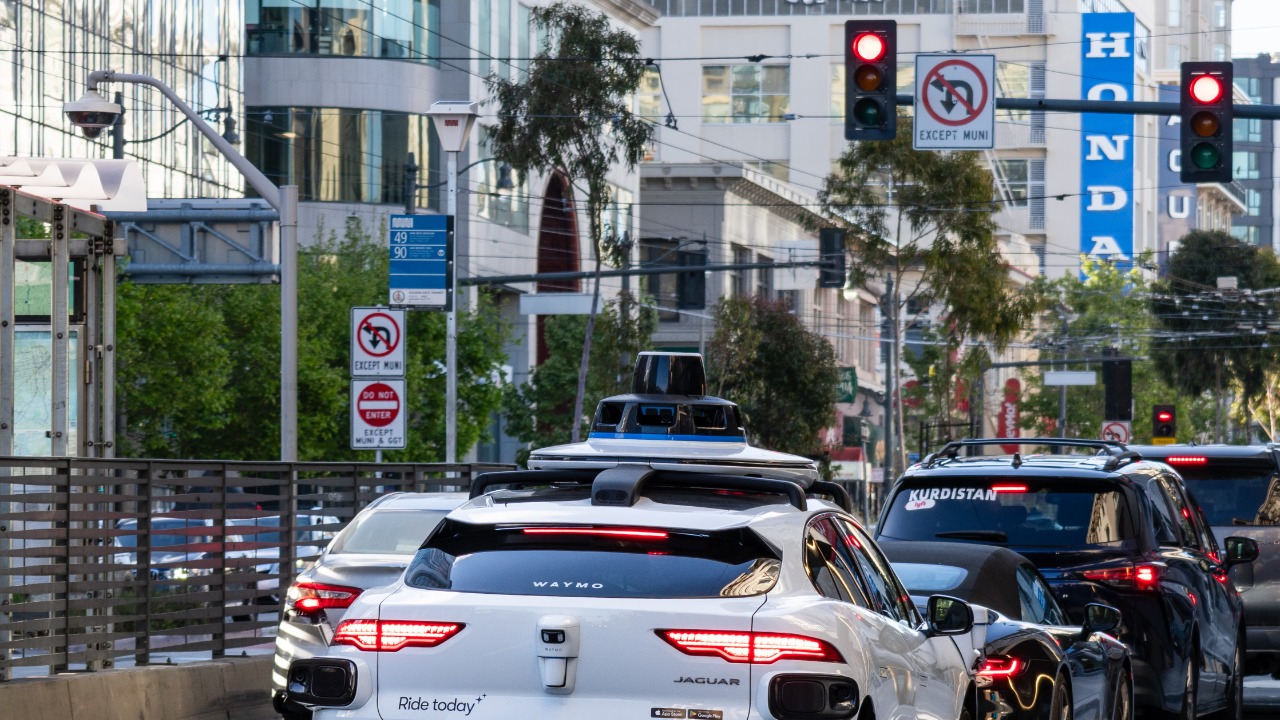
At that stage, Waymo said it would begin manually driving its all-electric Jaguar I-PACE vehicles around Sacramento. The purpose was to expose the Waymo Driver to local streets before eventually introducing passenger service.
Those drives allow the system to encounter the characteristics that make every city different.
Sacramento has tree-lined residential streets, a downtown grid, cyclists, pedestrians, light rail, highway traffic and government activity surrounding the state Capitol.
An autonomous-driving system needs to understand far more than road geometry.
It needs to respond correctly when a pedestrian unexpectedly enters a crosswalk, a delivery vehicle blocks part of a lane or construction changes a familiar route.
Waymo describes this as a gradual expansion process rather than simply dropping vehicles into a new city and immediately carrying paying passengers.
San Diego Is Further Along Toward Driverless Operation
San Diego has also been preparing for Waymo for some time.
The company announced in November 2025 that it intended to begin serving San Diego in 2026. It said it was expanding permits, working with local organizations and training first responders ahead of public operations.
The process moved forward significantly this summer.
In July 2026, Waymo announced that San Diego would be one of four cities where it was preparing to begin fully autonomous operation without a human specialist behind the wheel. Denver, Las Vegas and Tampa were the other three.
Initially, those driverless rides are intended for employees.
Public passengers come later.
That employee-only stage is significant because it represents the transition between testing with someone sitting behind the wheel and genuine rider-only operation.
Once a Waymo starts moving through San Diego with nobody in the driver’s seat, the company is effectively rehearsing the service customers will eventually receive.
Why Does Waymo Need State Permission?
California’s autonomous-vehicle regulations can be confusing because more than one state agency is involved.
The California Department of Motor Vehicles regulates autonomous-vehicle testing and deployment.
The California Public Utilities Commission regulates autonomous passenger transportation.
Those are different responsibilities.
A company can therefore have permission to operate autonomous vehicles on public roads without automatically having permission to run a commercial robotaxi business carrying paying passengers.
The California DMV maintains the state’s autonomous-vehicle testing and deployment framework, while the CPUC oversees autonomous passenger-service programs.
Sacramento’s own government makes the distinction explicit. The city says it does not issue autonomous-vehicle operating permits itself; authorization is handled at the state level.
This regulatory structure helps explain why Waymo can be visible on a city’s roads long before ordinary residents can order one.
Waymo’s California Territory Is Becoming Enormous
Sacramento and San Diego are not isolated experiments.
California DMV records show Waymo’s approved operational territory extending through a remarkable number of communities.
The approved areas include Sacramento County cities such as Sacramento, Elk Grove, Folsom, Rancho Cordova and Citrus Heights. In San Diego County, the authorized territory extends across numerous communities as well.
The company’s CPUC filing similarly describes an expanded Northern California territory including Sacramento County and a Southern California territory including San Diego County.
This points toward something bigger than individual city launches.
Waymo is gradually building large connected autonomous-driving regions.
That could eventually allow robotaxis to operate beyond compact downtown zones and handle much longer journeys across metropolitan areas.
This Is Very Different From Waymo’s Early Robotaxi Model
Early autonomous ride-hailing deployments were geographically conservative.
Vehicles operated inside carefully defined areas.
Those areas could be relatively small.
Expansion happened slowly because every new street environment introduced additional complexity.
Waymo’s current strategy looks increasingly ambitious.
In May, the company said its operational footprint would soon exceed 1,400 square miles across 11 cities as it expanded existing services.
Its future-city list is much larger.
Waymo currently identifies upcoming markets including Sacramento, San Diego, Chicago, Detroit, Denver, Las Vegas, Minneapolis, Pittsburgh, Portland and several others.
The company is no longer trying to prove that driverless ride-hailing can work in one carefully selected city.
It is trying to prove that it can scale.
Waymo’s Cars Need to Learn Different Driving Cultures
San Diego and Sacramento may both be in California, but their driving environments are not identical.
San Diego presents coastal roads, tourist traffic, dense urban areas and major freeway systems.
Sacramento combines government-district traffic with suburban neighborhoods, cycling infrastructure and different weather patterns.
Waymo argues that experience accumulated across existing cities allows the Waymo Driver to adapt to new locations more efficiently than during its earlier expansion years. In 2025, the company said operating across several major markets had strengthened the system’s ability to navigate unfamiliar cities.
That ability is crucial to robotaxi economics.
If every new city required years of engineering work from scratch, nationwide autonomous ride-hailing would be extremely difficult to scale.
A commercially successful autonomous driver needs to transfer much of what it has learned elsewhere.
The Hyundai IONIQ 5 Is Becoming Part of the Story
Another important change is happening inside Waymo’s fleet.
For years, the Jaguar I-PACE became almost synonymous with Waymo.
That is beginning to change.
Waymo said in July that it had started autonomously driving its growing fleet of Hyundai IONIQ 5 vehicles with autonomous specialists present as it validates its sixth-generation Waymo Driver on the new vehicle platform.
That matters because scaling robotaxis requires more than good autonomous-driving software.
Waymo needs vehicles.
A lot of them.
Expanding onto another mass-produced EV platform gives the company greater flexibility as it enters additional cities.
Passengers in future Waymo markets therefore should not assume their robotaxi will necessarily be the familiar white Jaguar.
What Will Riding in One Actually Be Like?
The basic experience is deliberately similar to conventional ride-hailing.
A passenger uses an app to select a destination and request a vehicle.
The difference becomes obvious when the car arrives.
There is no driver.
Passengers enter, confirm the trip and the Waymo Driver handles the journey.
Waymo says its public autonomous ride-hailing operation already runs 24/7 in supported markets. Its current public-service cities include Phoenix, Los Angeles, Miami and parts of the San Francisco Bay Area, among others.
That gives Sacramento and San Diego an advantage over Waymo’s earliest launches.
They are not becoming test cases for an entirely new business model.
They are joining a service that already operates commercially elsewhere.
Safety Will Remain the Biggest Question
The central argument for autonomous vehicles has always been safety.
Human drivers become distracted.
They become tired.
They speed.
They drive after drinking.
A computer does none of those things in the human sense.
But autonomous systems introduce different risks.
They can encounter situations their developers did not anticipate. They can behave unexpectedly around emergency scenes, construction zones or unusual road conditions.
California regulators therefore require autonomous passenger-service companies to provide safety information and operational reports. CPUC rules for driverless passenger programs include passenger-safety requirements and reporting obligations.
Waymo argues that its accumulated driving data demonstrates safety benefits compared with human driving, and it has increasingly made that evidence central to its expansion pitch.
As robotaxis spread beyond early-adopter markets, those claims will face increasing scrutiny.
Traditional Ride-Hailing Is About to Face a Different Kind of Competition
The expansion also creates an interesting economic question.
A conventional ride-hailing trip needs a driver.
The passenger’s fare has to compensate that driver while also supporting the platform.
A robotaxi eliminates the human driver but introduces substantial new costs: expensive sensors, autonomous-computing hardware, fleet maintenance, charging, cleaning and remote support.
If Waymo can operate those fleets efficiently at scale, however, autonomous vehicles could fundamentally change ride-hailing economics.
That puts the technology into direct competition with services built around human drivers.
Waymo already works alongside conventional ride-hailing in some markets rather than always competing independently, illustrating how complicated that transition may become.
The robotaxi industry may ultimately involve a mixture of autonomous fleets, traditional drivers and partnerships between technology companies and existing transportation platforms.
Sacramento and San Diego Still Have to Wait
Regulatory approval is therefore a major milestone, but it should not be confused with launch day.
Waymo’s own current ride information continues to list both Sacramento and San Diego among its upcoming markets rather than locations where anyone can immediately request a ride.
San Diego appears particularly close.
Waymo has already announced plans to begin fully autonomous employee operations there before opening the service to the public.
Sacramento remains in the preparation and testing process, although its inclusion within Waymo’s expanded regulatory territory clears an important path toward eventual passenger operations.
No firm public launch date has been announced for either city.
California Is Becoming Waymo’s Biggest Autonomous Driving Test
Phoenix proved that Waymo could operate a commercial driverless service.
San Francisco demonstrated that autonomous vehicles could navigate an extraordinarily complicated urban environment.
Los Angeles pushed the model into another enormous metropolitan area.
Sacramento and San Diego represent the next stage.
The challenge is no longer simply proving that a driverless car can safely complete a trip.
It is proving that thousands of those trips can happen every day across increasingly large and different cities without requiring a human driver.
Regulatory expansion into Sacramento and San Diego brings Waymo significantly closer to that goal.
Residents cannot necessarily summon one today.
But the regulatory, testing and fleet infrastructure required to make that possible is falling into place.
And once Sacramento and San Diego move from Waymo’s “Up Next” list to its “Serving Riders” list, California’s experiment with driverless transportation will no longer be concentrated in a few technology-heavy metropolitan areas.
It will be starting to look much more like a statewide transportation network.