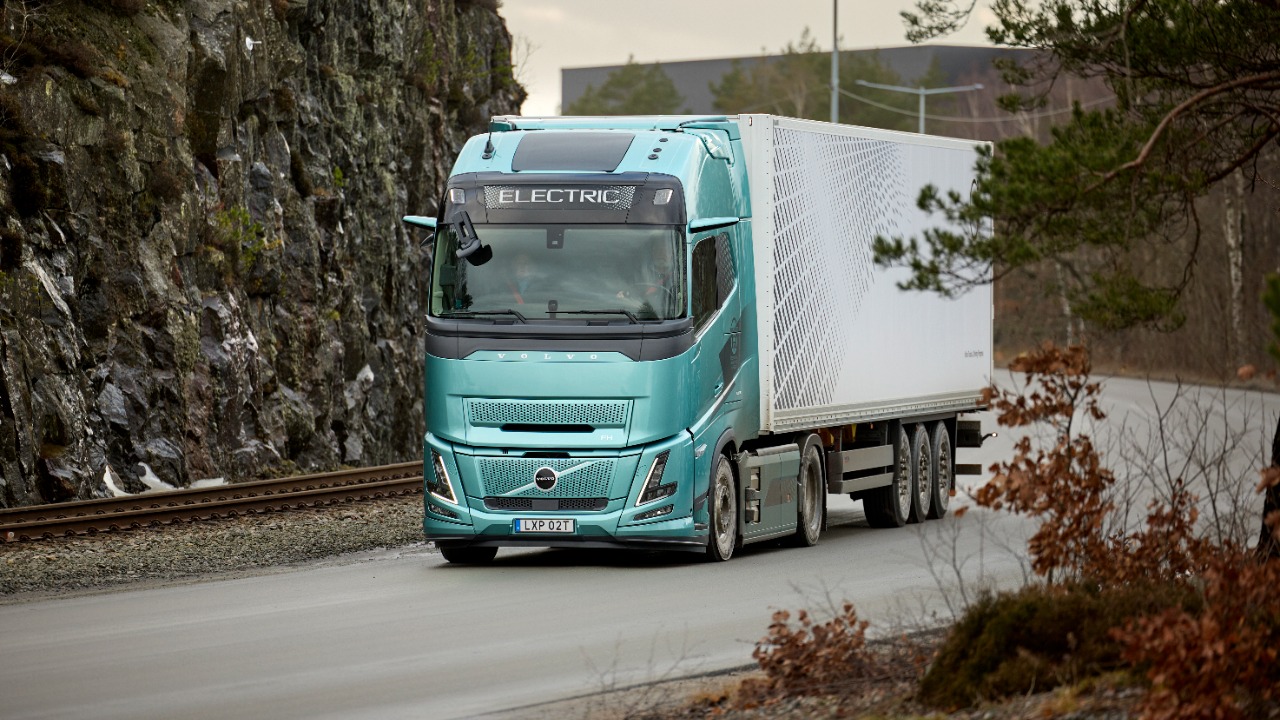

Volvo Trucks has unveiled new battery-electric heavy rigs with a rated driving range of up to 700 kilometres on a single charge, edging into territory traditionally dominated by diesel long-haul tractors. The announcement suggests that battery technology, charging strategies and vehicle efficiency have progressed to the point where electric trucks can handle routes well beyond short urban runs.
What Volvo’s longer-range electric trucks actually change
Volvo’s new long-range models are built to fit duty cycles that previously required internal-combustion power, such as regional distribution and certain linehaul corridors. With a rated range of up to 700 kilometres, a loaded truck can cover an entire shift between major cities or logistics hubs and then recharge during mandated driver rest periods instead of stopping only for fuel.
The higher range figure does not come solely from larger battery packs. Volvo and its suppliers have concentrated on more efficient electric drivetrains, better aerodynamics and energy management software that optimises how power is drawn and recovered. Regenerative braking on descents and in traffic can return significant energy to the battery, which has a much greater impact on a heavy truck than on a passenger car.
Charging strategy is another major shift. Rather than relying exclusively on slow overnight depot charging, the trucks are engineered to use high-power DC chargers along main freight corridors. This lets operators schedule a single fast charge during a lunch break or driver changeover, then complete several hundred more kilometres before the end of the day. For fleets that already run compressed schedules, aligning charging with existing rest windows is crucial.
The new trucks also incorporate digital tools that help dispatchers match loads, routes and charging stops. Route planning software can account for gradients, traffic patterns and available charging infrastructure, then predict remaining range with far greater accuracy than early-generation electric vehicles. That precision reduces the “range anxiety” that has been a persistent barrier for both drivers and fleet managers.
Volvo has already offered battery-electric models for urban distribution and refuse collection, where daily distances are shorter and trucks return to base each night. Extending range to 700 kilometres on a charge marks a shift in ambition from niche applications to mainstream freight lanes, where payload, uptime and total cost of ownership are scrutinised on every run.
Why long-haul capable electric trucks matter right now
Freight transport is a major source of greenhouse gas emissions, and heavy trucks account for a disproportionate share because they run high mileages and burn large volumes of diesel. Governments are tightening CO2 limits on commercial vehicles, while shippers such as major retailers and logistics firms are setting their own decarbonisation targets. Electric trucks that can credibly handle 500 to 700 kilometre routes give operators a practical tool to meet these commitments without overhauling their business models overnight.
Battery-electric trucks also improve local air quality in freight corridors and around ports and warehouses. Diesel exhaust contains nitrogen oxides and particulates that contribute to respiratory problems in communities along busy trucking routes. Zero tailpipe emissions from electric trucks cut those pollutants at the point of use, which is particularly important for urban areas that already face strict air-quality rules.
Economic pressures are pushing in the same direction. Electricity can be cheaper per kilometre than diesel, especially when fleets charge at depots during off-peak hours or integrate on-site solar generation. Maintenance costs for electric drivetrains are typically lower, since there are fewer moving parts and no oil changes, exhaust aftertreatment or complex gearboxes. Over the life of a truck that may cover more than a million kilometres, small savings per kilometre accumulate quickly.
The broader electric vehicle market is maturing as well, making long-haul trucks more viable. Battery costs have fallen compared with early EV deployments, while energy density has improved. Passenger EVs with ranges above 400 kilometres are now common, and markets such as Australia are preparing for an influx of new electric models, as shown by forecasts of electric cars coming to that country over the next few years. The same supply chains for cells, power electronics and charging hardware support heavy commercial vehicles.
Policy incentives add further momentum. Many jurisdictions offer purchase subsidies, road toll discounts or access advantages for zero-emission trucks. Some cities are planning low-emission zones that will restrict or penalise diesel freight vehicles, making early adoption of electric trucks a strategic hedge for logistics providers that need guaranteed access to central depots and urban customers.
For Volvo, delivering a truck that can realistically replace diesel on substantial parts of the network is also a competitive move. Other manufacturers are advancing their own electric platforms, and some are experimenting with alternative technologies such as hydrogen fuel cells. By pushing battery range into what had been considered fuel cell territory, Volvo is betting that improvements in batteries and charging will arrive faster and at lower cost than building a parallel hydrogen infrastructure.
How Volvo’s move reshapes the transition for fleets and infrastructure
The arrival of electric trucks with 700 kilometre capability changes the conversation inside transport companies. Instead of treating electrification as a pilot project limited to a few urban runs, fleet managers can begin mapping which regional and intercity routes could transition within the next vehicle replacement cycle. That planning is likely to proceed lane by lane, prioritising routes with reliable access to high-capacity charging.
Infrastructure providers will feel the effects as well. Highway service areas, logistics parks and truck stops along major freight corridors will see stronger business cases for installing megawatt-scale chargers. The power demand of a single high-capacity truck charger can rival that of dozens of homes, so grid operators and site owners need long lead times to upgrade connections, transformers and on-site energy storage.
Driver experience is another subtle but important shift. Electric trucks deliver instant torque and quiet operation, which can reduce fatigue and improve comfort on long runs. Noise reduction around depots and urban delivery points also benefits nearby residents. At the same time, drivers must adapt to new practices, such as planning regenerative braking on descents to maximise energy recovery and understanding how ambient temperature affects range.
The introduction of longer-range trucks also raises questions about payload. Batteries are heavy, and every kilogram devoted to energy storage is weight that cannot be used for cargo. Regulators in some regions have responded by allowing slightly higher gross vehicle weights for zero-emission trucks to offset the mass of the batteries. For fleet operators, the balance between range, payload and charging time will determine where these trucks make the most sense.
There is a supply chain dimension as well. Large-scale adoption of long-range electric trucks will increase demand for lithium, nickel and other battery materials. Manufacturers and policymakers are already working to secure sustainable sources, expand recycling capacity and support alternative chemistries that rely on more abundant elements. The speed at which those efforts progress will influence how quickly heavy-duty electrification can scale.
What comes next for Volvo and long-haul electrification
Volvo’s new trucks mark an important step, but they do not yet cover the entire spectrum of long-haul freight. Ultra-long routes that span more than 1,000 kilometres in a single shift, or that cross regions with sparse charging infrastructure, remain difficult for battery-electric powertrains. In those cases, interim solutions such as dual-fuel engines, biofuels or, in some markets, hydrogen may continue to play a role.
In the near term, Volvo is likely to concentrate on scaling production, supporting early adopters and gathering operational data from real-world fleets. That feedback will guide incremental improvements in battery chemistry, thermal management and software that can extract more usable range from each kilowatt-hour. Over-the-air updates to energy management systems can deliver efficiency gains to trucks already in service, helping protect early customers from rapid obsolescence.
Partnerships will be central to what happens next. Truck makers, charging providers, utilities and large shippers are already forming consortia to roll out corridor charging networks that mirror major freight flows. By synchronising vehicle launches with infrastructure build-out, companies like Volvo can accelerate adoption and reduce the perceived risk for fleet operators considering their first large orders of electric trucks.