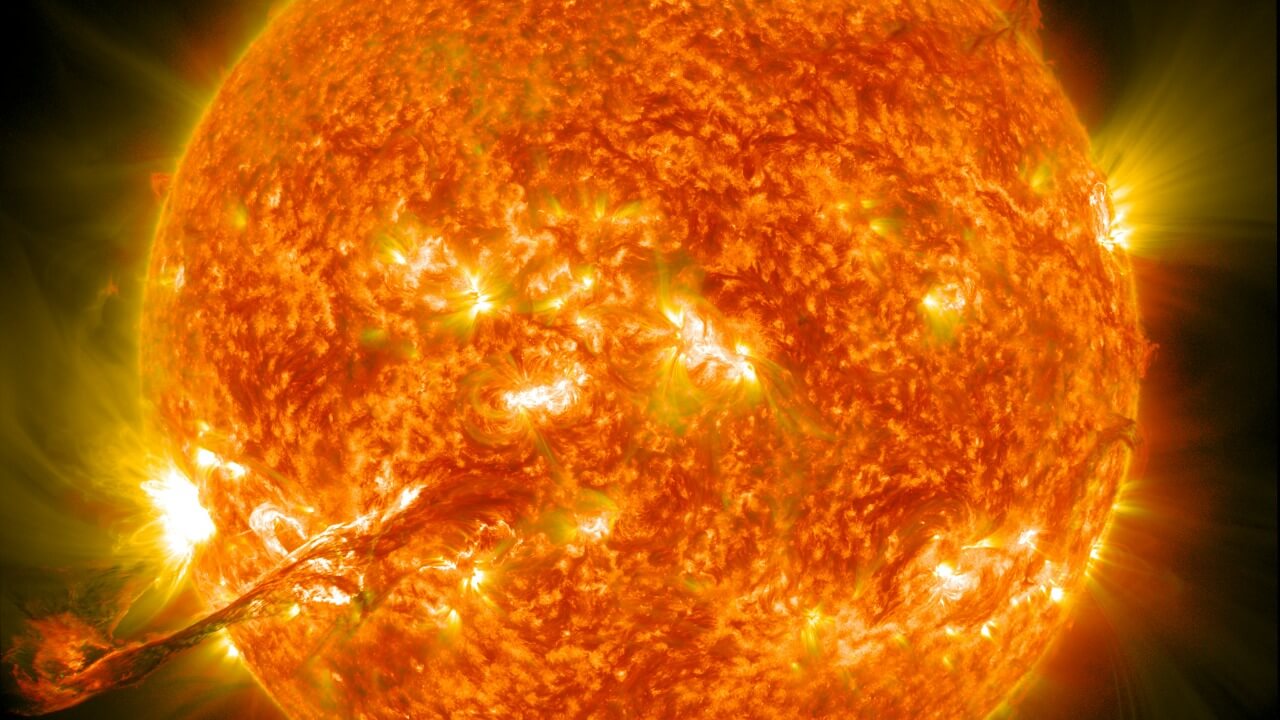

The Sun converts roughly 4 million tons of its own mass into energy every second, a transformation that quietly powers every living thing on Earth. That staggering loss sounds like a countdown to disaster, yet the star at the center of the solar system remains remarkably steady on human timescales.
Grasping how the Sun can burn so fiercely while staying so stable reshapes how people think about climate, long term habitability and the distant future of life around this star.
The physics behind the Sun’s staggering mass loss
The figure of about 4 million tons per second comes from Einstein’s relation between mass and energy. In the Sun’s core, hydrogen nuclei fuse into helium, and a tiny fraction of the original mass disappears, reappearing as energy that streams outward as light and heat. When that energy output is converted back into an equivalent mass, the result is a continuous loss of several million tons every second, a process explained in detail in analyses of how much mass the star sheds.
Despite that huge number, the Sun is so massive that this loss is negligible in relative terms. The star holds about 2 x 1030 kilograms of material, and the energy conversion that supports life on Earth erodes only an almost unimaginably small fraction of that total each year. Over billions of years, however, even small fractions accumulate, and the Sun’s total mass slowly declines.
The fusion process is not random. It is governed by the balance between the inward pull of gravity and the outward pressure of hot gas and radiation. In the core, temperatures reach millions of degrees and densities are extreme, so hydrogen nuclei collide often enough to sustain the reactions. That energy then diffuses outward through the interior before leaving the surface as sunlight.
How a star can burn furiously yet stay stable
For many readers, it is surprising that a star can continuously lose mass and still keep a nearly constant size and brightness for billions of years. The explanation lies in stellar equilibrium. Gravity tries to compress the gas, while the pressure from hot plasma and radiation pushes outward. When these forces match, the star sits in a steady state, a configuration that detailed discussions of solar stability describe as a long lasting balance.
As the Sun fuses hydrogen into helium, the composition of its core slowly changes. Helium is more compact, so the core contracts slightly. That contraction raises the temperature and pressure, which in turn speeds up fusion. The result is a self regulating system. If fusion slows, the core contracts and heats, which boosts the reaction rate. If fusion runs ahead, the extra pressure lets the core expand a little and cool, which slows the reactions.
This feedback loop keeps the Sun in the so called main sequence stage of its life. During this phase, the star burns hydrogen in its core at a relatively steady pace. Models of stellar evolution that track how stars live and show that the Sun has been in this stable phase for about 4.5 billion years and is roughly halfway through it.
Mass loss from fusion is not the only factor. The Sun also sheds material through the solar wind, a stream of charged particles that flows outward in all directions. Over time, the wind carries away additional mass and angular momentum. Yet fusion remains the dominant source of energy and the key driver of the Sun’s internal balance.
Why this constant burn matters for life on Earth
The conversion of mass into energy in the Sun’s core sets the brightness of the star, which in turn defines the climate envelope within which Earth orbits. The relatively stable output during the main sequence has allowed liquid water to persist on Earth’s surface for billions of years, giving biology a rare opportunity to evolve complexity.
That stability is not perfect, though. As fusion gradually speeds up in the contracting core, the star’s luminosity slowly rises. Long term models suggest that the Sun has already become significantly brighter than it was in its youth and will continue to brighten over the next billion years. That slow change shapes the concept of the habitable zone, the band around a star where conditions allow liquid water on a planet’s surface.
The Sun’s behavior is also the benchmark for understanding other stars, including the nearest stellar neighbor, Proxima Centauri. Proxima is a red dwarf, smaller and cooler than the Sun, with a very different pattern of energy output and flaring. Comparing the Sun with such stars helps astronomers evaluate how common long lived, stable energy sources might be in the galaxy.
This steady burn has direct consequences for technology and society. Solar power systems, climate models and satellite operations all assume that the Sun’s average output will not suddenly spike or collapse. Short term variations, such as the 11 year solar cycle and occasional flares, ride on top of the long baseline set by nuclear fusion in the core.
Reframing “solar death” as a very long story
The fact that the Sun is constantly losing mass can sound like a warning that the star is running out of fuel quickly. The detailed picture is more measured. Analyses of why the Sun despite this mass loss point out that the star has enough hydrogen in its core to continue main sequence fusion for roughly another 5 billion years.
Over that vast timescale, the Sun will slowly grow brighter and larger. Eventually, when the core hydrogen is exhausted, the equilibrium that keeps the star stable will fail. The core will contract and heat further, while the outer layers expand into a red giant. Studies of solar evolution trace this path toward a swollen, cooler surface and a much more luminous star.
For Earth, the key point is timing. Long before the red giant phase, the increasing luminosity is expected to drive a runaway greenhouse effect that strips the oceans and makes the planet uninhabitable at the surface. That shift is projected on a timescale of hundreds of millions to perhaps a billion years, far shorter than the full remaining lifetime of the Sun but still far beyond any human planning horizon.
The eventual fate of the Sun is to shed its outer layers and leave behind a white dwarf, a dense, Earth sized remnant that no longer supports fusion. By that stage the star will have lost a substantial fraction of its original mass, and the planets that survive will orbit farther out in response to the weaker gravitational pull.
What the Sun’s burn rate means for the future of exploration
Recognizing that the Sun converts mass to energy at a fixed and predictable rate shapes how astronomers think about the long term prospects for life and exploration in the solar system. The slow brightening suggests that worlds farther from the Sun, such as Mars or the icy moons of the outer planets, could become more temperate over immense timescales, while Earth gradually moves out of the comfortable zone.
The Sun also serves as a laboratory for fundamental physics. Precise measurements of its mass loss, through both fusion and the solar wind, test models of nuclear reactions and plasma behavior under extreme conditions. Observations of solar mass loss feed into calculations of how planetary orbits slowly expand as the star’s gravity weakens.
For missions that may one day travel to other stars, the Sun provides the reference case. Comparing its steady output with that of nearby stars helps mission planners evaluate which systems might host long lived habitable zones and which are dominated by violent flares or rapid evolution.
The headline figure, 4 million tons of mass turned into energy every second, captures the raw power of nuclear fusion. The deeper story is one of balance. That continuous burn has created a stable environment that has already lasted billions of years and is set to continue for billions more, giving life around this ordinary star an extraordinary window of time.