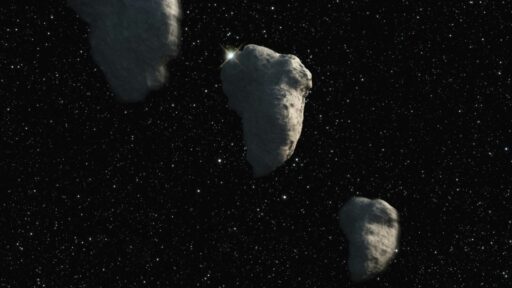
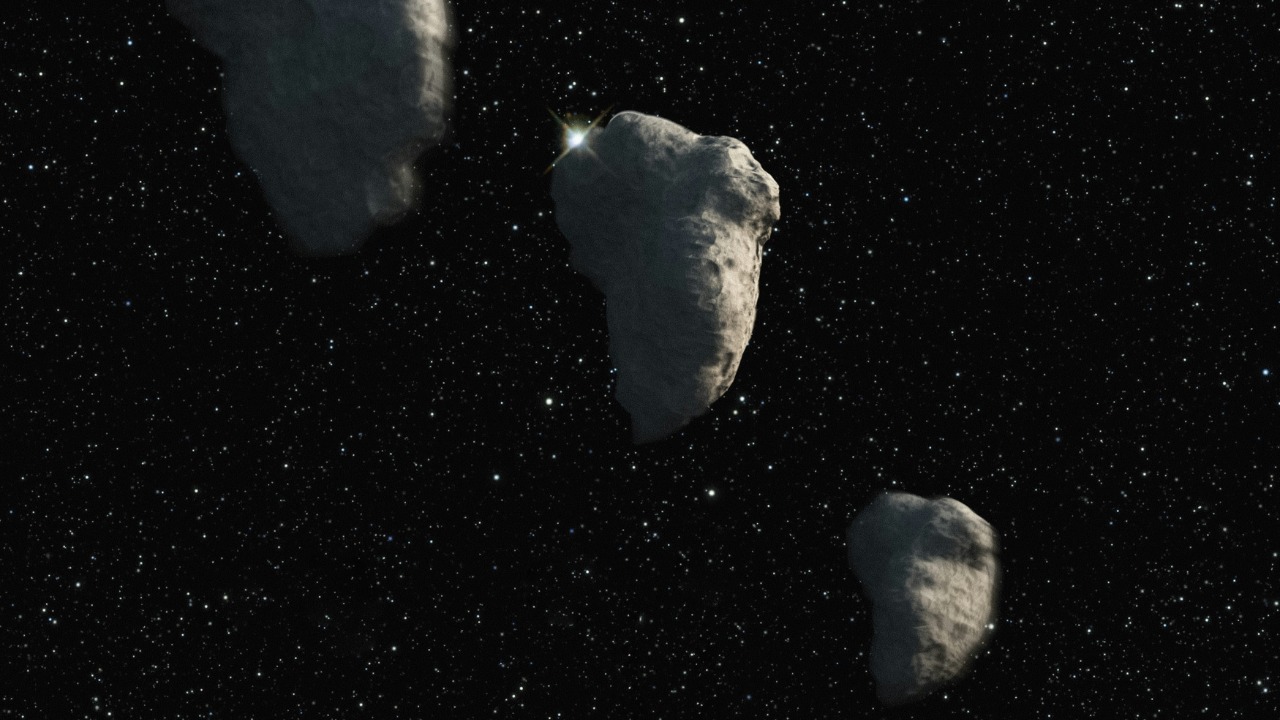

A NASA spacecraft has just returned the clearest look yet at a small asteroid that looks less like a rock and more like a lumpy, slowly spinning peanut in space. The oddly shaped body is more than a visual curiosity; it is a natural laboratory for how rubble-pile asteroids form, evolve, and potentially threaten Earth.
The new images and measurements reveal a world that tumbles rather than spins smoothly, with two bulging lobes connected by a thinner neck. That ungainly geometry is reshaping scientists’ ideas about how such objects hold together and how they might respond if humanity ever had to nudge one off a collision course.
Fresh close-ups of a wobbling peanut-shaped asteroid
The latest observations come from a NASA spacecraft that approached the asteroid closely enough to map its surface in detail and track its motion through space. High resolution images show a contact binary, a body made of two main lobes pressed together, whose overall outline resembles a rough peanut instead of a single rounded rock. The object’s surface is strewn with boulders, pits, and fine debris, a clear sign that it is a loose aggregate rather than a solid monolith.
Rather than rotating cleanly around a single axis, the asteroid tumbles in what scientists call non-principal-axis rotation. In practice, that means the object wobbles as it spins, so the orientation of its long axis shifts over time. The spacecraft’s cameras traced that motion over multiple passes, confirming that the peanut-like form and the irregular spin are linked, since the uneven mass distribution makes a simple rotation unstable.
Mission scientists also used the spacecraft’s instruments to estimate the asteroid’s density and internal structure. The data point to a rubble pile held together mostly by its own weak gravity and by friction between blocks, rather than by strong internal cohesion. That interpretation matches similar measurements at other small bodies and supports the idea that many near-Earth asteroids are fragile clusters of fragments instead of solid chunks of rock or metal.
Thermal observations add another layer of detail. As the asteroid rotates, some regions heat up and cool down faster than others, which helps researchers infer grain sizes and surface roughness. Combined with the visible imagery, those temperature patterns show that one lobe contains more fine regolith while the other hosts larger exposed boulders. That contrast hints that the two halves may have started as separate objects before gently merging.
The spacecraft’s close encounter also refined the asteroid’s orbit around the Sun. Precise tracking of the spacecraft’s trajectory, slightly tugged by the asteroid’s gravity, allowed navigators to update the object’s position and future path. Those refined orbital elements will feed directly into planetary defense models that assess long term impact risk.
Why a lumpy, tumbling space rock matters for planetary defense
At first glance, a peanut-shaped asteroid may sound like a cosmic oddity, but its structure carries direct implications for how Earth prepares for future threats. Many small near-Earth objects appear to be contact binaries or irregular rubble piles, and the new data confirm that this class of asteroid can wobble in complex ways while still remaining gravitationally bound. That behavior shapes how such bodies respond to sunlight, gravitational tides, and any human attempt to deflect them.
One key effect is the Yarkovsky and YORP phenomena, where uneven heating and re-radiation of sunlight slowly alter an asteroid’s spin and orbit. A skewed shape with two lobes and a wobbling rotation can amplify or complicate those thermal forces. By watching how the peanut-shaped asteroid’s spin state evolves, researchers can test models that predict how radiation torques nudge small bodies over decades and centuries. Those models, in turn, feed into long range impact probability forecasts.
The new observations also matter for impact mitigation strategies. If a future hazardous asteroid shares this object’s loose interior and irregular shape, a kinetic impactor or other deflection method would transfer momentum in a less predictable way. The force might compress one lobe, shake loose material, or even cause partial breakup instead of simply nudging the orbit. Experiments like NASA’s DART mission have already shown that ejecta can magnify the effect of an impact, but a contact binary adds another layer of uncertainty that engineers need to anticipate.
Surface geology on the peanut-shaped body provides clues about how such asteroids respond to smaller collisions and internal quakes. Clusters of boulders near the neck region and landslide-like streaks on the slopes suggest that material can migrate across the surface over time. That migration changes the distribution of mass, which can subtly shift the spin state and orbital behavior. The more examples scientists have of such evolution, the better they can generalize to the broader population of near-Earth objects.
The mission’s findings also feed into basic science about how planetary building blocks assembled. Contact binaries likely form when two smaller bodies, born from the same parent or from a debris field, spiral together and gently merge. The detailed topography and internal structure of this peanut-shaped asteroid help researchers reconstruct that process. A recent analysis described the object as a wobbling peanut asteroid, a phrase that captures both its shape and its unstable spin state, and highlights how such bodies can preserve the history of early solar system collisions.
Beyond the technical details, the mission also has a public engagement angle. Vivid images of a bizarrely shaped asteroid, paired with clear explanations of why its wobble matters, help make planetary defense research tangible. When people can picture the target, it becomes easier to explain why tracking and characterizing these objects is a long term global priority.
Future missions and models built on the peanut asteroid’s data
The encounter with the lumpy, slowly tumbling asteroid is not an isolated event. It is part of a broader sequence of missions and studies that aim to build a detailed catalog of small body types, spin states, and internal structures. The data now flowing back will guide both future spacecraft designs and ground based observing campaigns.
On the mission side, engineers can use the new shape model and gravity field estimates as a testbed for navigation algorithms around irregular bodies. Simulated flybys and proximity operations around the peanut-shaped asteroid will help refine guidance techniques for spacecraft that must operate close to low gravity, uneven targets. That experience is especially valuable for sample return missions that need to touch the surface safely and then depart.
Scientists are also folding the asteroid’s wobbling rotation into dynamical models that track how contact binaries evolve. By combining the spacecraft’s measurements with long term ground observations, they can check whether the spin state drifts over time in ways that match theoretical predictions. Any mismatch will point to missing physics, such as internal energy dissipation or subtle mass movements under the surface.
On Earth, radar and optical telescopes will continue to monitor other peanut-like asteroids that pass within observational range. The new spacecraft data provide a template that helps interpret lower resolution signals. For example, a particular pattern in a radar echo or light curve might now be confidently tied to a contact binary shape or to non-principal-axis rotation, because the spacecraft has provided a ground truth example.
Planetary defense planners are likely to incorporate the mission’s findings into updated risk scenarios. Training exercises that simulate a future impact threat can now include targets with rubble pile interiors and complex spin states, rather than assuming a simple solid sphere. That shift will influence how agencies evaluate the effectiveness of kinetic impactors, gravity tractors, or other proposed deflection methods for different asteroid types.
There is also interest in how such irregular bodies might be used as resources. Although the primary focus of the current mission is scientific, the detailed mapping of surface composition and structure informs longer term ideas about asteroid mining. A contact binary with accessible regolith and low gravity could, in theory, be a source of water or metals for in-space use, provided that future missions can anchor safely to such an unstable surface.