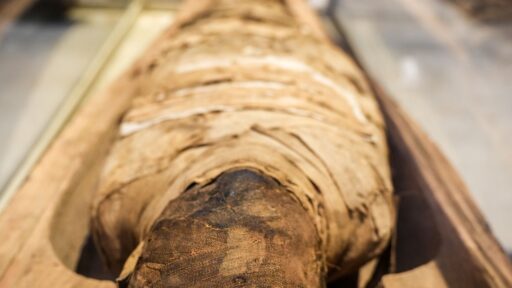
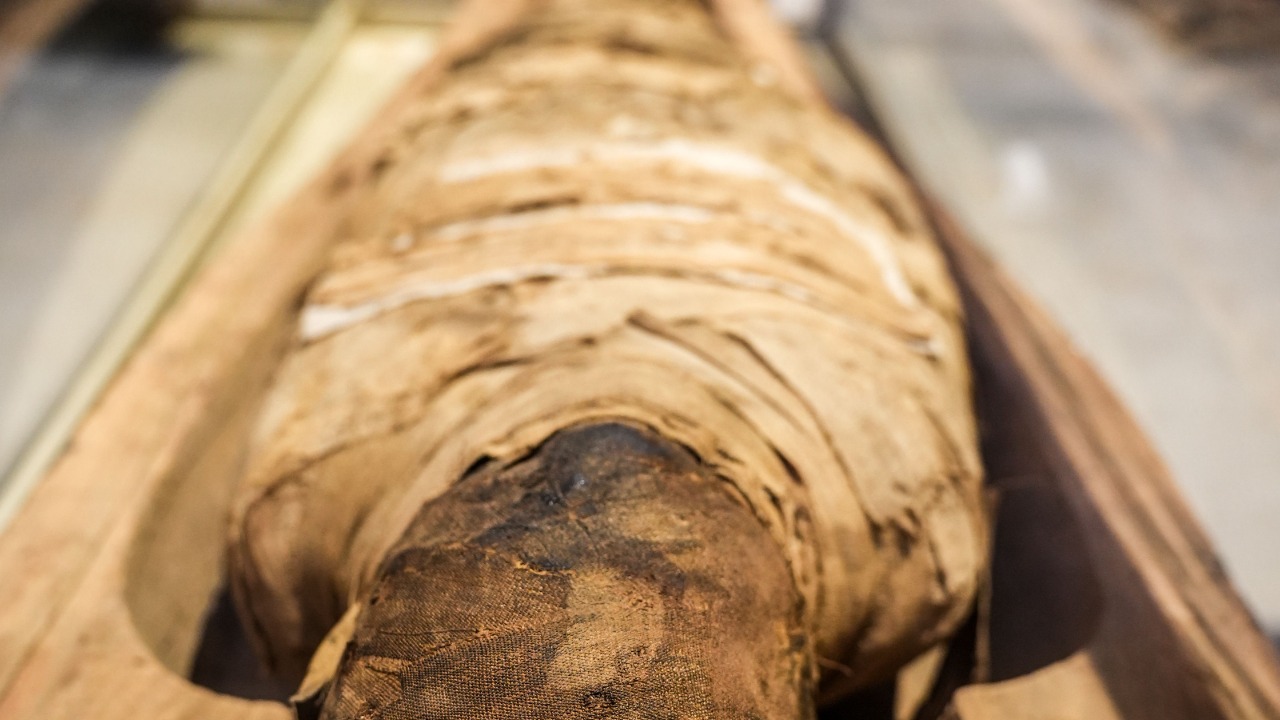

An apparently ordinary Egyptian mummy has turned out to be anything but. During a new scientific examination, researchers discovered that a passage from Homer’s Iliad had been placed inside the body, preserved for centuries in the wrappings and gut of the deceased. The find ties a classic of Greek literature directly to the intimate, ritual world of ancient Egyptian burial.
Fresh analysis reveals a Homeric text hidden in a mummy
The mummy at the center of the discovery had been stored in a collection and only recently underwent detailed re-examination using modern imaging and conservation techniques. As specialists scanned and carefully opened sections of the wrappings, they found fragments of papyrus that turned out to contain lines from the Iliad. According to researchers, the text was not simply tucked under bandages but was located within the body cavity itself.
Initial inspection showed that the papyrus had been folded and inserted during or shortly after the mummification process, a placement that suggests a deliberate act rather than later contamination. Material analysis and paleographic study of the Greek script helped confirm that the fragment belongs to the long tradition of handwritten copies of Homer that circulated in the Hellenistic and Roman periods. The papyrus appears to have been trimmed to fit the available space, indicating that embalmers or relatives actively repurposed an existing manuscript for the burial.
Further details emerged when conservators compared the writing style and the composition of the ink with other known papyri. Their work supports the conclusion that the text was already several generations old when it was placed with the dead. Reporting on the find describes how the team identified specific verses from the Iliad that deal with themes of honor, death, and heroic remembrance, themes that would have resonated strongly in a funerary context.
Accounts of the autopsy-style investigation explain that the papyrus was discovered in the abdominal region, among the remnants of packing material used to stabilize the corpse after internal organs were removed. One report notes that the fragment was effectively “stuffed inside the abdomen,” a detail that aligns with the standard practice of filling the torso with linen and resins, but here with the unusual addition of literary text. Coverage of the case, including a description on a British site, emphasizes how unexpected it is to find Greek epic in such a visceral location.
From curiosity to case study in cultural entanglement
At first glance, the idea of a mummy “wearing” a piece of the Iliad might sound like a quirky anecdote from archaeology. Looked at more closely, it opens a window onto how deeply Greek and Egyptian cultures had intertwined by the late first millennium BCE. Egypt had long been under Greek and then Roman rule, and Greek language and literature circulated widely among urban elites. The presence of Homeric verse inside an Egyptian-style burial shows that these influences extended directly into funerary ritual.
Specialists quoted in coverage of the discovery argue that the find illustrates how Homer functioned not only as school literature but also as a source of quasi-sacred language. The Iliad was copied, memorized, and quoted across the eastern Mediterranean. By placing a passage inside the body, mourners may have been trying to surround the deceased with prestigious, protective words in addition to traditional Egyptian spells. A report in a science magazine notes that similar papyrus scraps often show up in trash heaps or as reused wrapping, but rarely in such an intimate, intentional setting.
The discovery also matters for historians of the book. Papyrologists usually reconstruct ancient texts from fragments preserved in desert rubbish dumps or abandoned houses. In this case, the Iliad survives because embalmers treated a written sheet as a physical object suitable for ritual use. That choice helps scholars understand how people valued manuscripts, not only as carriers of text but also as material goods that could be recycled, gifted, or sacrificed.
For Egyptologists, the case feeds into a broader rethinking of how “Greek” and “Egyptian” identities overlapped. The mummy’s wrappings, style, and treatment of the body follow native traditions, yet the inserted papyrus carries Greek script and Greek myth. This combination supports the idea that families in cosmopolitan centers could be bilingual and bicultural, drawing on multiple religious and literary repertoires at once. An analysis highlighted by a British newspaper frames the mummy as evidence that Homeric poetry had become part of everyday spiritual life in Egypt, not just a classroom exercise for scribes.
The find also sharpens debates over how to interpret reused texts in burials. Scholars have long known that embalmers sometimes recycled older papyri as padding or external wrappings. In many cases, the content of the reused sheets appears random, suggesting that scribes treated them as scrap. The Iliad fragment, however, sits at the intersection of reuse and reverence. It might have been a discarded school text that gained new life as a funerary charm, or it might have been chosen precisely because of its content. That ambiguity forces researchers to consider not just the economic logic of recycling but also the symbolic weight of particular works.
Future research paths and unresolved questions
Although the discovery has already attracted global attention, the most significant work may still lie ahead. The fragment needs full transcription, high resolution imaging, and comparison with existing catalogues of Homeric papyri. Specialists will want to check whether the wording matches known versions of the Iliad or preserves a unique reading. Even a single variant line could refine reconstructions of the poem’s transmission in Greek-speaking Egypt.
Conservators are likely to continue noninvasive scanning of the mummy to search for additional fragments. Given that embalmers often worked with multiple sheets, there is a real possibility that more text remains hidden in the torso or limbs. If further pieces are found, they could reveal whether the embalmers inserted a continuous passage, a selection of favorite lines, or simply whatever scrap lay at hand. That distinction would help clarify whether the insertion had a clear ritual script behind it or reflected ad hoc improvisation.
The case also raises ethical and practical questions for museums that hold mummies. Institutions must decide how far to go in opening human remains for research, especially when invasive procedures might damage both the body and any associated artifacts. The discovery of a literary treasure inside one mummy will strengthen arguments for targeted imaging campaigns that prioritize minimal intervention but still allow scholars to detect hidden objects, from papyri to amulets and jewelry.
Digital humanities projects are likely to play a central role in what comes next. Once the Iliad fragment is fully documented, it can be added to online databases that map every known Homeric papyrus by location, date, and textual features. That integration will let researchers see how this funerary copy fits into broader patterns of circulation. It may, for example, cluster with other Egyptian manuscripts that share similar handwriting or dialectal spellings, hinting at a particular workshop or school.
For classicists and Egyptologists alike, the mummy has become a test case for interdisciplinary collaboration. Future publications will need to balance detailed anatomical reporting with literary analysis and cultural history. Teams that include radiologists, conservators, papyrologists, and historians of religion will be better equipped to interpret both the physical context and the poetic content. The goal is not only to read the text but also to understand why someone thought it belonged inside a human body prepared for eternity.
There is also a public dimension to what happens next. As museums and research teams release images and translations, educators will likely use the story to illustrate how fragile texts survive and how ancient people mixed traditions. The image of a corpse carrying Homer in its abdomen is arresting, but behind that image lies a complex history of empire, language, and faith. Each new technical report or exhibition label will have to translate that complexity for visitors who may know the Iliad only as a distant school assignment, if at all.