
Drinking water on Earth requires almost no thought. Gravity keeps the liquid at the bottom of a glass, brings it toward the rim when the glass is tilted and helps it flow into the mouth.
None of those familiar actions work normally aboard the International Space Station.
In microgravity, water does not settle at the bottom of an open container. It can form floating spheres, cling to surfaces or spread across equipment. A loose droplet could enter electronics, ventilation systems or an astronaut’s nose and eyes.
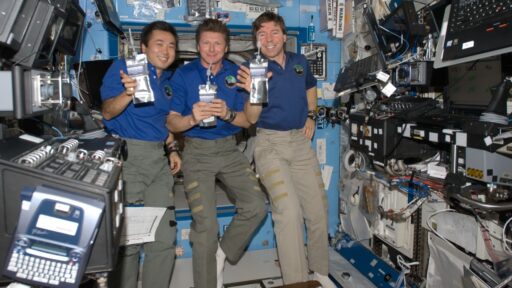
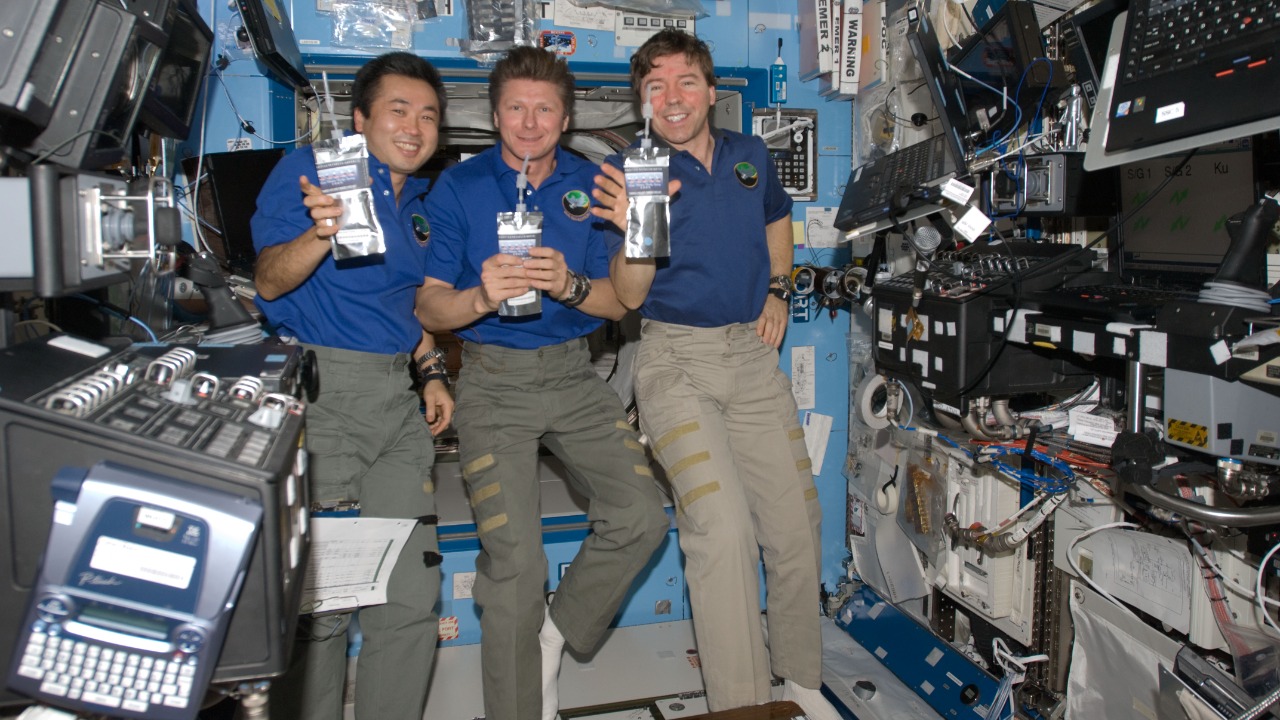
NASA astronauts therefore usually drink from sealed pouches fitted with valves and straws. The liquid remains contained, while the astronaut pulls it through the straw using suction. Space crews can also use specially designed capillary cups that guide beverages toward the rim without relying on gravity.
The drinking method looks simple, but it depends on fluid physics, careful packaging and an advanced life-support system that recycles much of the station’s wastewater into clean drinking water.
Most Drinks Come in Sealed Pouches
The standard space-drinking container resembles a flexible plastic pouch.
It is filled with water, juice, coffee or another prepared beverage and fitted with a straw or nozzle. A clamp or valve prevents the liquid from escaping when nobody is drinking.
To take a sip, an astronaut opens the valve and sucks the liquid through the straw. Once finished, the valve is closed so no droplets can float away.
NASA’s technical description of the zero-gravity cup notes that the conventional method for drinking in microgravity is to draw liquid from a sealed bag or pouch through a straw. The pouch system remains practical because it contains the drink securely and requires little space.
The flexible container also collapses as the liquid is consumed. This prevents a large pocket of air from replacing the missing beverage and makes it easier to extract nearly all the contents.
Astronauts cannot simply place an ordinary open glass on a table. The glass would remain in place only if secured, while the water inside could separate from it and float around the cabin.
Why Water Behaves Differently in Space
Gravity is not completely absent aboard the space station. The station and everything inside it are continuously falling around Earth, creating the condition commonly called microgravity.
Because objects and liquids fall together, astronauts experience apparent weightlessness.
On Earth, gravity usually dominates the visible behaviour of a drink. In orbit, other forces become much more noticeable, especially surface tension, adhesion and capillary action.
Surface tension encourages water molecules to pull together. This is why loose water commonly forms rounded blobs in microgravity.
Adhesion causes liquid to cling to surfaces such as plastic, metal or skin. Instead of falling away, a droplet may spread along an object or remain attached to it.
Capillary action can pull liquid through narrow spaces or specially shaped channels. NASA has used this effect to create containers that function more like ordinary cups despite the lack of gravity. Its research into fluid behaviour has also supported new life-support and liquid-management technologies.
Astronauts Do Not Pour Drinks Normally
Preparing a drink in orbit requires controlled dispensing.
The International Space Station includes a potable-water dispenser that supplies measured quantities of hot or room-temperature water. Astronauts use it to fill drinking pouches and rehydrate food.
The pouch connects directly to the dispenser. Water enters through a valve rather than being poured through open air.
For powdered beverages, the dry ingredients are already sealed inside the package before launch. The astronaut connects the package to the water dispenser, selects the correct amount and allows the water to enter.
After gently mixing the contents, the astronaut inserts or opens the drinking straw.
This system can be used for beverages such as coffee, tea, fruit-flavoured drinks and electrolyte mixtures. The preparation method prevents powder and liquid from escaping into the cabin.
NASA documentation explains that the station’s potable-water dispenser supplies water for both drinking packages and food rehydration.
Coffee Is Usually Drunk Through a Straw
Most coffee consumed in space is prepared inside a pouch and drunk through a straw.
The coffee may be supplied plain or with predetermined amounts of sugar and creamer based on each astronaut’s preference. Preparing the combinations before launch prevents loose sugar granules or powdered creamer from floating through the station.
This method provides caffeine but does not reproduce the full experience of drinking from a cup. The astronaut cannot easily smell the beverage while sipping through a sealed straw, and smell contributes strongly to flavour perception.
The experience changed when researchers developed a cup that could use microgravity rather than fight against it.
The Space Cup Uses Capillary Action
The Capillary Beverage Cup, commonly known as the Space Cup or zero-gravity cup, allows astronauts to sip from an open rim.
Its unusual shape includes a narrow, angled channel running along one side. Surface tension and the wetting characteristics of the cup cause liquid to move through that channel toward the rim.
When the astronaut touches the rim and takes a sip, more liquid automatically moves forward to replace what was consumed.
NASA explains that the channel creates an equilibrium in which capillary forces hold the beverage near the lip. Drinking disturbs that equilibrium, causing additional liquid to move from the reservoir toward the astronaut’s mouth.
The cup does not need a pump, straw or electric motor. Its geometry controls the liquid passively.
Astronauts can lift it toward their lips and sip using an action similar to drinking on Earth. NASA’s visual demonstration of drinking in zero gravity shows how the cup keeps the beverage contained while directing it toward the rim.
The Space Cup Began as an Astronaut’s Experiment
NASA astronaut Don Pettit helped develop an early version of the cup after experimenting with fluid behaviour during spaceflight.
He created a prototype using flexible transparent material shaped to form an acute corner. That corner acted as a capillary channel capable of directing liquid.
Researchers later refined the idea into more durable cups with carefully calculated geometry.
NASA describes how Pettit demonstrated that surface tension, wetting and container shape could hold coffee in the Space Cup. The design became part of the Capillary Beverage investigation aboard the station.
The experiment was not created only to make coffee more enjoyable. It helped scientists understand how complex fluids behave when gravity no longer controls their location.
That knowledge is useful for spacecraft fuel tanks, cooling systems, water processors and medical equipment.
Astronauts Have Drunk Espresso From Open Cups
One of the Space Cup’s best-known demonstrations involved espresso.
European Space Agency astronaut Samantha Cristoforetti drank espresso from a capillary cup aboard the station in 2015. Images of the event attracted attention because the astronaut appeared to be enjoying coffee from an open container while floating in orbit.
The cup was part of an investigation involving several liquids with different physical properties. Researchers examined how water, juice, tea, cocoa and other beverages moved along the cup’s specially shaped channel.
NASA’s account of the experiment explains that the design allowed researchers to study passive fluid movement while also improving the experience of consuming beverages in space.
Different liquids do not behave identically. Sugar, milk, oils and suspended particles can change viscosity, surface tension and wetting behaviour.
A cup designed for water may therefore move espresso or a smoothie differently. Testing several beverages helped researchers understand those variations.
Floating Water Blobs Are Mostly Used for Demonstrations
Videos frequently show astronauts playing with floating balls of water.
They may release a carefully controlled droplet, move it with airflow or insert a straw into the floating sphere. These demonstrations reveal how surface tension shapes liquid in microgravity.
They are not the normal way astronauts remain hydrated.
Allowing water to float freely creates unnecessary risk. A small blob can separate into smaller droplets and become difficult to collect. It may enter ventilation openings or settle on equipment.
Astronauts conduct such demonstrations under controlled conditions and usually recapture the liquid afterward.
For daily drinking, sealed pouches are faster, safer and easier to store.
Where the Drinking Water Comes From
Some station water is launched from Earth, but continually transporting all the water needed by the crew would be expensive and inefficient.
The International Space Station therefore operates an extensive Water Recovery System as part of its Environmental Control and Life Support System.
It collects several sources of wastewater, including urine, moisture from crew members’ breath and sweat, cabin humidity and water associated with spacesuit systems. The recovered liquid passes through multiple treatment stages before becoming potable water.
NASA’s ECLSS overview explains that the Water Recovery System sends treated wastewater through equipment designed to meet strict purity standards before the water is reused.
The system reduces the amount of water that must be delivered from Earth and provides practical experience for future missions that may travel too far away for regular resupply.
Astronauts Are Not Directly Drinking Urine
The statement that astronauts drink recycled urine is technically connected to the system but often presented misleadingly.
Urine is one of several wastewater sources processed aboard the station. The crew does not drink it directly.
The Urine Processor Assembly first extracts recoverable water. That output joins other wastewater streams and passes through the Water Processor Assembly.
Specialized filters remove contaminants, and a catalytic reactor breaks down remaining trace compounds. Sensors check the resulting water. Any batch that fails to meet the required standards is processed again rather than released for crew use.
NASA says accepted water is treated to prevent microbial growth and stored until needed. The agency emphasizes that astronauts drink reclaimed, filtered and thoroughly cleaned water—not untreated waste.
The treatment principle is comparable to water recycling on Earth, although the space station must perform it inside a compact, carefully monitored closed environment.
The Station Can Recover About 98 Percent of Its Water
NASA has worked for years to reduce the amount of water lost during processing.
Earlier configurations recovered roughly 93 to 94 percent of available wastewater. The addition of a brine-processing system enabled the station to demonstrate an overall water-recovery rate of approximately 98 percent.
The brine processor extracts additional moisture from the concentrated material left behind by the urine-processing system. Warm, dry air passes over the brine, causing water to evaporate.
That humid air is then captured by the station’s water-collection equipment and sent through the purification process.
NASA announced the 98 percent water-recovery milestone in 2023 and has continued using the station to improve regenerative life-support technology.
A nearly closed water loop will be essential for missions to Mars, where carrying years of drinking water from Earth would add enormous mass.
Each Astronaut Needs Water for More Than Drinking
NASA estimates that each crew member requires about one gallon of water per day for drinking, food preparation and hygiene.
Not all of that water is consumed as a beverage. It is also used for rehydrating meals, brushing teeth and supporting other daily activities.
Astronauts do not shower in the same way people do on Earth. They generally clean themselves using damp towels, rinseless products and limited quantities of water.
This careful use reduces demand on the recycling system.
Hydration remains medically important because microgravity changes fluid distribution in the body. Astronauts may initially feel congested as fluid shifts toward the head, while long missions can affect bones, muscles, kidneys and cardiovascular function.
Crew members therefore monitor their fluid intake rather than drinking only when they happen to feel thirsty.
Drinking Through a Straw Requires a One-Way Valve
An ordinary open straw would not be sufficient in microgravity.
After the astronaut stopped drinking, liquid could remain inside the tube and escape from the end. Air could also enter the pouch, changing how the drink moves.
Space beverage packages therefore use clamps or valves that control flow.
The astronaut opens the mechanism before drinking and closes it afterward. Some designs use bite valves similar to those found on hydration packs.
The valve keeps the liquid contained even when the pouch is stored on a wall, placed inside a food tray or allowed to float temporarily.
Velcro, clips and restraints are used throughout the station to prevent packages from drifting away.
Carbonated Drinks Are Complicated in Microgravity
Carbonated beverages create an additional problem.
On Earth, gravity separates gas bubbles from liquid. The bubbles rise and collect at the top of a container, allowing a person to drink the liquid and later release the gas by burping.
In microgravity, the gas and liquid do not separate normally. The drink can become a foam-like mixture containing bubbles throughout its volume.
When consumed, the gas and liquid can remain mixed inside the stomach. Releasing the gas may also bring liquid back up, creating what astronauts sometimes describe as a wet burp.
This makes conventional sodas less comfortable and less practical in orbit.
Space agencies have experimented with carbonated beverage systems, but water, coffee, tea and powdered fruit drinks remain more straightforward choices.
Space Drinking Technology Has Uses Beyond Beverages
Research into drinking in microgravity contributes to broader spacecraft engineering.
Future vehicles will need to control fuel, coolant, waste, drinking water and medical liquids when gravity is weak or absent. Pumps add mass, consume electricity and can fail.
Capillary systems can sometimes move or separate liquids passively using carefully designed surfaces and channels.
NASA has developed capillary concepts for water tanks, life-support systems and carbon-dioxide-removal equipment. Its research into capillary fluid behaviour aboard the station shows how small experiments can inform larger spacecraft systems.
The same principles may eventually support lunar habitats, Mars vehicles and long-duration medical systems.
Drinking in Space Is Simple Only After Extensive Engineering
From the astronaut’s perspective, drinking can be as easy as opening a valve and taking a sip.
Behind that action is a complex system.
The liquid must be packaged or dispensed without creating floating droplets. The straw must close securely. The water must be collected, processed, tested and stored. Every container must function in microgravity while remaining light enough to launch.
Sealed pouches remain the everyday solution because they are dependable and compact. Capillary cups offer a more natural experience by using surface tension to guide coffee, water or juice toward an open rim.
Together, these methods demonstrate how spaceflight turns an ordinary human activity into an engineering challenge.
NASA astronauts drink much the same liquids people consume on Earth. The difference is that in orbit, every sip depends on controlling a fluid that no longer knows which way is down.