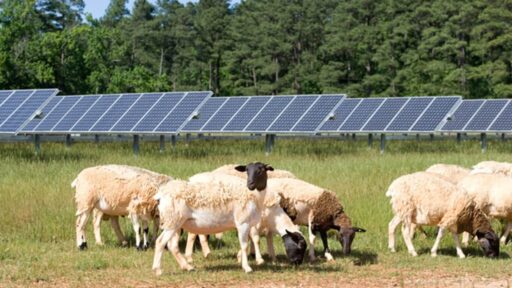
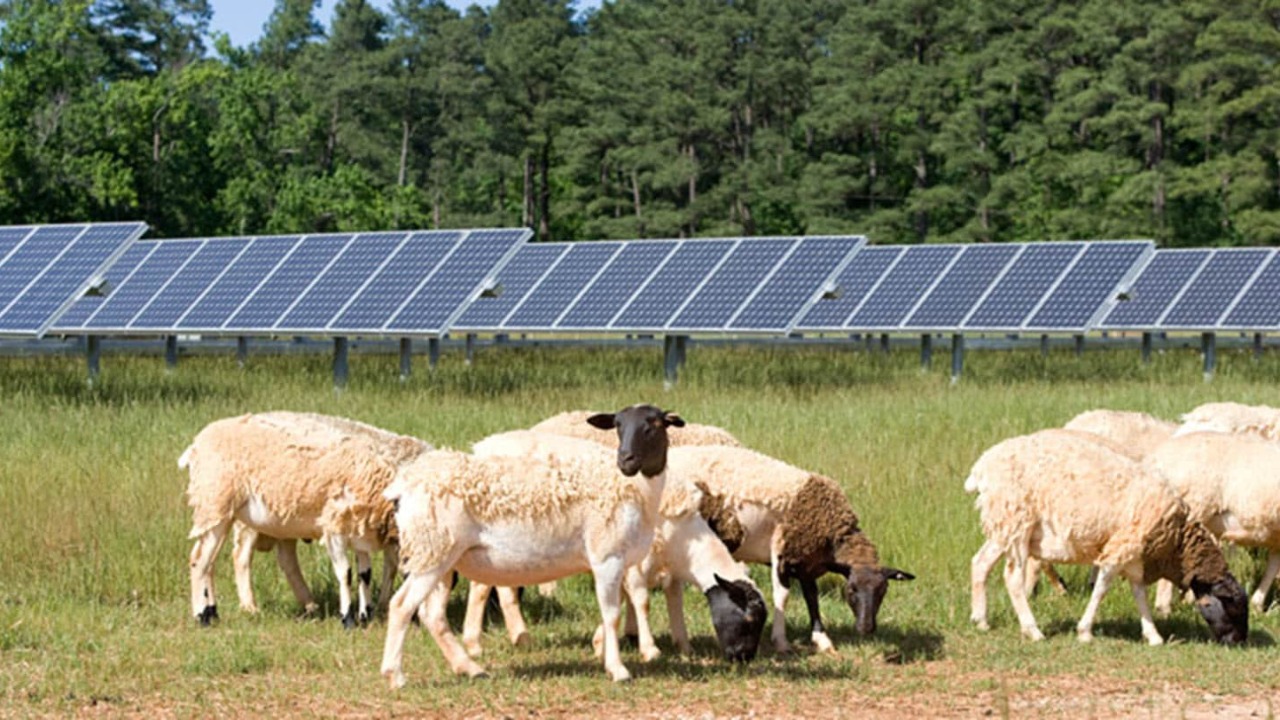

Rows of solar panels may appear to remove farmland from agricultural production, but thousands of sheep are turning those energy sites back into working pastures.
Known as solar grazing, the practice allows farmers to move their flocks onto utility-scale solar farms, where the animals eat grass and weeds beneath and between the panels. Solar companies pay farmers for vegetation management, while the farmers gain access to grazing land without buying or leasing conventional pasture.
The financial effect can be significant. A 2025 profitability study found that solar-grazing businesses could generate returns on investment ranging from 16 to 43 percent under the scenarios examined. The researchers concluded that reliable payments from solar operators could make sheep farming considerably more profitable than relying only on lamb or wool sales. The complete analysis was published in Applied Energy and is available through ScienceDirect.
This system does not suit every farm or solar project. It requires suitable fencing, water, transport and animal management. However, for farmers facing unstable crop prices and limited access to affordable land, grazing beneath solar panels is becoming an increasingly valuable business opportunity.
Solar Companies Already Need Vegetation Management
Ground-mounted solar arrays do not eliminate plant growth.
Grass, weeds and shrubs continue growing underneath the panels and along access lanes. If vegetation becomes too tall, it can shade the lower edges of the modules, obstruct maintenance work and increase fire risk.
Solar operators traditionally control that growth with mowing crews, herbicides or mechanical trimming. Those methods require fuel, equipment, labor and repeated visits throughout the growing season.
Sheep can perform much of the same work naturally.
They are small enough to move between tightly spaced panel rows and usually graze without damaging the equipment. Unlike goats, which may climb or chew exposed components, sheep tend to remain focused on low vegetation.
This creates a commercial relationship rather than simply free pasture. Solar companies contract farmers to provide a vegetation-management service, and the farmer receives payment for bringing, monitoring and rotating the flock.
The US Department of Energy describes this combination of agriculture and energy production as agrivoltaics. The category includes crops, livestock and pollinator habitats located beneath or between solar panels.
Farmers Can Earn From Both Grazing Contracts and Livestock
A conventional sheep operation earns primarily from selling lambs, breeding animals, milk or wool.
Solar grazing adds another revenue stream. The farmer is paid to manage vegetation while the flock continues producing marketable livestock.
That arrangement changes the economics of the business. Instead of paying for pasture or purchasing all the animals’ feed, the farmer may receive money for placing sheep on land that already contains usable forage.
Researchers from Western University examined two Ontario business models: one in which farmers maintained breeding ewes and sold their lambs, and another in which operators purchased lambs at auction, grazed them on solar sites and later resold them.
The projected returns on investment ranged from 16 to 31 percent for the breeding model and 22 to 43 percent for the auction model. The study also found that earnings margins were higher than typical agricultural-industry values because grazing-service payments offered a dependable source of revenue. A summary of the results is available through Western University.
These figures are modelled results rather than guaranteed income for every farmer. Profitability depends on contract rates, travel distance, flock size, labor, land conditions and the cost of equipment.
Nevertheless, the research shows why solar grazing can be more attractive than ordinary pasture-based production.
A Texas Farmer Used Solar Grazing to Escape Crop Losses
The financial benefits are not limited to theoretical models.
Reuters documented the experience of Texas farmer Chad Raines, who moved away from cotton production after years of weak prices and mounting financial pressure. He began grazing sheep beneath solar panels and securing vegetation-management contracts from energy companies.
The arrangement allowed the farm to receive service income while continuing to raise livestock. Rather than being exposed entirely to commodity-market fluctuations, the operation gained a more predictable source of cash.
Solar grazing has become especially attractive in regions where farmers face drought, high debt and low crop margins. The contracts can provide income even when weather conditions reduce the profitability of conventional production.
Other Texas operators have expanded dramatically through the same model. One farmer profiled by the San Antonio Express-News grew his flock to approximately 10,000 sheep and managed grazing across tens of thousands of acres after developing relationships with solar farms.
These examples do not mean every participant will build a large company. They show that vegetation management can become a separate agricultural service business rather than a minor side activity.
Solar Grazing Is Expanding Rapidly Across the United States
The scale of the industry has grown far beyond a few experimental projects.
The American Solar Grazing Association’s 2024 census identified approximately 113,050 sheep grazing on 129,261 acres across 506 solar sites in 30 states. Those figures represent only the projects reported to the organization, meaning the actual total may be higher. The full results are available through the association’s Solar Grazing Census.
The practice has expanded particularly quickly in Texas and the northeastern United States, where large solar sites require regular vegetation control.
At one Texas project, roughly 3,000 sheep were used to maintain land around a utility-scale array. Solar-grazing contractors have reported rapidly increasing demand as developers recognize that livestock can be more practical than repeated mechanical mowing.
The Department of Energy has reported more than 2.8 gigawatts of agrivoltaic capacity in the United States, with sheep grazing and pollinator habitats accounting for much of the documented activity.
As more solar farms are constructed, the amount of potential grazing land could increase substantially.
The Panels Can Improve Conditions for Sheep
The animals do more than maintain the solar property. In some environments, the panels can make the pasture more comfortable.
Solar modules provide shade during hot weather and shelter during rain or wind. Sheep can move between sunny and shaded areas, allowing them to regulate their exposure more effectively than in an open field.
Research summarized by the USDA Climate Hubs found that sheep in agrivoltaic environments often preferred grazing beneath the panels. The shade may reduce heat stress and help vegetation retain moisture during dry periods.
That protection can be particularly valuable in hot climates, where heat reduces feeding activity and animal performance.
The panels may also create different growing conditions across the site. Some areas receive direct sunlight, while others remain shaded for part of the day. This can extend the availability of certain grasses during dry or hot conditions.
The benefit is not automatic. Poorly designed sites may have compacted soil, unsuitable seed mixtures or inadequate drainage. Solar operators and farmers need to establish vegetation that is safe and nutritious for livestock.
Sheep Can Reduce Costs for Solar Operators
The arrangement works only when it provides value to both sides.
For solar companies, vegetation management is a long-term operating expense. A utility-scale project may cover hundreds or thousands of acres and remain in service for several decades.
Mechanical mowing requires equipment capable of moving around posts, wiring and narrow spaces. Workers may need to use handheld trimmers near sensitive components, increasing labor costs.
Sheep can graze areas that are difficult for machines to reach. They also avoid some of the fuel consumption, noise and soil disturbance associated with repeated mowing.
Earlier research found that sheep grazing could control vegetation effectively while requiring less labor than conventional landscaping. The animals kept plants from shading the modules and performed the service at a competitive cost.
The farmer’s payment can therefore be justified by savings in vegetation management rather than treated as an agricultural subsidy.
Solar Sites Give Farmers Access to Scarce Land
Obtaining enough land is one of the largest barriers to expanding a sheep business.
Pasture prices may be high, while suitable parcels can be fragmented or unavailable near the farmer’s existing operation. Solar farms create large enclosed areas that often contain grass but cannot be used for conventional cropping.
A grazing agreement opens that land without requiring the farmer to purchase it.
In the United Kingdom, some farmers have expanded their flocks significantly because solar operators allowed them to use land that would otherwise have been inaccessible. Farmers described the arrangement as transformative at a time when agricultural land and operating costs were becoming increasingly difficult to manage.
This access may be as valuable as the direct contract payment. More pasture allows farmers to maintain larger flocks, reduce purchased feed and produce more lambs.
The solar developer benefits because the land remains visibly agricultural rather than becoming an unmanaged industrial site.
Solar Grazing Can Keep Agricultural Land Productive
Opposition to solar farms often centres on the fear that energy development will permanently remove land from food production.
Solar grazing offers a partial answer.
The same parcel can generate electricity while continuing to produce lamb, wool or dairy products. The land does not support the same activity it did before construction, but it remains part of an agricultural system.
The USDA’s agrivoltaics overview explains that the term has expanded to include livestock grazing, crops and pollinator habitat located around solar infrastructure.
This dual use can increase total land productivity because the site produces two outputs rather than one.
It may also help solar developers gain community acceptance, particularly when local farmers are visibly involved and economic benefits remain in the surrounding area.
However, solar grazing should not be used to claim that every project preserves all previous agricultural value. Soil disturbance, fencing and panel placement can still limit future land uses.
Soil Health May Improve Under Managed Grazing
Properly managed sheep can return nutrients to the soil through manure and stimulate plant regrowth through controlled grazing.
A two-year study involving solar sites in the northeastern United States found that grazed locations tended to have more soil organic matter and a more neutral pH than comparable non-grazed solar areas. The researchers stressed the importance of appropriate stocking and pasture management rather than allowing animals to remain in one place continuously.
Rotational grazing is generally more effective than leaving the flock across the entire property for an extended period. Farmers divide the site into sections and move animals according to vegetation growth.
This gives previously grazed areas time to recover and reduces the risk of bare soil or overgrazing.
Environmental results will differ by climate, soil type, vegetation and stocking density. The USDA has noted that research into utility-scale solar grazing remains limited and that more evidence is needed on ecological performance under different conditions.
The Business Comes With Additional Costs
Solar grazing is not free money.
Farmers may need portable fencing, water tanks, livestock trailers and trained guardian animals. Large sites can require full-time monitoring, particularly when they are located far from the home farm.
Transport costs can reduce profitability if sheep must be moved frequently between distant projects.
The solar site may also contain unfamiliar hazards. Exposed wiring, narrow gaps, drainage channels and construction debris must be identified before animals arrive.
Contracts need to define responsibility for damaged equipment, animal escapes, veterinary emergencies, vegetation targets and losses caused by predators.
Farmers must also coordinate with solar technicians who require access for inspections and repairs.
A profitable operation therefore depends on professional livestock management and carefully negotiated service agreements. Simply releasing sheep beneath panels without a grazing plan could damage the pasture, create animal-welfare problems and expose both parties to liability.
Not Every Solar Farm Is Designed for Livestock
Many existing solar arrays were built without considering agricultural access.
Panels may be too low, rows may be too narrow and perimeter gates may be unsuitable for trailers. Water may not be available, and the vegetation may contain plants that offer little nutritional value.
Agrivoltaic sites designed from the beginning can avoid some of these problems by providing wider access lanes, suitable fencing and dependable watering points.
The Department of Energy notes that the added design requirements can raise project costs, especially when panels must be elevated or spaced more widely to accommodate agricultural activities.
Sheep generally require fewer structural changes than cattle or machinery-based crop production, which is one reason they have become the most common livestock used on solar farms.
Even so, developers need to involve farmers during the planning stage rather than treating grazing as an afterthought.
A New Agricultural Service Industry Is Emerging
Solar grazing is changing the traditional image of a sheep farmer.
Some operators now function partly as vegetation-management contractors. They negotiate commercial agreements, move animals between energy sites and manage flocks across land owned by several different companies.
Income can come from the service contract, livestock sales and the avoided cost of ordinary pasture.
That combination may make sheep production viable for farmers who could not survive through lamb or wool prices alone.
The system also gives solar operators a practical reason to maintain agricultural relationships throughout the life of a project.
Solar grazing will not solve every financial problem facing agriculture, and its rapid growth requires stronger standards for contracts, animal welfare and land management. It nevertheless demonstrates that renewable-energy development does not always have to compete directly with farming.
For a growing number of farmers, the land beneath solar panels is no longer wasted space. It is dependable pasture, a source of service revenue and a route toward a more resilient agricultural business.