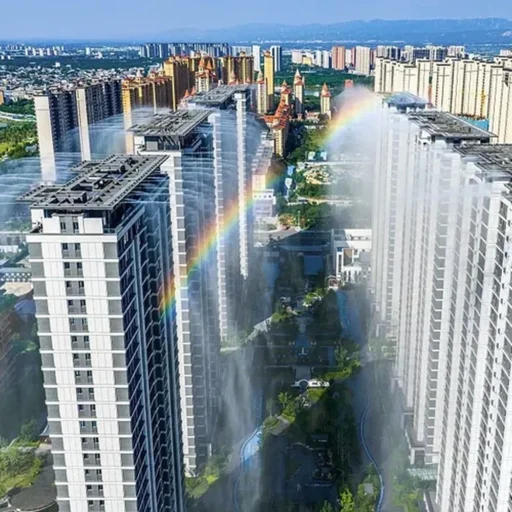
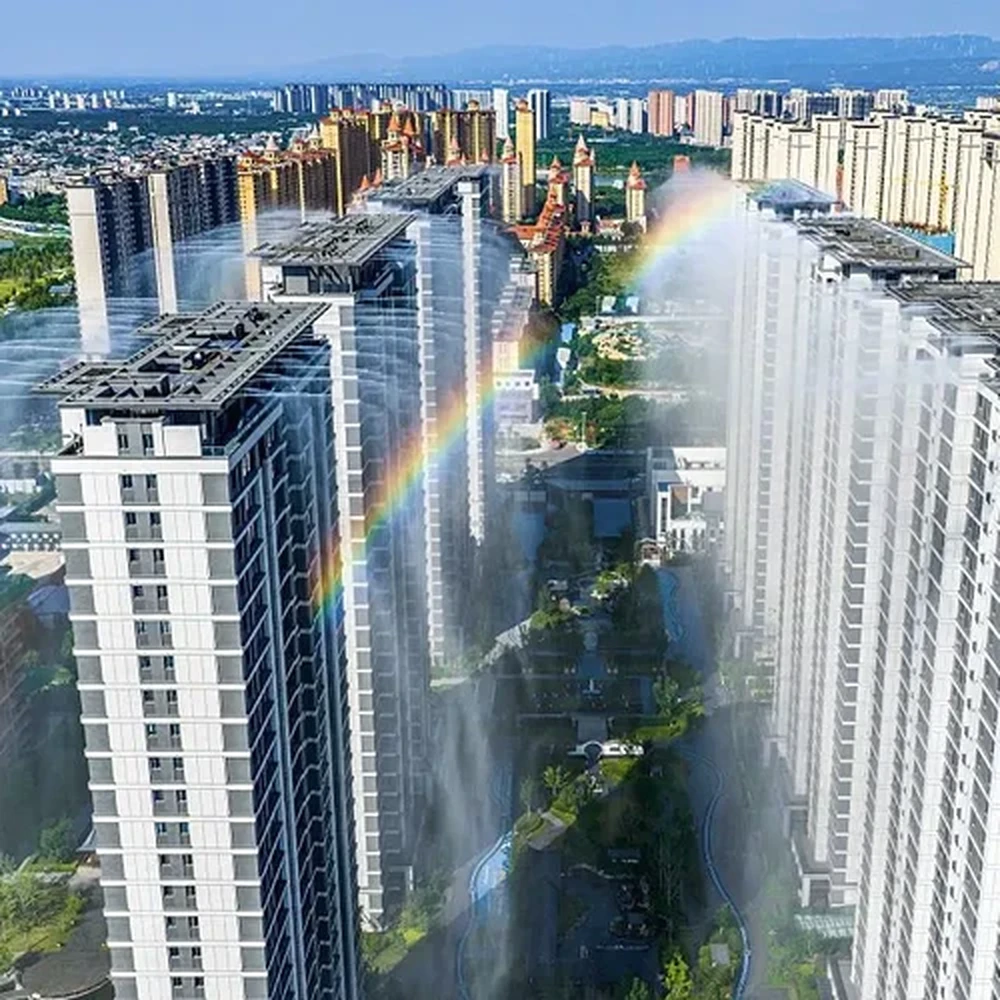

Videos from China showing artificial “rain” falling from apartment rooftops have attracted attention as cities search for practical ways to make extreme summer heat more bearable.
The system does not create real rain or change the weather. It uses rooftop pipes and hundreds of nozzles to release extremely fine water droplets into the surrounding air. As those droplets evaporate, they absorb heat and temporarily lower the temperature near the buildings.
Reports surrounding a residential development in Yuncheng, Shanxi province, claim that the system can reduce local temperatures by approximately 5 to 8 degrees Celsius, equivalent to about 9 to 14 degrees Fahrenheit, after operating in short intervals. However, those specific performance figures have not yet been independently confirmed through publicly available scientific testing.
The underlying cooling method is nevertheless well established. It is called evaporative cooling, and it is the same physical process behind human sweating, traditional desert coolers and the chill felt when leaving a swimming pool on a hot, dry day.
How China’s Rooftop Rain System Works
The viral installation reportedly uses roughly 200 nozzles positioned around the roofs of residential buildings. The nozzles release a fine mist that appears from a distance like light rain falling around the structures.
Rather than running continuously, the system reportedly operates for intervals of around 10 minutes. The goal is to create droplets small enough to evaporate quickly instead of soaking pedestrians, balconies and streets below.
When liquid water becomes water vapor, it needs energy to complete the phase change. It takes that energy from the surrounding air and nearby hot surfaces in the form of heat. The air loses some of its sensible heat, so its measured temperature falls.
This is why a wet surface feels cool as it dries. The effect does not require a refrigerant compressor like conventional air conditioning. It mainly requires water pressure, pumps, pipes and properly designed misting nozzles.
The system therefore resembles large-scale outdoor misting installations used at restaurants, amusement parks, industrial sites and transit areas. China’s rooftop version differs mainly in its placement and coverage: distributing the mist from above allows gravity and air movement to carry it across the spaces between buildings.
Why Tiny Droplets Cool Better Than Heavy Rain
Droplet size plays a major role in the system’s effectiveness.
Large drops contain more water but have less surface area relative to their volume. They are more likely to fall quickly and reach the ground before fully evaporating.
A fine mist divides the same quantity of water into thousands of tiny droplets. This creates a much larger combined surface area exposed to warm air, accelerating evaporation.
If the droplets are sufficiently small and the air is hot and dry enough, much of the mist can become vapor before reaching people or surfaces below. That allows the system to cool the air without creating standing water comparable to actual rainfall.
Wind speed also matters. A light breeze can distribute cooled air and mist across a wider space. Strong wind may blow the droplets away from the intended area before they provide much benefit.
Nozzle height, spacing, water pressure and operating time must therefore be adjusted to local conditions. Simply spraying ordinary water from the roof would not necessarily produce the same result.
Can It Really Lower Temperatures by 14 Degrees Fahrenheit?
A reduction of up to 14 degrees Fahrenheit is physically possible under favorable evaporative-cooling conditions, but the viral claim needs context.
Reports generally describe a local or surface-level temperature reduction of approximately 5 to 8 degrees Celsius. They do not establish that an entire neighborhood’s official air temperature remains 14 degrees cooler for long periods.
Temperature readings can differ substantially depending on where and how they are measured. A sensor directly beneath an active misting nozzle may record a larger drop than a weather station positioned in an open, shaded and properly ventilated location.
The system may also cool hot building surfaces, balconies, walkways and the immediate air around residents without meaningfully changing temperatures several streets away.
BGR noted that independent sources had not confirmed the reported 9-to-14-degree reduction. The fairest interpretation is therefore that the system may create a substantial short-term cooling effect in the treated area, while the exact maximum remains a reported claim rather than a verified universal result.
Laboratory research supports the broader principle that watering roofs can reduce roof temperatures and alter the surrounding microclimate during heatwave conditions. A 2025 study investigated roof watering under controlled temperature, humidity and simulated solar exposure, measuring changes in temperature, heat flow and surface energy balance.
The System Works Best in Hot, Dry Air
Humidity determines how much additional water the air can absorb.
Dry air has considerable capacity to accept water vapor, allowing mist droplets to evaporate quickly and remove more heat. When relative humidity is already high, evaporation slows because the air contains more moisture.
That means rooftop rain should generally perform better in a hot, relatively dry inland climate than in a humid coastal city.
Scientific comparisons of passive cooling methods have similarly found that evaporative cooling is particularly effective in high-temperature, low-humidity conditions. Its performance becomes less dependable as humidity rises.
In very humid weather, some droplets may remain liquid and settle on windows, walls, balconies and pavements. The system could still provide some cooling, but the temperature reduction may be smaller and the risk of unwanted wetness greater.
This limitation prevents rooftop misting from becoming a universal substitute for indoor air conditioning. It is best understood as a localized outdoor heat-management tool.
Why Cities Are Interested in Rooftop Cooling
Dense cities frequently experience the urban heat-island effect. Concrete, asphalt, glass and dark roofing materials absorb solar energy during the day and release it slowly after sunset.
Tall buildings can also restrict airflow, while vehicles, cooling systems and industrial activity add waste heat to the environment. As a result, densely built neighborhoods may remain noticeably hotter than surrounding rural areas.
A rooftop mist system attacks the problem close to one of its sources. It can cool sun-heated roof surfaces while also lowering the temperature of the air moving between buildings.
Placing the nozzles at roof level may offer another advantage: the equipment occupies space that would otherwise remain unused. It does not require large machines on crowded sidewalks or major reconstruction of streets.
The system can also operate only during the hottest periods, reducing unnecessary water and electricity use when conditions are milder.
Rooftop Rain Still Uses Water and Energy
Although evaporative cooling can consume less electricity than compressor-based air conditioning, it is not resource-free.
Pumps must pressurize and distribute the water. Filters and nozzles require maintenance, particularly where water contains minerals that can cause scaling or block small openings.
The water demand may also become significant if a large system operates repeatedly across multiple buildings. This creates an important trade-off in places that experience both extreme heat and water scarcity.
Designers must calculate whether the cooling benefit justifies the amount of water consumed. Recycled rainwater, treated greywater or captured condensate could potentially reduce dependence on drinking-water supplies, provided the water is sufficiently clean and the system meets health regulations.
Poorly maintained systems could create sanitation concerns. Water that sits inside warm pipes or storage tanks may support microbial growth. Fine mist can then distribute contaminated droplets into occupied areas.
Safe operation therefore requires proper drainage, filtration, regular flushing and water-quality management rather than simply connecting rooftop nozzles to any available tank.
It Cannot Replace Indoor Air Conditioning
The viral clips have led some observers to describe the technology as an “outdoor air conditioner,” but that label is somewhat misleading.
A traditional air conditioner removes heat from an enclosed indoor space and usually reduces humidity at the same time. Rooftop misting cools open air temporarily while adding moisture.
Because outdoor air continually mixes and moves, the cooling effect fades after the system stops. Sunlight, hot surfaces and warmer surrounding air begin reheating the treated area.
The mist also cannot maintain a precise indoor temperature or protect vulnerable residents during a severe heat emergency in the same way as a properly cooled building.
Its strongest use may be improving comfort in courtyards, walkways, playgrounds and spaces between apartment towers. Even a modest local reduction can make outdoor areas easier to use during periods when exposed concrete becomes intensely hot.
Other Heat-Reduction Methods May Work Alongside It
Rooftop rain does not need to function alone.
Cities can combine misting with shade structures, trees, reflective roofs, green roofs and improved natural ventilation. Each method addresses heat differently.
Shade prevents solar radiation from reaching people and surfaces. Trees add both shade and evaporative cooling through transpiration. Reflective materials absorb less sunlight, while green roofs protect the underlying structure and release moisture through vegetation.
Rooftop mist may be most valuable as an active system that turns on during the hottest hours, supplementing passive measures that operate continuously.
The best solution depends on local climate, water availability, building design and maintenance capacity. A dry city with abundant reclaimed water may benefit more than a humid location where evaporation is slow.
A Real Cooling Principle Behind a Viral Idea
China’s rooftop rain is visually dramatic, but the science is not mysterious. It uses fine water droplets to absorb heat as they evaporate, creating a cooler microclimate around the buildings.
The reported maximum reduction of 14 degrees Fahrenheit should be treated cautiously until independent measurements confirm where the temperature was recorded, how long the effect lasted and how much water was consumed.
Even so, the system demonstrates how a familiar physical process can be adapted for dense residential developments. It will not eliminate urban heat or replace indoor cooling, but it may offer targeted relief in hot, dry conditions.
As cities face longer and more intense heatwaves, practical solutions may involve a combination of advanced materials, better urban design and simple processes that nature has used all along.