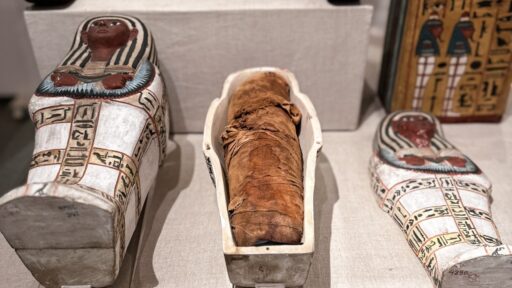
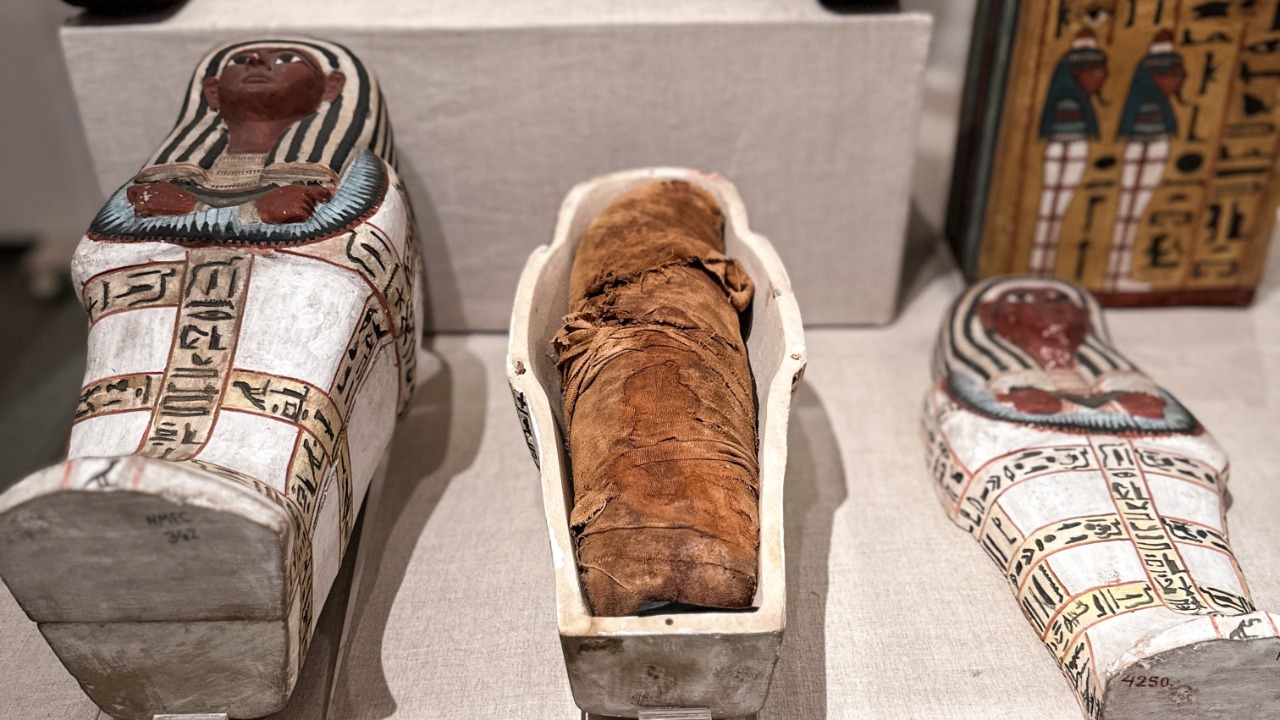

Egyptian archaeologists have uncovered a Roman-era burial site where several mummies were interred with thin gold foil in place of their tongues, a startling detail that blends local funerary tradition with imperial influence. The discovery adds a new chapter to how ancient communities along the Nile imagined the journey after death and the power of speech in the next world.
Golden tongue amulets have appeared in earlier digs, but the clustering of such burials in a single tomb highlights how a once rare ritual could become a localized fashion in a multicultural province of the Roman Empire.
New details from a Roman-era tomb in Egypt
The newly reported tomb belongs to a cemetery that dates to the Roman occupation of Egypt, when Greek, Roman, and Egyptian customs overlapped in daily life and in death. Archaeologists describe a rock-cut complex with multiple burial shafts, where mummified individuals were wrapped in linen and placed in simple coffins or directly in niches carved into the walls.
Within these burials, several skulls show a striking modification: instead of a preserved tongue, a thin sheet of gold foil had been carefully positioned in the mouth. In some cases the foil follows the approximate shape of a human tongue, while in others it is a more abstract strip of metal. The sheets are extremely thin, closer to leaf than to solid jewelry, which suggests they were meant as symbolic offerings rather than displays of wealth.
The same cemetery includes more conventional grave goods such as terracotta figurines, glass and ceramic vessels, and amulets that echo older Pharaonic motifs. One burial, for example, combines a Roman-style coffin with iconography more typical of Ptolemaic Egypt, illustrating how families mixed traditions as they navigated a changing political order.
Comparable finds from other sites show that experimentation in burial practice was common in this era. At another Egyptian site, researchers identified a mummy whose abdomen had been packed with shells and plant material that appear to reference episodes from the Iliad, a reminder that Greek literary culture circulated widely in the eastern Mediterranean, as described in the study of the so-called Iliad mummy.
How golden tongues change the story of Egyptian mummification
Egyptian embalmers had long focused on preserving the body so the soul could recognize and reinhabit it. Traditional procedures removed the brain and internal organs, dried the corpse with natron, then wrapped it in linen. By the Roman period, however, the quality of mummification varied dramatically, and many bodies were treated in a more cursory way. The golden tongues stand out because they represent added effort and expense at a time when some other aspects of preservation were being simplified.
Earlier golden tongue finds were usually isolated curiosities. A single mummy from Taposiris Magna, another from a separate Roman-era necropolis, and a few scattered cases elsewhere suggested that the practice existed but did not reveal how widespread it was. The new cluster of burials indicates that in at least one community, placing gold foil in the mouth was a recognized and perhaps fashionable rite, not just an eccentric choice by a single family.
For Egyptologists, this has two implications. It shows, first, that families were willing to invest in targeted ritual enhancements even when they cut corners on other parts of the process, such as resin application or fine linen wrapping. It also expands the catalog of known mouth treatments. Earlier periods favored organic substances, small amulets, or ritual tools used during the Opening of the Mouth ceremony. Here, the tongue itself is replaced or augmented by a precious metal, which suggests a more permanent, visually striking solution to the problem of speech in the afterlife.
The find also pushes scholars to refine how they date and classify late mummification styles. Gold tongue burials can now serve as chronological markers for a specific phase of Roman influence in Egypt, especially when combined with associated pottery and coinage from the same tomb complex.
Religious meaning behind a tongue of gold
The most immediate interpretation of the golden tongues is religious. In traditional Egyptian belief, the dead person needed to speak to deities, recite spells, and defend their moral record in the Hall of Judgment. Texts like the Book of the Dead describe the deceased declaring innocence of specific sins before Osiris and a panel of divine assessors. A tongue that never decays, made of a metal associated with the flesh of the gods, would be a powerful guarantee that speech remained possible.
Gold carried layered symbolism in Egyptian thought. It was linked to the sun, to the bodies of the gods, and to permanence. By giving the dead a tongue of gold, families may have hoped to align their loved ones with divine qualities of truth and endurance. The practice also resonates with Greek and Roman ideas about eloquence and the moral weight of speech, which would have been familiar in a cosmopolitan province where Greek was widely spoken and Roman law shaped public life.
Some scholars suggest that the golden tongues might echo the Opening of the Mouth ritual, during which priests touched the lips and other senses of the mummy or statue to restore its faculties. In this case, the ritual is materialized inside the body itself. Instead of a temporary ceremonial gesture, the capacity to speak is built into the corpse as a permanent artifact.
There is also a social dimension. Gold foil, while thin, still required resources. Choosing this treatment would signal that a family had access to metalworkers and could afford a small but symbolically potent luxury. In communities where status was negotiated through both Roman and Egyptian lenses, such a choice might have served as a hybrid marker of piety and prestige.
Why the discovery resonates with the present
The golden tongue mummies arrive at a moment when Egypt is investing heavily in heritage as a driver of tourism and national identity. High profile discoveries, from massive coffins at Saqqara to painted tombs in Luxor, have been publicized as evidence that the country still holds vast archaeological potential. A visually arresting find such as a mouth lined with gold is likely to capture public imagination and feed that narrative.
For researchers, the tomb offers a rare snapshot of cultural blending under empire. Roman rule in Egypt is often described in administrative terms, but burial customs show how ordinary people lived that experience. The combination of Greek literary references, Roman-style objects, and deeply Egyptian religious ideas in sites across the country reveals a society that was not simply colonized but engaged in constant negotiation over identity and belief.
The find also intersects with debates about the ethics of displaying human remains. Mummies with unusual modifications tend to draw crowds in museums and online, yet they were once individuals whose bodies were prepared for a sacred journey. Curators now face pressure to balance scientific interest and public curiosity with respect for the dead, especially when remains carry dramatic features such as gilded tongues or experimental embalming techniques.
At the same time, advances in noninvasive imaging and biomolecular analysis mean that each new burial ground is a potential archive of information about health, diet, and mobility in the ancient world. If permission is granted, the golden tongue mummies could yield data on disease patterns, ancestry, and even the metals used in local workshops, all without disturbing the gold foil that makes them distinctive.
Future research and unanswered questions
The discovery raises as many questions as it answers. One immediate task is to determine whether all the golden tongue individuals share demographic traits. If they cluster by age, sex, or social status, that pattern could point to a targeted ritual for specific categories of people, such as priests, children, or members of a particular association.