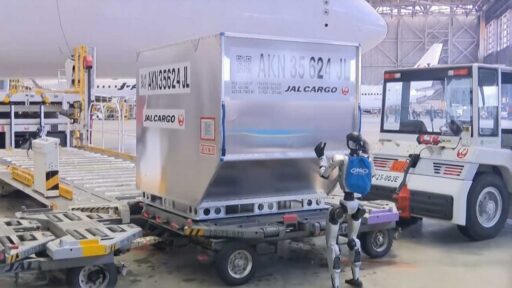
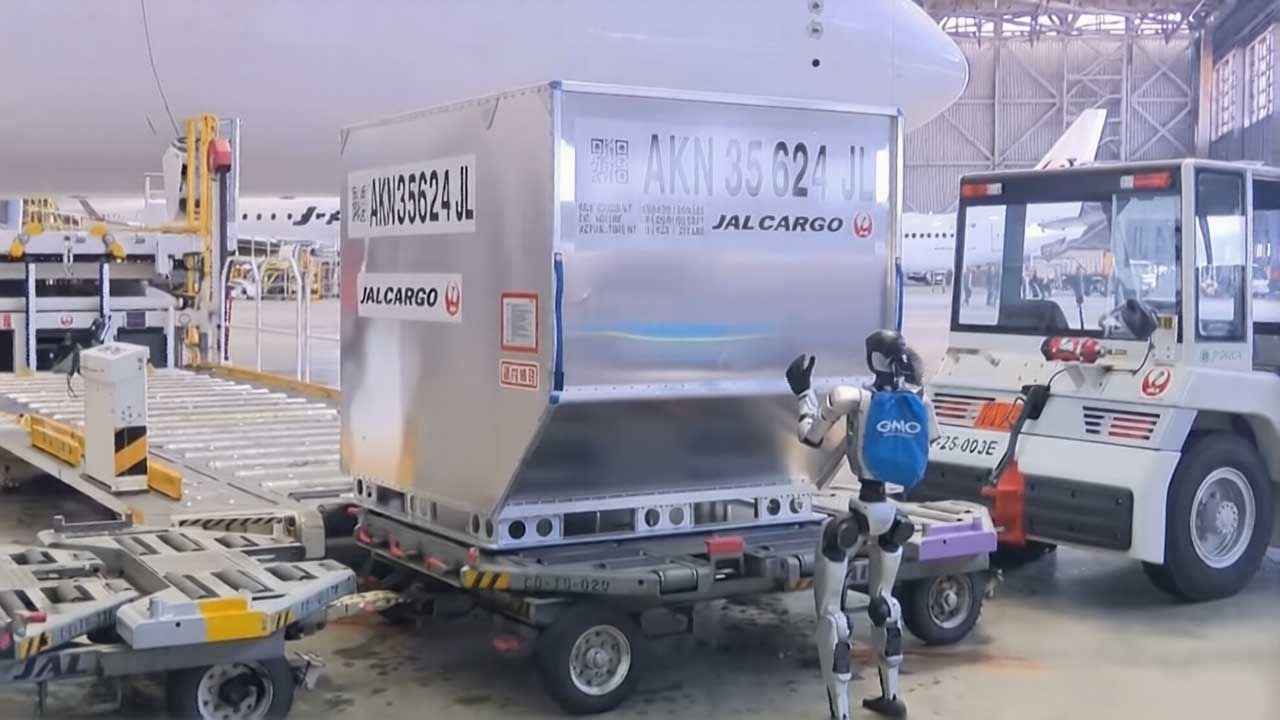

Japan Airlines has begun using humanoid robots alongside ground staff at Tokyo’s Haneda Airport, turning a long-discussed vision of automated baggage handling into a live trial. The project pairs human workers with machines that look and move more like people than traditional industrial robots, testing whether they can safely take over some of the heaviest and least popular tasks on the ramp.
The trial remains limited in scope, but it signals how one of the world’s most technologically advanced aviation markets is trying to keep flights running on time despite an aging workforce and intense competition for labor.
How Japan Airlines is changing day-to-day work at Haneda
Japan Airlines has deployed a set of humanoid robots at Haneda that can lift and move passenger suitcases, work around aircraft on the apron, and interact with the same carts and conveyor belts used by human crews. The machines are being tested as baggage handlers and ground support, rather than as customer-facing concierges, which makes this experiment different from previous airport robots that mostly offered directions or entertainment. According to reporting on the trial, the carrier is using robots designed to operate in tight, human-scale spaces and to handle tasks like loading and unloading bags from airport trolleys near the aircraft stands.
The robots are being introduced in phases, with Japan Airlines initially assigning them to specific gates and time windows where operations can be closely monitored. Coverage of the project describes how the machines are set up to work in teams with existing staff, who oversee safety and step in if anything goes wrong. The goal is not to run a fully automated ramp, but to see which repetitive jobs can be reliably handled by machines while humans focus on supervision and exceptions. One report notes that the robots are part of a broader experiment in which Haneda is becoming a testbed for advanced airport automation, including autonomous vehicles and smarter baggage systems.
The appearance of the robots is also deliberate. Rather than faceless boxes, they are built with arms, legs and a torso that can navigate stairs, uneven ground and the confined spaces around aircraft doors. A detailed account of the project explains that the humanoid form is meant to let them use existing tools and infrastructure without expensive redesigns. Instead of building new conveyor systems or special cages, Japan Airlines wants machines that can walk up to a standard baggage cart, pick up a suitcase and place it on a belt, much as a human handler would.
Passengers are not yet seeing robots everywhere at Haneda, but they are visible around some domestic operations, where they work within marked safety zones and under constant human oversight. A report on the early days of the trial notes that the airline is collecting data on how quickly the robots work, how often they need help, and how they cope with weather, cluttered aprons and irregular luggage shapes.
Why humanoid ground crews matter for Japan and its airlines
The push to put humanoid machines on the ramp is driven first by demographics. Japan Airlines has been explicit that it is facing a labor shortage in ground operations as the country’s population ages and younger workers gravitate toward less physically demanding jobs. One analysis of the project links the Haneda trial to a wider concern that airlines and airports across Japan may struggle to fill roles that involve heavy lifting, night shifts and outdoor work in all weather. By testing robots that can shoulder some of the physical burden, the carrier hopes to keep flights moving without overloading a shrinking pool of staff.
Safety and ergonomics are another major factor. Baggage handling is one of the most injury-prone jobs in aviation, with back strains and joint damage common among workers who repeatedly lift and twist with heavy suitcases. Coverage of the Haneda trial explains that Japan Airlines wants robots to take on the most strenuous motions, such as lifting bags from ground level to conveyor height, which could reduce injuries and sick leave among human crews. In this model, people would manage exceptions, operate equipment and oversee operations, while robots do the heaviest lifting.
There is also a competitive angle. Airports in Asia and the Middle East are racing to introduce automation that cuts turnaround times and keeps planes on schedule. Reports on the Haneda project suggest that Japan Airlines sees humanoid robots as a way to maintain punctuality and reliability even when staffing is tight. Faster, more consistent baggage handling can reduce delays that ripple through the network, especially at a busy hub like Haneda where domestic and international banks of flights are tightly timed.
The technology partners behind the robots see the airport as a proving ground for humanoid machines in real industrial settings. One detailed technical report describes how the robots, developed with Unitree, are built to handle outdoor conditions, uneven pavement and the cluttered environment around aircraft. The same account notes that the machines are designed to operate with a mix of onboard autonomy and remote supervision, which could allow a small team of specialists to manage multiple robots across several stands. That model could appeal to other airports that face similar labor and efficiency pressures.
Public reaction is another factor that Japan Airlines has to manage. Some passengers may be uneasy about machines handling their luggage, while others may welcome the novelty and the promise of fewer lost bags. Coverage of the trial indicates that the airline is framing the robots as helpers for staff rather than replacements, and is emphasizing benefits like safety and reliability. The presence of human supervisors on the apron is part of that message, reassuring travelers and regulators that people remain in charge.
Where Japan Airlines’ robot experiment could go next
Japan Airlines has described the Haneda deployment as a trial, not a finished product, and several reports outline potential next steps if the experiment is judged a success. One likely move would be to expand the number of robots at Haneda and assign them to more gates and time periods, gradually increasing their share of baggage handling tasks. Analysis of the project suggests that the airline is measuring key performance indicators such as bags handled per hour, error rates and downtime, which will shape decisions on scaling up.
Another possible direction is to extend humanoid robots to other airports in the Japan Airlines network. Some coverage points out that the carrier is already considering future use at other Tokyo airports and regional hubs, especially where local labor markets are tight. If the machines can prove themselves in the complex environment of Haneda, with its mix of domestic and international operations, they may be even more attractive at smaller airports with fewer resources.
The scope of tasks could also broaden. Reports on the technology behind the robots mention potential roles beyond baggage, including cleaning aircraft cabins, moving cargo containers and assisting with maintenance logistics. For example, one account notes that the same humanoid platforms could be adapted to push cleaning carts down jet bridges or carry equipment to and from maintenance bays. Japan Airlines is likely to start with the most repetitive and physically demanding jobs, then explore whether robots can safely handle more varied work without slowing operations.
Regulation and labor relations will shape how far and how fast the airline can go. While there is no suggestion in current reporting of immediate job cuts tied directly to the Haneda trial, unions and regulators will watch closely for any sign that automation is being used primarily to reduce headcount rather than to address shortages and safety. Future agreements may set limits on robot deployment or require retraining programs for staff whose roles change as machines take on more tasks.