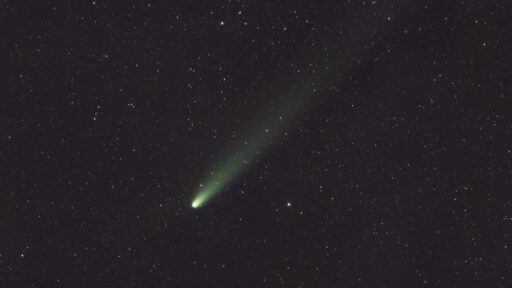
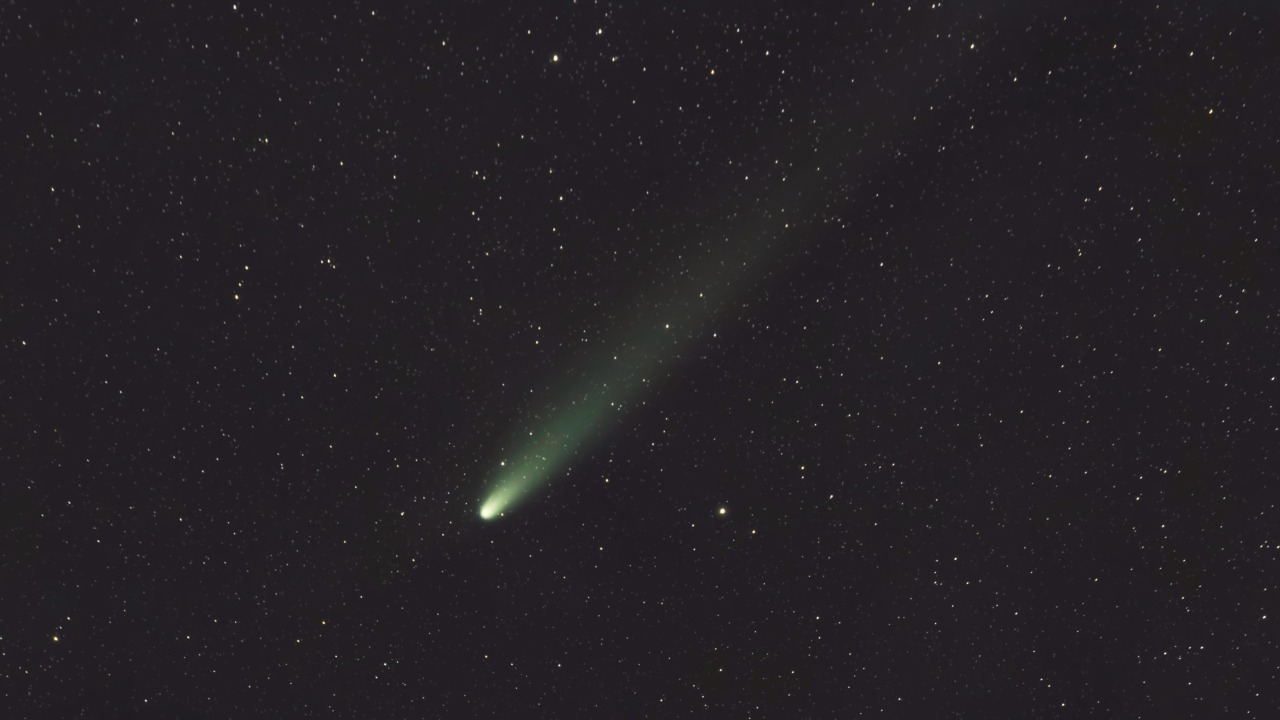

The James Webb Space Telescope has picked up a strong methane signal from interstellar comet 3I/ATLAS, revealing a chemical recipe unlike that of any comet yet studied in the solar system. The object appears to be at least 10 billion years old and carries an unusual mix of methane, carbon dioxide, and other ices that point to a very different birthplace around another star.
The detection turns a once-faint visitor into a rare probe of how planets and comets form in distant systems, hinting that the building blocks of worlds can vary far more than local examples suggested.
New Webb data show methane-rich ice and an alien chemical mix
Interstellar comet 3I/ATLAS was discovered as it sped through the outer solar system on a hyperbolic path that proves it is not gravitationally bound to the Sun. Using its Mid-Infrared Instrument and Near-Infrared Spectrograph, Webb captured the comet’s spectrum and identified a prominent methane signature, along with carbon dioxide and water vapor, in the gas streaming off the nucleus. The Webb observations show that methane is unusually abundant compared with other detected volatiles.
Researchers report that the methane appears to originate from deep inside the nucleus rather than from a thin surface layer. Gas production rates change as sunlight warms the comet, suggesting that buried methane-rich ices are being exposed and sublimated. According to the spectral analysis, the relative strengths of methane and carbon dioxide bands do not match the patterns cataloged for solar system comets, even after accounting for differences in activity and distance.
Webb’s sensitivity also allowed astronomers to constrain the presence of other molecules, including carbon monoxide and more complex organics. Some of these species are present, but their ratios to methane and carbon dioxide again fall outside the usual solar system range. A separate team that modeled the outgassing rates concluded that the nucleus must contain large reservoirs of methane-rich ice, which is unexpected for an object that has spent billions of years in interstellar space where cosmic rays gradually erode volatile molecules.
Earlier observations from the Neil Gehrels Swift Observatory had already shown that 3I/ATLAS was releasing water, confirming that it is an icy body and not a rocky fragment. Webb’s detection of methane and carbon dioxide builds on that picture by revealing the deeper layers of the nucleus and their unusual chemistry. Taken together, the datasets indicate that the comet’s interior has remained cold and relatively well preserved since it was ejected from its home system.
How 3I/ATLAS breaks the mold of solar system comets
Comets inside the solar system typically show certain patterns in their volatile content. Methane is present but usually at modest levels relative to water and carbon monoxide, and carbon dioxide tends to track with other carbon-bearing ices. In 3I/ATLAS, Webb found that methane is far more prominent than expected while carbon dioxide is also abundant, yet carbon monoxide appears comparatively weak. That combination, highlighted in the Webb methane study, does not resemble the typical comet families linked to the Kuiper Belt or Oort Cloud.
Laboratory experiments and disk chemistry models suggest that such a volatile mix would require formation in a region that stayed extremely cold but also had specific radiation and grain-growth conditions. The strange chemistry described in the detailed analysis implies that the comet’s natal disk may have had a different temperature gradient, dust composition, or ultraviolet environment than the one that produced Jupiter-family and Oort Cloud comets.
Age estimates add another layer of context. Based on its trajectory through the galaxy and models of stellar cluster dispersal, astronomers infer that 3I/ATLAS is at least 10 billion years old, meaning it formed when the Milky Way was much younger and less enriched in heavy elements. That conclusion comes from dynamical modeling summarized in the age and origin, which argues that the comet likely came from a low-mass star that has long since moved far from the Sun.
If that age is correct, 3I/ATLAS predates the Sun by several billion years, so its chemistry captures an earlier chapter of planetary formation history. The methane-rich composition suggests that even in that ancient era, some protoplanetary disks could efficiently trap and preserve volatile carbon in ices. This runs against a simple picture in which early disks were uniformly poor in such molecules and hints at significant diversity in how the first generations of planets and comets formed.
Comparisons with the only other well studied interstellar comet, 2I/Borisov, reinforce the message that these visitors are not interchangeable. Borisov looked chemically similar to carbon-rich solar system comets, while 3I/ATLAS appears skewed toward methane and carbon dioxide with a different pattern of minor species. Together, they suggest that interstellar comets sample a broad range of disk environments rather than converging on a single typical composition.
Why a methane-heavy interstellar comet matters for planetary science
The methane detection on 3I/ATLAS is more than a curiosity about an exotic visitor. It provides a rare test of theories about how volatiles freeze out and migrate in disks around other stars. Models of planet formation often assume that the chemistry of the early solar system is a reasonable template for other systems. The findings presented in the Webb spectroscopy results challenge that assumption by showing that at least one ancient disk produced a comet with a very different ice inventory.
Those results have direct implications for the atmospheres and surface conditions of planets that might form in such systems. If methane-rich ices are common in some disks, then young planets there could accrete envelopes with higher methane content, affecting greenhouse warming, photochemistry, and the appearance of potential biosignatures. For example, astronomers interpreting methane detections in exoplanet atmospheres may need to consider whether the gas comes from primordial ices like those in 3I/ATLAS or from biological or geological activity.
The comet also offers a benchmark for how well ices can survive in interstellar space. Over billions of years, cosmic rays and ultraviolet photons gradually break apart molecules in exposed ices. The strong methane signal suggests that at least part of the nucleus has remained shielded, perhaps under a protective crust of processed material. That survival story matters for theories that link interstellar comets and asteroids to the delivery of organic molecules to young planetary systems.
From an observational perspective, 3I/ATLAS shows the value of catching interstellar visitors early and pointing powerful infrared telescopes at them. Webb’s instruments were able to separate overlapping spectral lines and identify individual molecules that would have been invisible to previous facilities. The ESA-led campaign coordinated timing between instruments to track how the comet’s activity evolved, helping distinguish surface processes from deeper outgassing.
The result is a more complete chemical inventory than was possible for earlier interstellar objects. That inventory feeds directly into models of disk evolution and helps calibrate how astronomers read the spectra of distant protoplanetary disks that Webb observes around young stars.
Next steps for decoding 3I/ATLAS and future interstellar visitors
3I/ATLAS is already receding from the inner solar system, and no spacecraft is in position to chase it. The next phase of study will rely on continued remote monitoring while the comet remains bright enough for spectroscopy. Teams are planning follow up observations with ground based infrared telescopes to refine the methane, carbon dioxide, and water production rates and to search for additional organics that might still be hidden in Webb’s data.
Researchers are also revisiting models of protoplanetary disks to identify conditions that can produce the volatile ratios seen in 3I/ATLAS. The chemical modeling work points to extremely cold regions beyond the traditional methane snow line, possibly in disks around low mass stars with different radiation fields. Future simulations will test whether such environments can also explain the apparent age and dynamical history inferred from the comet’s trajectory.
Looking ahead, the community is preparing for the discovery of more interstellar comets by wide field surveys. Facilities like the Vera C. Rubin Observatory are expected to spot small, fast moving objects that fit the same hyperbolic profile. Experience with 3I/ATLAS will guide how quickly astronomers mobilize Webb and other observatories to capture spectra before these visitors fade.