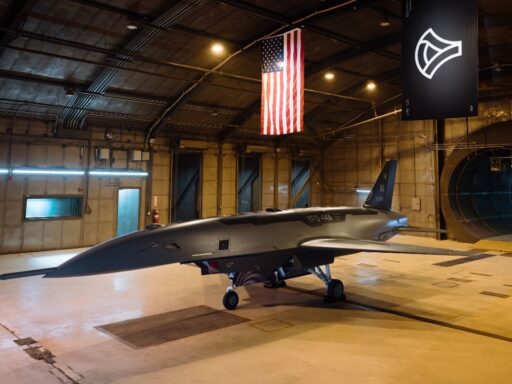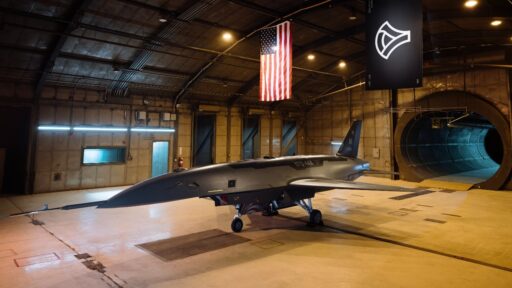
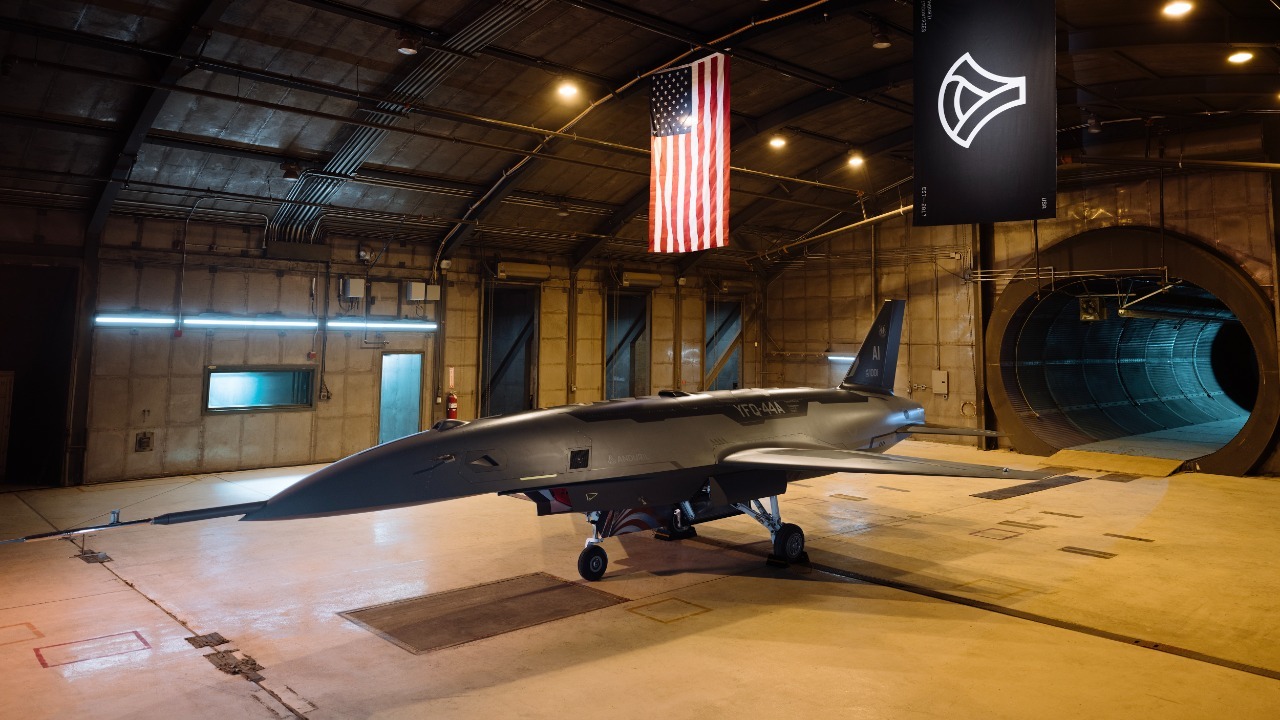

The United States Air Force has taken a concrete step toward pairing human pilots with autonomous combat aircraft, selecting Anduril’s FQ-44 as one of its first production “robot wingmen.” The choice moves the Collaborative Combat Aircraft program from concept to hardware, with a specific jet-sized drone now slated to fly alongside frontline fighters. The decision signals that autonomous systems are no longer experimental side projects but are being woven directly into the future force structure.
How the FQ-44 decision reshapes the Collaborative Combat Aircraft program
The Air Force’s selection of the FQ-44 comes as part of its first production contracts for Collaborative Combat Aircraft, a family of uncrewed jets designed to operate in formation with fighters such as the F-35 and F-22. According to program details, the service has moved from a competitive prototyping phase into production awards that cover both the FQ-42A and the FQ-44A, with contracts structured to deliver operational aircraft rather than just demonstrators. Those initial awards, described in an overview of CCA production contracts, mark a shift from technology exploration to building a fleet.
The FQ-44 is one of two autonomous jet combat drones chosen to fly combat missions alongside human pilots. Reporting on the program describes the aircraft as a high-performance uncrewed jet, sized to keep up with modern fighters and carry meaningful payloads. The Air Force intends to use it as a “loyal wingman,” a term that covers roles ranging from escort and screening to strike and electronic attack. By selecting two designs, the service is hedging its bets, allowing different airframes to specialize in different mission sets while sharing a common autonomy and control architecture.
Technical details from early descriptions of the autonomous jets highlight a focus on modularity and mission flexibility. The FQ-44 is expected to accommodate swappable payloads that can include air-to-air missiles, precision-guided munitions, or advanced sensors, depending on the sortie. The aircraft will rely on secure datalinks to receive tasking from a human pilot or mission commander, but its onboard software is designed to handle navigation, threat avoidance, and basic tactical maneuvers without constant human input. That mix of human direction and machine autonomy is central to the CCA concept.
By structuring the contracts around production, the Air Force is also locking in a path for scaling. The CCA plan anticipates a significant number of uncrewed jets operating alongside a smaller fleet of exquisite crewed fighters. The production awards for the FQ-42A and FQ-44A, which include options for additional aircraft, are the mechanism that will turn that vision into squadrons of deployable systems rather than a handful of prototypes.
Why Anduril’s robot wingman matters for airpower and budgets
The selection of the FQ-44 is not just a technology story; it is a strategic and budgetary move aimed at preserving U.S. air dominance in the face of rising threats. Analysts tracking the program point out that the Air Force is under pressure to field more combat capacity without the cost and complexity of building large numbers of new crewed fighters. The CCA concept, with aircraft like the FQ-44, is intended to provide additional mass in the air at a lower unit price than a fifth- or sixth-generation fighter.
Descriptions of the two chosen autonomous jets emphasize that they are designed to be “attritable,” which in Pentagon language means they are affordable enough to be put in harm’s way with an acceptance that some will be lost. Coverage of the Air Force’s decision to pick two autonomous jet highlights this point, noting that the service wants aircraft it can send into contested airspace ahead of or instead of human pilots. That shift could change how commanders think about risk, allowing them to employ more aggressive tactics against advanced air defenses.
The FQ-44 also matters because it embodies a broader bet on software-centric defense companies. Anduril has built its reputation on rapid iteration and digital-first design, and the FQ-44 program is a test of whether that approach can scale to front-line combat aircraft. Supporters argue that a software-heavy architecture will allow the Air Force to push frequent updates to autonomy algorithms and electronic warfare packages, keeping pace with adversary tactics without waiting for new airframes.
At the same time, critical analysis has questioned whether Anduril’s drones can fully close the capability gap between the United States and a rapidly modernizing Chinese air force. One assessment argues that Anduril drones will that gap on their own, pointing to the scale of China’s investments in fighters, missiles, and integrated air defenses. From that perspective, the FQ-44 is a helpful addition to U.S. airpower, but not a silver bullet. It can add capacity and complicate an adversary’s targeting problem, yet it still depends on a broader ecosystem of tankers, surveillance assets, and crewed fighters.
Operationally, the robot wingman concept could change cockpit workloads and tactics. A single fighter pilot might control several FQ-44s, using them as forward scouts, decoys, or distributed weapons trucks. That arrangement could allow a small number of crewed aircraft to project force over a much wider area. It could also demand new training pipelines, as pilots learn to manage teams of autonomous jets, interpret their sensor feeds, and intervene when the autonomy stack encounters ambiguous situations.
There are also implications for allies and export policy. If the FQ-44 and its sibling CCA platform prove effective, partner air forces might seek similar capabilities to augment their own fighters. The United States would then face decisions about how much autonomy and sensor capability to export, and under what conditions. Those choices will shape coalition airpower in any future conflict, especially in the Indo-Pacific, where geography favors distributed, networked forces.
Next steps for integrating the FQ-44 into front-line squadrons
With production contracts in place, the next phase for the FQ-44 is a rapid march through flight testing, software maturation, and operational evaluation. The Air Force will need to validate that the aircraft can safely operate in close proximity to crewed fighters, handle basic formation flying, and respond predictably to pilot commands. Early test campaigns are likely to focus on simpler missions such as basic escort and sensor extension before moving into complex strike packages and electronic warfare tasks.
Integration with existing platforms will be a major challenge. The FQ-44 must connect with the datalinks and mission systems used by aircraft like the F-35A and F-22A, as well as with command and control networks that span airborne and ground nodes. That means aligning communications standards, encryption, and battle management software so that autonomous jets can plug into the same tactical picture as human pilots. The CCA program envisions a common control interface that can run in a cockpit or on a ground station, which would allow flexibility in how the FQ-44 is tasked and supervised.
Doctrine and rules of engagement will evolve alongside the hardware. Commanders will have to decide which decisions can be delegated to the FQ-44’s onboard autonomy and which must remain in human hands. For example, the aircraft might be allowed to maneuver to avoid a surface-to-air missile without explicit direction, but weapons release could still require positive human authorization. Those boundaries will shape how quickly the robot wingman can react in fast-moving engagements and how comfortable policymakers are with its use in contested environments.
Looking ahead, the Air Force has signaled that the CCA family is expected to grow beyond the initial FQ-42A and FQ-44A. Follow-on increments could introduce variants optimized for long-range sensing, standoff jamming, or even air-to-air dominance in support of crewed fighters. The early production lots will provide data on cost, reliability, and mission effectiveness that will inform those future designs. If the FQ-44 meets expectations on price and performance, it could become the template for a broader shift toward mixed formations of crewed and uncrewed combat aircraft.