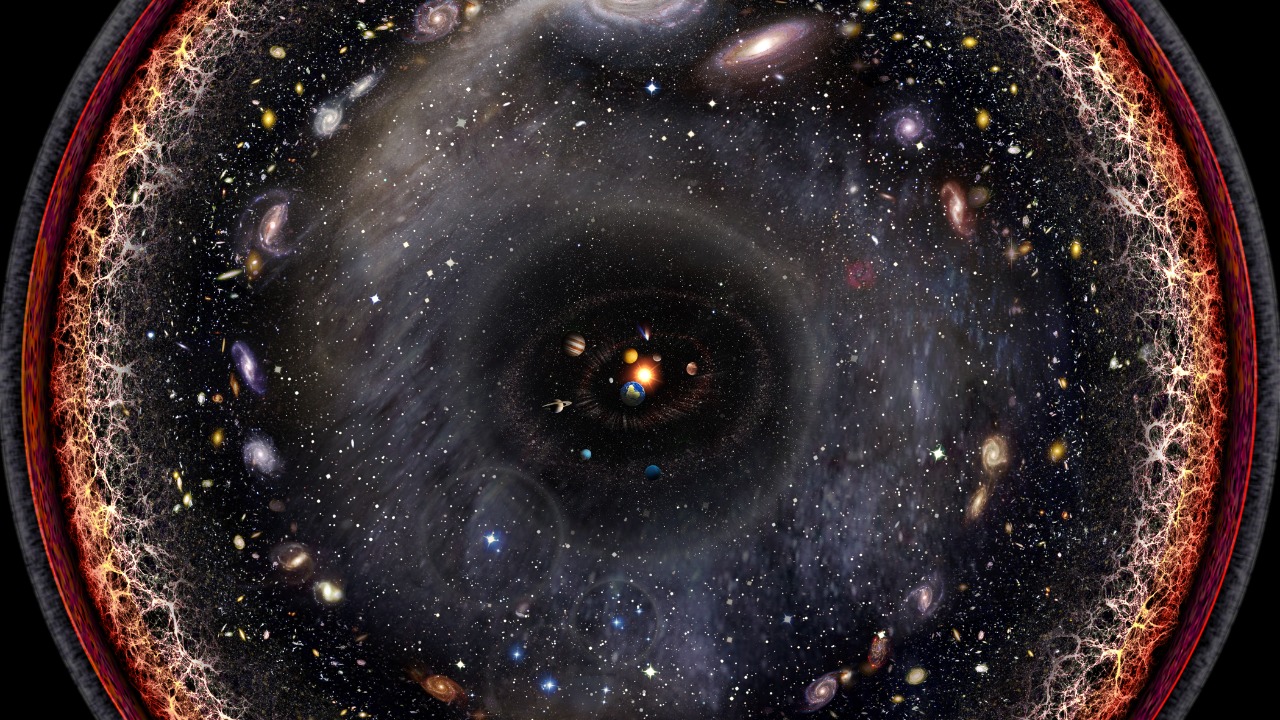

The observable universe is often described as a bubble about 93 billion light-years across, a figure that upends any intuitive sense of distance or scale. That number folds together the finite age of the cosmos, the speed of light, and the fact that space itself has been stretching while light travels. Grasping what that vast span really means, and what it does not, has become central to how scientists and the public think about the universe.
How the 93‑billion‑light‑year figure emerged and keeps evolving
At first glance, the size of the observable universe seems like it should be limited by its age: if the universe is about 13.8 billion years old, light should have had only that long to reach observers on Earth. The key complication is that the fabric of space has been expanding the entire time. Because of that expansion, the most distant galaxies whose light can be seen today are now much farther away than 13.8 billion light-years. Cosmologists calculate that the radius of the observable universe is roughly 46.5 billion light-years, which yields a diameter close to 93 billion light-years once the growth of space is taken into account and described in standard cosmological models.
This calculation depends on precise measurements of the cosmic microwave background, the relic radiation from shortly after the Big Bang, and on how fast the universe has expanded at different epochs. Analyses of that background radiation treat it as a snapshot of the early cosmos and use its subtle temperature variations to infer the overall geometry and expansion history of space. From that, researchers derive the current distance to the most remote regions that can still be observed. Guides that explain how scientists estimate whether the universe is finite or infinite describe how this approach leads to the familiar 93‑billion‑light‑year figure for the part that can be seen from Earth, while leaving open the question of what lies beyond the observable edge, as discussed in whether the universe.
The picture is not static. As telescopes improve, astronomers push observations closer to the cosmic dawn, adding more distant galaxies and quasars to the map. Each discovery tests the underlying model that links redshift, which measures how much light is stretched by expansion, to distance. Articles that walk through the current best estimates of cosmic scale describe how refinements to the Hubble constant, the parameter that sets the expansion rate, can slightly shift the inferred size of the observable region. Over time, this has turned the 93‑billion‑light‑year figure from a rough estimate into a carefully constrained value, grounded in multiple, independent observations and summarized in resources that explain the size of the.
What a 93‑billion‑light‑year cosmos reveals about structure and scale
Knowing the span of the observable universe is only the first step. Within that volume, matter is arranged in a hierarchy of structures, from planets and stars to galaxies, clusters, and superclusters. Visual guides that rank the largest known objects describe features such as enormous galaxy clusters and cosmic filaments that stretch across hundreds of millions of light-years. Lists that compare the largest known things help translate an abstract diameter into a more tangible sense of scale by showing how even the biggest structures occupy only a tiny fraction of the observable volume.
On human scales, even a single light-year is hard to grasp. The nearest star system, Alpha Centauri, is a little more than four light-years away, and the Milky Way galaxy is about 100,000 light-years across. Set against a cosmos that spans tens of billions of light-years, it becomes clear that the galaxy that contains the Sun is only a small component of a much larger web. Narrative tours that carry readers from Earth’s orbit to the farthest known galaxies, such as essays that trace a journey beyond the blue, highlight how quickly familiar landmarks fade into insignificance once the scale moves beyond the local group of galaxies.
These structural maps also feed back into the question of whether the universe as a whole is finite or infinite. Observations of the largest visible patterns, including the distribution of galaxies and the cosmic microwave background, indicate that space is very close to geometrically flat. That result is consistent with a universe that could extend far beyond the observable boundary, potentially without limit. Coverage that explains how scientists test this idea outlines how they search for repeating patterns or matched circles in the microwave background that might indicate a closed or multiply connected cosmos, as described in photo features that ask whether the universe.
Why the observable limit matters for science, technology, and culture
The size of the observable universe is not just a curiosity. It sets the boundary conditions for cosmology and shapes what questions can be answered with data. Any theory about the origin or fate of the cosmos must match the structures and radiation seen within this 93‑billion‑light‑year sphere. If a model predicts patterns that should be visible on scales larger than that, those predictions are effectively untestable, because information from beyond the horizon has not had time to reach Earth. This limitation forces cosmologists to distinguish between ideas that can be confronted with evidence and those that remain speculative.
The observable limit also influences how astronomers design instruments. Telescopes that study the early universe, such as those that focus on high‑redshift galaxies, target light that has traveled for more than 13 billion years and has been stretched into infrared wavelengths. Engineers must account for how expansion affects the signals they are trying to capture. Planning surveys that map large‑scale structure requires balancing depth, which probes farther into the universe, with sky coverage, which samples more of the cosmic web. The known size of the observable region helps set those trade‑offs by defining the total volume that could, in principle, be mapped.
Beyond science, the number reshapes cultural narratives about humanity’s place in the cosmos. When educational resources explain that the part of the universe that can be seen is finite, yet potentially embedded in a much larger or even infinite whole, they challenge older pictures that placed Earth at the center of a small, closed system. Articles that walk through whether the universe might extend forever, such as analyses that ask space goes on, often frame the observable limit as a horizon of knowledge rather than a hard physical edge. That distinction influences how the public interprets discoveries about exoplanets, dark matter, and dark energy, all of which are studied within the observable volume but may reflect properties of a much larger reality.
Future measurements and the expanding horizon of what can be seen
Although the observable universe already spans roughly 93 billion light-years, that boundary is not fixed. As time passes, light from more distant regions has a chance to arrive, so the radius of the observable sphere grows. At the same time, cosmic expansion continues to carry faraway galaxies outward. Some will eventually cross a threshold where their light can no longer reach Earth, even in principle. Articles that examine how large the universe might become discuss this competition between the growth of the horizon and the acceleration driven by dark energy, and explain how the observable region will change over trillions of years, as outlined in discussions of how big the.
In the nearer term, new observatories will refine estimates of cosmic size and structure. Space‑based infrared telescopes and ground‑based survey projects are already extending the catalog of known galaxies to higher redshifts, which correspond to earlier cosmic times. Each new detection at the edge of visibility provides another test of models that link distance, redshift, and expansion history. Explanations of how large the observable universe is, such as guides that walk through how big the, emphasize that these measurements are part of an ongoing effort rather than a finished map.