
Building a power plant is difficult enough when engineers have roads, stable ground, predictable weather, and easy access to equipment.
But what happens when the energy resource exists precisely because the landscape is difficult?
Hydroelectric dams need enormous rivers and steep terrain. Offshore wind farms need exposed seas. Solar projects seek some of the hottest and driest land available. Once engineers arrive, the very conditions that make those locations valuable can turn construction into an extraordinary logistical challenge.
Some projects therefore become impressive for more than the amount of electricity they generate. They demonstrate how engineering teams can redesign construction methods around mountains, deserts, deep water, unstable seabeds, extreme temperatures, and distances that make an ordinary repair job a major operation.
From diverting the Colorado River through tunnels to assembling wind turbines miles offshore, these five energy giants show what happens when engineers cannot change the landscape and instead have to design around it.
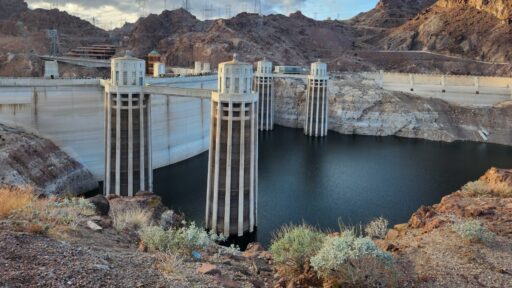
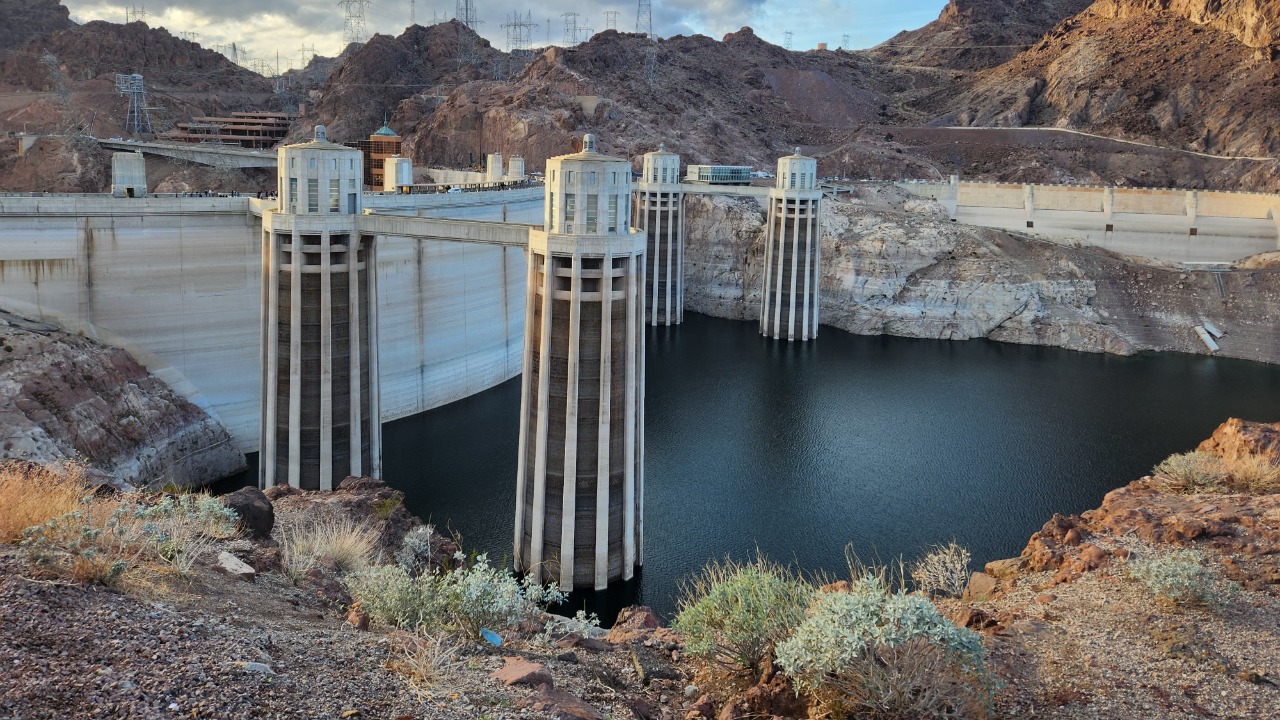
Hoover Dam Had to Move a River Before It Could Control One
Hoover Dam looks so permanent today that it is easy to forget what engineers had to do before its concrete structure could even begin rising.
The dam occupies Black Canyon on the Colorado River between Nevada and Arizona. The narrow canyon provided exactly what designers wanted because its rock walls could help support an enormous arch-gravity structure.
But there was one obvious problem.
The Colorado River was still flowing through the construction site.
Engineers could not simply build a massive concrete dam underwater. They first had to temporarily move the river.
Workers excavated four enormous diversion tunnels through the canyon walls, two on each side. The Bureau of Reclamation says the tunnels had a combined length of nearly 16,000 feet, or more than three miles. Once lined, each tunnel was about 50 feet in diameter.
The conditions were brutal. During tunnel construction, temperatures inside the workings reportedly reached around 140 degrees Fahrenheit. Early access was so difficult that workers and equipment initially had to enter parts of the canyon by boat.
Anyone interested in how that extraordinary construction was accomplished can explore the Bureau of Reclamation’s history of Hoover Dam.
Even pouring the dam required unusual thinking. Engineers could not pour the entire structure as one gigantic block because the enormous mass of concrete would have generated and retained too much heat while curing. Instead, the dam was assembled from hundreds of interlocking concrete blocks that could be cooled before being joined together.
The canyon was both the project’s greatest advantage and its greatest obstacle.
Ivanpah Turned the Mojave Desert Into a Giant Optical Machine
A desert seems like an obvious place for solar power.
There is abundant sunlight, huge areas of open land, and relatively little cloud cover. But does that mean constructing an enormous solar facility there is easy?
Ivanpah Solar Electric Generating System demonstrated why the answer is no.
Located in California’s Mojave Desert, Ivanpah uses concentrating solar power rather than conventional photovoltaic panels. Thousands of software-controlled heliostats follow the sun and reflect its energy toward boilers mounted on three towers.
The U.S. Department of Energy lists the original project at 392 megawatts and says its towers stand approximately 450 feet high. Concentrated sunlight creates steam that drives conventional turbines.
The entire landscape effectively became part of an enormous optical system.
Each mirror needed an effective view of a receiver. Roads, equipment, electrical systems, and maintenance operations all had to function under desert conditions where heat and dust are permanent concerns.
The project also had to coexist with sensitive desert habitat, adding an environmental dimension to the engineering problem.
The California Energy Commission currently lists the facility as operational and describes it as three concentrating solar thermal plants at the base of Clark Mountain.
Ivanpah has also experienced a complicated economic story. PG&E previously sought to end power purchases beginning in 2026, but California regulators rejected the proposed contract termination in December 2025.
The plant remains a fascinating example of how engineers tried to convert one of America’s harshest environments into a giant solar power machine. Technical details remain available through the U.S. Department of Energy’s Ivanpah project profile.
London Array Took Construction Away From Roads Entirely
On land, a broken piece of equipment might be reached by truck.
What happens when that equipment stands kilometers offshore?
That is the fundamental engineering challenge behind the London Array.
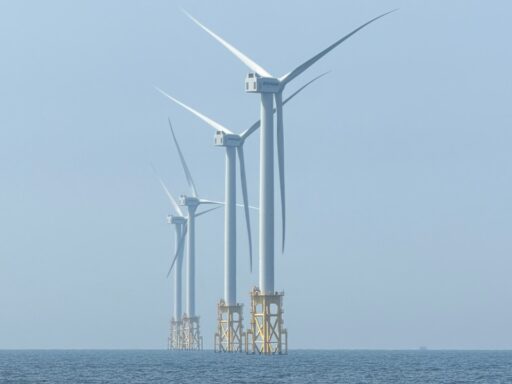
The 630-megawatt offshore wind farm sits roughly 20 kilometers from England’s Kent and Essex coasts in the Thames Estuary. NASA documented 175 turbines spread across approximately 100 square kilometers of water. Each turbine connects through cables buried beneath the seabed, with electricity routed through offshore substations before reaching land.
Suddenly, construction logistics that seem routine onshore become complicated.
There is no road to a turbine foundation.
Workers travel by vessel. Heavy components require specialized installation ships. Foundations must interact with seabed conditions rather than ordinary soil. Electrical cables must survive underwater. Wind and waves can determine whether crews are able to work at all.
Even spacing the turbines becomes a landscape problem. NASA notes that the machines stand hundreds of meters apart across natural sandbanks, with water reaching roughly 25 meters deep in parts of the site.
The same open marine environment that provides powerful, consistent wind also makes every construction and maintenance operation more difficult.
A satellite perspective of the scale can be seen through NASA Earth Observatory’s London Array feature.
London Array showed that a power station did not necessarily need a conventional construction site. It could be distributed across miles of sea.
Walney Extension Had to Be Built Around the Weather
If London Array demonstrated the challenges of offshore construction, Walney Extension pushed the idea even further.
Located approximately 19 kilometers west of Barrow-in-Furness in the Irish Sea, Walney Extension covers around 145 square kilometers and contains 87 turbines with a combined capacity of 659 megawatts.
When it opened in 2018, it was the world’s largest operational offshore wind farm.
Its individual components were enormous. Ørsted says the project used 40 MHI Vestas 8-megawatt turbines and 47 Siemens Gamesa 7-megawatt turbines. Some turbine blades weighed more than 30 tonnes, while blade-tip heights approached 200 meters above sea level.
But lifting such massive components was only part of the difficulty.
Offshore construction revolves around weather windows.
A specialized vessel may be ready. The turbine component may be ready. The crew may be ready. Yet if wind or waves move beyond safe limits, an installation can be delayed.
Unlike a normal building site, engineers cannot control the ground beneath the crane because there may be no ground at all.
Jack-up installation vessels and specialized marine equipment effectively create temporary construction platforms in the sea. Everything from foundations and towers to blades and cables has to reach the site through a carefully coordinated supply chain.
Once construction finishes, the challenge does not disappear. Saltwater promotes corrosion, technicians still need vessels to reach equipment, and major repairs can depend on suitable weather.
Ørsted’s official Walney Extension project page explains how the project was constructed and how it continues to be maintained.
At Walney, the landscape did not merely influence engineering.
The weather controlled the construction calendar.
Topaz Solar Farm Turned Miles of Dry Land Into One Power Plant
Topaz Solar Farm presents almost the opposite problem.
There are no deep waters or narrow canyon walls.
Instead, there is an enormous amount of land.
Located on California’s Carrizo Plain, Topaz is a 550-megawatt photovoltaic facility covering roughly 9.5 square miles. NASA reports that approximately nine million solar modules were installed across the site. Construction began in 2011 and the facility was completed in 2014.
That scale changes the engineering challenge.
Instead of building one enormous structure, teams had to repeat relatively small construction tasks millions of times while ensuring the entire network eventually behaved as a single power station.
Panels needed support structures. Electrical systems needed to collect energy from enormous numbers of modules. Roads had to provide maintenance access across the site. Drainage had to be considered despite the dry climate because occasional storms could still damage infrastructure.
Then there was the land itself.
Environmental documentation for Topaz examined issues ranging from agricultural land and biological resources to drainage, geology, transportation, vegetation, wetlands, and wildfire.
An open landscape may look empty from a distance, but engineers rarely have the luxury of treating it as empty.
NASA’s before-and-after satellite view of Topaz Solar Farm shows just how dramatically a utility-scale solar installation can reorganize a landscape.
Topaz did not conquer the terrain with one giant wall or tower. It did it through repetition—millions of components carefully arranged across miles of dry country.
The Landscape Is Often Part of the Machine
These five projects use completely different technologies, yet they share the same contradiction.
Their difficult locations are also what make them possible.
Hoover Dam needed the Colorado River and Black Canyon, even though engineers first had to divert that river through the canyon walls.
Ivanpah needed the Mojave Desert’s powerful sunlight, even though desert heat, dust, habitat, and scale complicated construction.
London Array and Walney Extension needed exposed seas because that is where valuable wind resources existed, even though those same seas eliminated roads and placed construction at the mercy of weather.
Topaz needed enormous stretches of sunny land, yet operating on that scale turned geography itself into an engineering problem.
That may be the defining feature of truly massive energy infrastructure.
Engineers are not simply deciding where to place a machine. They are learning how to make the surrounding landscape become part of the machine.
And sometimes, before they can capture the energy hidden in a river, desert, or ocean, they first have to solve everything the landscape does to prevent them from getting there.