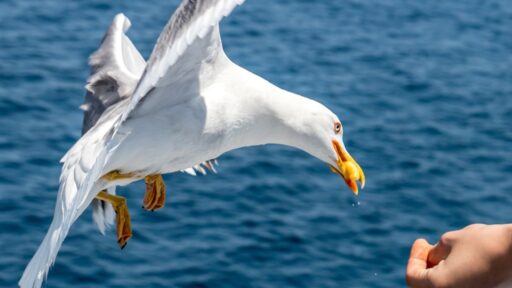
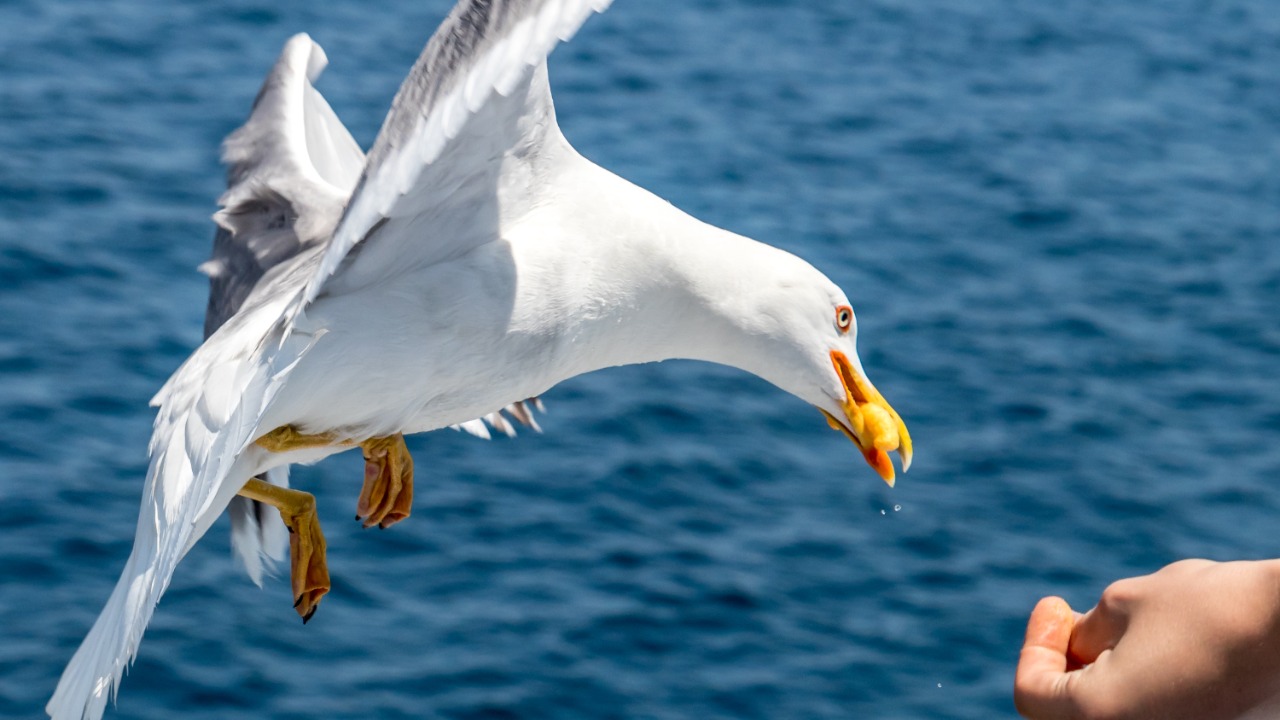

There is something almost comical about watching a seagull stroll across a beach as if it owns the place.
Then someone opens a packet of chips.
Suddenly, that relaxed-looking bird becomes a highly focused food thief.
Seagulls have become remarkably successful at living alongside humans, particularly in coastal towns, cities and busy tourist destinations where discarded food and outdoor eating provide easy opportunities.
Their reputation as aerial thieves is not entirely undeserved.
But the reason they steal food is less about aggression and more about adaptation, opportunity and learning.
If a seagull repeatedly discovers that humans carrying food are an easy source of calories, it has little reason to stop trying.
A recent BBC article exploring why seagulls steal food and how people can prevent it highlights the fascinating behaviour behind these increasingly confident urban birds.
Why Do Seagulls Steal Food?
The simplest answer is that stealing food can be an extremely efficient feeding strategy.
Wild birds spend considerable amounts of time searching for food.
A seagull living near humans may discover an easier option.
People sitting on beaches, eating outdoors or carrying takeaway food create predictable opportunities.
The bird does not need to catch fish.
It does not need to search through tidal pools.
It does not need to compete with other predators.
It simply needs to identify the right opportunity.
And seagulls are surprisingly good at doing exactly that.
Seagulls Are Smarter Than They Look
Calling seagulls “thieves” can make their behaviour sound instinctive.
But research suggests these birds are capable of sophisticated learning.
They can remember locations associated with food and adapt their behaviour based on human activity.
That makes urban environments particularly useful.
A busy promenade can effectively become a predictable feeding ground.
The bird learns where people gather, when food is available and which situations provide the greatest chance of success.
Research published in the Royal Society’s journals has examined how gulls respond to human cues and food, contributing to the growing understanding of their ability to learn from people.
The lesson for anyone eating outdoors is uncomfortable:
The seagull may be watching you more carefully than you realise.
They Can Watch What You Are Eating
One reason food theft can seem so sudden is that gulls are capable of paying close attention to human behaviour.
A person holding food creates an obvious visual signal.
The bird does not necessarily need to smell the meal from a great distance.
It can simply observe.
This creates a strange behavioural competition.
The human thinks:
“I’ll just sit here and eat.”
The gull thinks:
“That person has food.”
And if the bird has successfully stolen food from someone in the same location before, the incentive becomes even stronger.
Why Running Away Can Make Things Worse
Panic can be a poor strategy.
If a person suddenly waves food around, runs or reacts dramatically, the movement can attract even more attention.
From the gull’s perspective, unusual movement around food may signal that something valuable is happening.
The better strategy is usually to avoid creating an obvious opportunity in the first place.
Keep food close.
Avoid holding it above your head.
Keep bags closed when possible.
And pay attention to birds that are already nearby.
Do Not Feed the Gulls
This is perhaps the most important rule.
Feeding gulls teaches them that humans are a reliable food source.
A bird that receives food from people repeatedly has little reason to remain cautious around humans.
Over time, that can contribute to increasingly bold behaviour.
The Royal Society for the Prevention of Cruelty to Animals also advises against feeding wild birds inappropriate human food, while local authorities in many coastal communities actively discourage feeding gulls because it can contribute to nuisance behaviour.
The problem extends beyond one person’s picnic.
A single feeding event can reinforce behaviour that affects an entire community.
Keep Food Covered
The simplest defence is surprisingly effective.
If food is visible, it is easier for a bird to target.
A sandwich wrapped in paper, food kept inside a container or snacks stored inside a closed bag are less obvious than a meal sitting openly on a table.
This does not make the food invisible.
It simply removes the easy visual cue.
Think of it as removing the invitation.
Choose Your Eating Location Carefully
Location can make a significant difference.
Open beaches, busy promenades and areas where gulls regularly gather are naturally high-risk environments.
A quieter location away from large concentrations of birds may make eating outdoors considerably easier.
Gulls are opportunistic.
If one location repeatedly produces food, they are likely to return.
If another location produces nothing, there is less incentive to spend time there.
That is why human behaviour can influence gull behaviour over time.
Watch the Birds Around You
One of the easiest mistakes is to focus entirely on the food.
People look down at their sandwich.
The gull watches from above.
By the time the person notices the bird approaching, it may already be too late.
Paying attention to nearby gulls can give you an important advantage.
If several birds are circling or repeatedly approaching people, it may be a warning that the area has become a feeding hotspot.
Moving before opening your food can be much easier than defending it after the attack begins.
Why Gull Attacks Can Feel So Sudden
Gulls have several physical advantages when attempting to steal food.
They can approach from behind or above.
They can fly quickly.
And their size gives them enough confidence to approach humans at very close range.
A person sitting down is also less mobile than a bird.
The gull effectively controls the vertical dimension.
That is why a theft can appear to happen almost instantaneously.
The bird does not need to engage in a prolonged confrontation.
It only needs a brief opportunity.
Don’t Chase or Hit Them
It can be tempting to react aggressively after losing a meal.
But chasing, hitting or attempting to injure wildlife is not an appropriate response.
Gulls are wild animals, and defensive or aggressive human behaviour can make encounters more dangerous rather than less.
The safer strategy is prevention.
Protect the food.
Avoid feeding.
Move away from concentrated groups.
And give the birds enough space to leave.
Wildlife organisations such as the RSPCA provide guidance on interacting responsibly with wild animals.
Why Urban Gulls Are Becoming Such a Problem
The relationship between humans and gulls has changed as cities and coastal communities have expanded.
Buildings can provide nesting opportunities.
Restaurants and food businesses generate waste.
People leave food behind.
Landfills and waste systems can provide enormous quantities of edible material.
From the gull’s perspective, the urban environment can be remarkably productive.
The bird is not necessarily invading human territory.
In many cases, humans have created an environment where gulls can thrive.
That creates a complicated conservation and urban-management problem.
Better Waste Management Could Be More Effective Than Scaring Birds
It is easy to focus on the bird.
But the food source is often the real issue.
If rubbish is easily accessible, gulls have a strong incentive to remain nearby.
Secure bins, better waste collection and reducing food litter can remove those incentives.
That approach is increasingly important because simply trying to scare birds away does not necessarily solve the underlying problem.
If food remains available, gulls have a reason to return.
Remove the food opportunity, and the location becomes less attractive.
Why Gull Problems Are Not Just About Annoyance
Food theft might seem like a harmless nuisance.
But large concentrations of gulls can create wider problems.
Bird droppings can damage property and create cleaning costs.
Noise can disturb residents.
Aggressive behaviour can frighten children and other vulnerable people.
Large bird populations around waste areas can also create sanitation concerns.
That is why many local authorities treat gull management as an environmental and public-space issue rather than simply a picnic problem.
The Cleverest Way to Beat a Seagull
The irony is that defeating a food-stealing gull usually requires very little confrontation.
The best strategy is to make the opportunity disappear.
Do not advertise your food.
Do not feed the birds.
Keep food covered.
Choose locations carefully.
Watch what is happening around you.
And dispose of leftovers responsibly.
The gull is not plotting revenge.
It is simply responding to an environment where humans have accidentally taught it that stealing food can be rewarding.
That is what makes the behaviour so fascinating.
The bird is not merely reacting to the presence of food.
It is learning from us.
And if humans can change the lesson, they may be able to change the behaviour.
So the next time a seagull begins watching your lunch with suspicious intensity, remember: the safest picnic is the one the bird never realises is worth stealing.