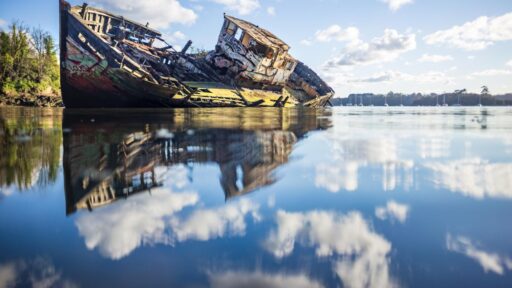

Sonar scanners have turned Seattle’s Lake Union into an underwater map, revealing a dense cluster of more than 20 shipwrecks that researchers are now calling a “shipwreck city.” The discovery recasts a familiar urban lake as a layered archive of working boats, wartime relics, and forgotten infrastructure lying just out of sight beneath kayaks and floatplanes. What began as a technical survey has quickly become a new way to read the city’s maritime past and its environmental future.
The mapping effort shows how modern acoustic tools can reconstruct decades of human activity from a lakebed that most residents only know from the surface. It also raises practical questions about preservation, tourism, and how far Seattle is willing to go to protect a hidden fleet it never expected to find concentrated in one place.
New sonar maps turned a vague legend into a detailed underwater district
For years, divers and local historians traded stories about scattered wrecks in Lake Union, but the full scale remained guesswork. That changed when a team using remotely operated vehicles and high resolution sonar systematically scanned the lake and stitched the data into a three dimensional picture of the bottom. The result revealed more than 20 distinct hulls clustered in a relatively compact area that researchers began informally describing as a kind of underwater neighborhood.
The project relied on side scan sonar and multibeam systems that send acoustic pulses across the lakebed and record the returning echoes as detailed contours. On the resulting images, intact hulls stand out as crisp silhouettes, while collapsed decks and debris fields appear as rough scatter. To ground truth the sonar hits, the team then used the remotely piloted vehicles, flying cameras close to promising shapes to confirm whether they were vessels, pilings, or natural features. According to the survey, the combination of wide area sonar coverage and targeted dives is what transformed isolated rumors into a mapped “city” of wrecks in Lake Union.
Some of the ships appear to be workboats that supported the lake’s long history as a hub for tug operations, fishing fleets, and shipyards. Others show design traits that suggest military or research use, with sharper bows, reinforced hulls, or unusual deck structures. The sonar images also captured non vessel infrastructure, including remnants of old piers and industrial debris that ring the cluster and help explain why so many hulls settled in the same zone.
Researchers involved in the project have described the new map as a baseline, not a finished catalog. The sonar signatures show hulls of different lengths and beam widths, hinting at a mix of eras and uses, but many of the individual identities remain unconfirmed. The team expects that cross referencing builder’s plans, historic photographs, and registry records will eventually match at least some of the wrecks to known vessels that disappeared from the logs without a clear fate.
Lake Union’s hidden fleet reshapes Seattle’s sense of its own waterfront history
Lake Union has long been framed as a recreational and residential waterway, lined with houseboats, parks, and tech offices. The discovery of a concentrated cluster of wrecks complicates that image and reinforces how central maritime work has been to Seattle’s growth. Each hull on the sonar map points back to a period when the lake was crowded with sawmills, shipyards, and moorage for commercial fleets that served the larger port on Elliott Bay.
The survey team’s findings echo oral histories that describe vessels being scuttled in place when they outlived their usefulness, rather than towed out to sea. In a working harbor, retiring a wooden tug or barge sometimes meant stripping it of valuable equipment and then sinking the empty shell in deep water. The new sonar map suggests that Lake Union hosted a similar pattern, where obsolete boats quietly joined a growing underwater graveyard instead of leaving the city.
That context helps explain why the wrecks matter to historians. They provide physical evidence of industrial decisions that rarely left detailed paperwork. A half collapsed hull on the lakebed can show how a particular shipyard framed its ribs, how thick the planking was, and where modifications were made over time. In some cases, the sonar images and remotely operated vehicle footage reveal details such as winch mounts, railings, and hatch layouts that match known designs from specific builders.
The cluster also intersects with Seattle’s aviation history. Lake Union is home to a busy seaplane base, and the same sheltered waters that attract modern floatplanes once hosted experimental aircraft and support barges. The sonar survey documented not only boats but also scattered metal structures that may be linked to earlier aviation or industrial projects. Together, those pieces turn the lakebed into a layered record of how different technologies shared the same limited space.
Local interest ramped up after television coverage highlighted the work of the remote operated vehicle team that mapped the wrecks and shared video of the most photogenic hulls. The report showed how the group used sonar to locate targets, then piloted small submersibles along the lakebed to film them in detail, capturing images of intact wheelhouses, railings, and cabin windows. The segment on remote vehicles helped cement the “shipwreck city” nickname and drew a wider audience to what had been a niche mapping effort.
Environmental concerns and legal questions give the discovery new urgency
Finding a dense field of wrecks in a freshwater urban lake is not just a historical curiosity. It also raises environmental questions about what those hulls are made of and what they might still be leaking. Many of the vessels likely predate current regulations on fuel storage and anti fouling paints, which means their tanks, batteries, and coatings could contain materials that modern standards treat as hazardous.
Sonar alone cannot answer those questions, but it can help regulators prioritize which wrecks to study more closely. A large steel vessel with visible tank structures poses different risks than a small wooden tug that has been submerged for decades. By mapping hull size, orientation, and depth, the survey gives environmental agencies a starting list for targeted sampling rather than a vague sense that “old boats” are down there somewhere.
The cluster also intersects with legal and cultural debates about underwater heritage. In many jurisdictions, wrecks older than a set number of years qualify as protected archaeological sites, which limits salvage and requires formal permits for disturbance. Lake Union’s wrecks span a range of ages, but some likely cross that threshold and may now fall under state or federal protections. That status could complicate any plan to remove hulls that are leaking contaminants, since agencies would need to balance environmental cleanup with preservation rules.
Public safety is another concern. Recreational divers already visit some of the better known wrecks, and the new map will almost certainly draw more interest. Clear charts of wreck locations can reduce the risk of accidental entanglement or collisions with active boat traffic, but they can also encourage untrained divers to push their limits. Authorities will need to decide how much detail to share and whether to formalize some sites as recognized dive locations with guidelines and signage.
On the policy side, the discovery arrives as Seattle and Washington state continue to debate how to manage aging maritime infrastructure. Derelict vessel removal programs in nearby waterways have focused on floating hazards and shoreline eyesores. The Lake Union survey shifts attention to what lies out of sight on the bottom and may prompt calls to extend those programs to include long sunk hulls that still affect water quality.
Next steps: from sonar map to living archive, research lab, and potential attraction
The team behind the Lake Union survey has signaled that the current map is only the first phase of work. Next steps are likely to include higher resolution passes over selected wrecks, detailed photogrammetry using the remotely operated vehicles, and collaboration with maritime historians to match hulls to specific vessels. Over time, that process could turn the “shipwreck city” from a generic label into a catalog of named boats, each with a documented story.