
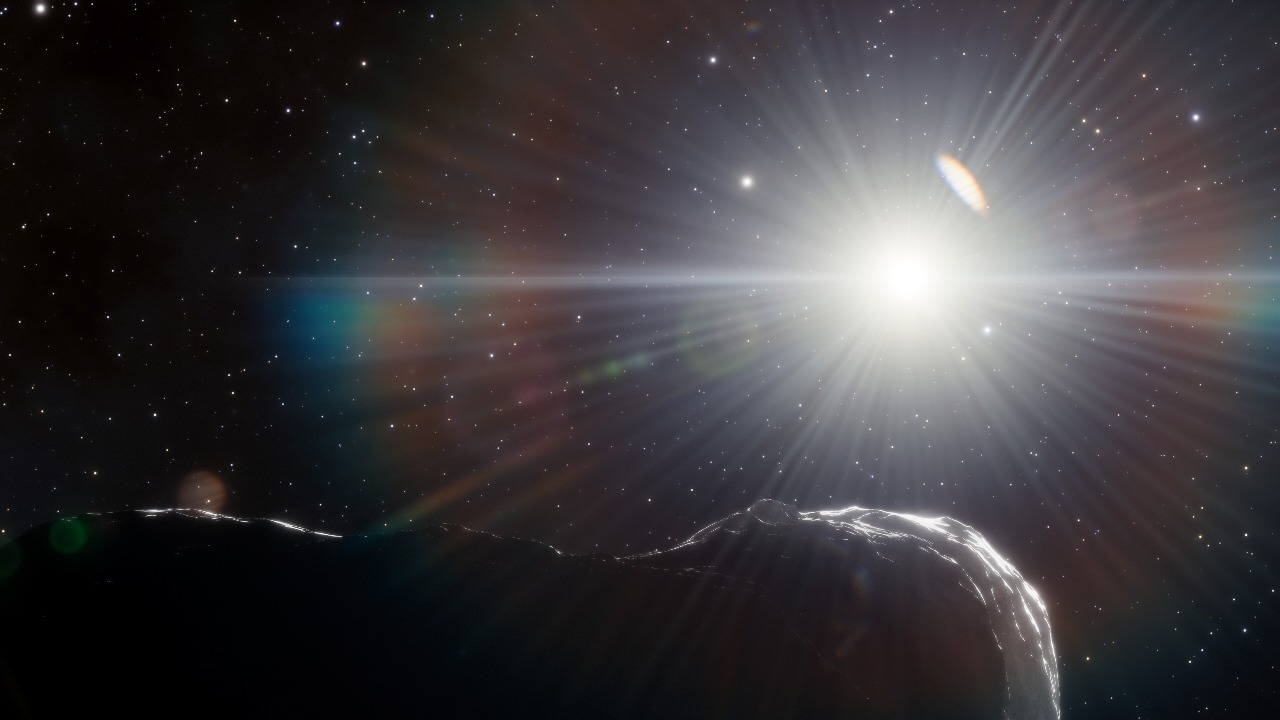

A newly discovered asteroid is set to skim past Earth on Monday at a distance closer than the moon, offering scientists an unexpected opportunity to study a near-Earth object in real time. The flyby is safe, yet the speed and proximity of the encounter underscore how quickly small asteroids can slip into view and then rush past the planet.
The object, designated 2026 JH2, was spotted only shortly before its close approach and will swing inside the orbit of the moon before heading back into deep space. For planetary defense researchers, the encounter serves as a live test of how well current sky surveys can catch and characterize such visitors on short notice.
Fresh data on asteroid 2026 JH2 and its close pass
The asteroid now drawing attention, 2026 JH2, belongs to the class of near-Earth asteroids that cross or approach Earth’s orbit and are tracked for any potential risk. Early measurements indicate that 2026 JH2 is relatively small compared with the largest known near-Earth objects, with estimates of its diameter derived from its brightness and reflectivity. Those size estimates place it far below the threshold that would cause global effects, according to initial assessments described in coverage of the newly discovered asteroid.
Trajectory solutions show that the object will pass closer than the average distance between Earth and the moon, a span of roughly 384,400 kilometers. Orbital calculations compiled for near-Earth asteroid 2026 indicate that the flyby distance will be a fraction of that gap, placing the rock well inside the lunar orbit for a brief window. Even at that range, however, the asteroid will still be tens of thousands of kilometers from Earth’s surface, leaving no realistic chance of impact during this pass based on the published solutions.
As with many small asteroids, 2026 JH2 was detected only after it was already on a trajectory that would carry it near Earth. Survey telescopes picked up its motion against the background stars, and follow-up observations quickly refined its orbit. The short discovery lead time is consistent with earlier cases where objects of similar scale, moving on comparable paths, were first identified only days before a close approach, as described in technical summaries of asteroid 2026 JH2.
Despite the late notice, astronomers have now locked in the key parameters of the flyby. The asteroid’s path, speed, and closest approach distance have been calculated with enough precision to rule out any collision in this passage. That level of confidence comes from repeated measurements of its position over multiple nights, which tighten the orbit solution and shrink the uncertainty region that surrounds its projected track.
How this close pass reshapes the story of 2026 JH2
The main change in the story of 2026 JH2 is the shift from an unknown speck on survey images to a well-characterized visitor with a mapped-out trajectory. When it first appeared in telescope data, the object carried the same uncertainty that accompanies any fresh detection. With only a handful of observations, its orbit could have spanned a wide range of possibilities. As more data came in, the projected path narrowed until the current solution showed a safe but unusually close pass, summarized in analyses of the close pass near.
That refinement process has also changed how scientists talk about the asteroid’s risk profile. Early on, a newly logged object can briefly appear on automated watch lists that flag any orbit with a remote chance of intersecting Earth. Once the calculations mature, those preliminary flags are often cleared. In the case of 2026 JH2, the updated track removed any plausible impact scenario for this encounter and reframed the event as a science opportunity rather than a hazard.
The characterization of the asteroid itself has evolved as well. Initial brightness readings gave a rough estimate of its size, but those figures come with wide margins because they depend on how reflective the surface is. Continued monitoring, combined with comparisons to other objects of similar brightness and composition, has narrowed the likely diameter range. That work, outlined in scientific briefings on close-range sweep past, supports the conclusion that 2026 JH2 is a modestly sized rock that would not pose a global threat even in a hypothetical impact.
The timing of the pass has also sharpened. At first, the expected moment of closest approach carried an uncertainty window that stretched across several hours. With each new observation, that window has narrowed to a much shorter interval, which helps both professional observatories and advanced amateurs plan their viewing campaigns. That planning matters because the asteroid will be faint, fast moving, and visible only from certain parts of the globe during the critical minutes of its nearest pass.
Why a moon-skimming asteroid encounter matters right now
A close, safe flyby like this matters for two reasons: what it reveals about Earth’s defenses and what it offers for pure science. On the defense side, 2026 JH2 is a reminder that small asteroids can approach with limited warning. The object is not large enough to trigger the same level of concern as kilometer-scale bodies, but it falls into the size class that could cause regional damage if it ever struck. The fact that it was detected before its closest approach, rather than after the fact, shows that survey networks are improving, yet the short lead time also exposes the remaining blind spots described in coverage of the newly discovered asteroid.
From a scientific perspective, 2026 JH2 provides a rare chance to study a small asteroid at relatively close range without sending a spacecraft. As it zips past, astronomers can use radar to bounce signals off its surface and reconstruct its shape, rotation, and possibly even surface features. Optical telescopes can track how its brightness changes over time, which reveals how fast it spins and whether it has an elongated or irregular form. These observations help refine models of how such objects formed and how they respond to sunlight and gravitational nudges.
The encounter also feeds into the broader effort to map the population of near-Earth objects. Each new detection adds to the statistical picture of how many asteroids of a given size exist and how often they approach the planet. That information in turn shapes decisions about where to invest in new telescopes, satellites, or space missions designed to test deflection techniques. Policymakers rely on those statistics to weigh the cost of planetary defense against other space priorities, and a close pass like this one provides a concrete example of the stakes involved.
For the public, the event offers a visible reminder that Earth orbits in a busy neighborhood. Past incidents, including the airburst of a smaller object over a populated region, have shown that even modest asteroids can have local consequences. While 2026 JH2 will not come anywhere near the atmosphere, its proximity and the fact that it was discovered only shortly before the flyby help make the abstract idea of near-Earth objects more tangible. That can translate into greater support for continued investment in survey programs and early warning systems.
What the 2026 JH2 flyby sets up for future asteroid tracking
Once 2026 JH2 recedes into the distance, astronomers will fold the new data into long-term tracking models. The refined orbit will allow prediction of its future positions years or decades ahead, which helps determine whether it might ever pose a threat in later passes. That process mirrors how other near-Earth asteroids have been monitored over time, with each close approach used to tighten the orbit solution and update risk assessments, as reflected in technical discussions of close-pass asteroids.
The flyby will also serve as a real-world drill for planetary defense infrastructure. Tracking centers, observatories, and data pipelines will review how quickly they were able to identify the object, share information, and coordinate observations. Any delays or gaps that emerge from that review can guide upgrades to software, hardware, or communication protocols. In that sense, 2026 JH2 functions as a natural test object that stresses the system without creating danger.