
Jaguar has spent the past two years telling the world that its next generation of cars would look and feel nothing like the Jaguars people already know.
Now there is finally something tangible to judge.
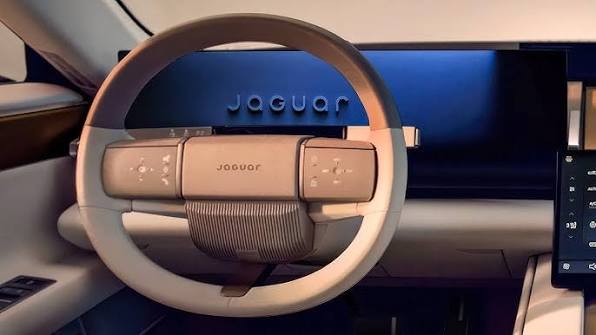
The company has revealed the interior of the production Jaguar Type 01, its upcoming all-electric four-door grand tourer, ahead of the car’s full exterior debut on October 6, 2026. The first images show a cabin that is dramatically different from the traditional wood-and-leather luxury associated with older Jaguars. Instead, the Type 01 uses a low, architectural layout, a long central spine, digital displays and metallic materials to create something that feels closer to a modern design studio than a conventional luxury sedan.
For Jaguar, this interior is about much more than a new dashboard.
It is the clearest indication yet of what the company’s controversial reinvention will actually mean for customers.
The Type 01 Is the Production Car Jaguar Has Been Building Toward
Jaguar first shocked the automotive world with the Type 00 concept in 2024.
That vehicle was deliberately theatrical. It featured exaggerated proportions, dramatic surfaces and an almost complete rejection of the restrained luxury design language associated with previous Jaguar models. Jaguar itself described Type 00 as a non-production vehicle intended to communicate the direction of the brand rather than preview a showroom model literally. The company’s official Type 00 page still makes that distinction clear.
The Type 01 is different.
Jaguar has confirmed that it is a production vehicle and describes it as the most advanced and powerful production Jaguar it has ever created. The car is built on Jaguar’s dedicated electric architecture and is intended to become the flagship of the company’s new era. Jaguar has already shown camouflaged versions publicly, including an appearance in Monaco, while keeping most of the final exterior design hidden.
The newly revealed cabin therefore matters because this is no longer concept-car theater.
Customers will actually sit in something very close to this.
The Interior Is Built Around a Central Spine
The most striking feature is the long structure running through the middle of the cabin.
Rather than using a conventional center console that ends somewhere between the front seats, Jaguar extends what it calls a central spine through the passenger compartment. It visually divides the interior and helps create four clearly separated seating spaces.
That makes the cabin feel unusually architectural.
Most luxury cars try to create one continuous lounge-like environment. Jaguar appears to be doing almost the opposite. Each occupant is given a more defined personal zone, while the central structure becomes part of the vehicle’s visual identity.
The idea also connects the production car with the Type 00 concept, which used strong linear elements and dramatic proportions throughout its design.
This is important because Jaguar’s redesign could easily have become superficial.
If the production car had simply placed a few unusual materials inside an otherwise conventional dashboard, the Type 00 would have looked like a marketing exercise. The Type 01 interior suggests that Jaguar is genuinely carrying the concept’s design philosophy into production.
Jaguar Has Not Filled the Dashboard With Giant Screens
One of the more surprising choices is what Jaguar has not done.
Many modern EVs compete by installing enormous tablet-style touchscreens in the middle of the dashboard. Jaguar has taken a more restrained approach.
The Type 01 uses a wide digital display positioned in front of the driver, while a smaller vertically oriented touchscreen lower in the center area appears to handle functions such as climate and audio controls.
That gives the dashboard a much cleaner appearance.
The design does not remove technology. It hides more of it.
Jaguar has emphasized that certain controls and storage areas remain concealed until they are needed. That philosophy allows the cabin to appear calm when the technology is not actively being used.
It is a significant departure from the dashboard-as-computer-screen trend that now dominates much of the EV market.
Anyone following Jaguar’s official reinvention can see the broader design language through the company’s new-era brand site, where the company repeatedly emphasizes originality and challenging convention.
The Rearview Mirror Is Not Where Drivers Expect It
Another unusual feature is the digital rearview mirror.
The Type 01 does not rely on a conventional glass rear window. Instead, Jaguar uses what it calls the ClearSight Rear View Display, which receives imagery from an exterior camera.
Its placement is particularly interesting.
Rather than mounting the digital mirror high near the roof in the conventional position, Jaguar has positioned it lower, near the base of the windshield and roughly aligned with the exterior mirrors. The idea is to reduce the amount of eye movement required when the driver looks between the central rear view and the side mirrors.
That may take some adjustment.
Drivers have spent decades instinctively looking upward for the rearview mirror. Moving it lower challenges a deeply ingrained habit.
But the reasoning is understandable.
If a digital display no longer needs to occupy the traditional mirror position, there is no technical reason it must remain there.
The Type 01 is therefore questioning something most manufacturers simply copy because it has always been done that way.
The Driving Position Is Deliberately Low
Electric vehicles often force designers into compromises because batteries are installed beneath the cabin floor.
That battery placement can raise the seating position and make performance EVs feel more like crossovers than traditional grand tourers.
Jaguar appears determined to avoid that.
The company has emphasized a low seating position in the Type 01, describing the layout as a proper GT driving environment. Reviewers who have seen the cabin also note that the seats sit unusually low for a modern electric vehicle.
That could have a major effect on how the car feels.
Luxury is not only about materials. Seating position, sightlines and the relationship between the driver and the car’s body can completely change the character of a vehicle.
A low driving position reinforces Jaguar’s intention to position the Type 01 as a grand tourer rather than simply another large premium EV.
Jaguar has already described the car as a low-center-of-gravity electric GT, using knowledge from its Formula E program as part of the vehicle’s development.
Traditional Wood and Chrome Have Mostly Disappeared
Older Jaguars often relied heavily on familiar luxury cues.
Wood veneer, polished metal and leather helped communicate that the cabin belonged to a premium British automobile.
The Type 01 moves away from that vocabulary.
Instead, Jaguar is using metallic brass-like finishes, light-colored surfaces and materials inspired by natural stone. Some of the detailing reportedly takes inspiration from travertine, creating a warmer and more architectural appearance than the cold aluminum or glossy black plastics commonly found in modern cars.
The visual effect is intentionally unfamiliar.
Jaguar appears less interested in competing directly with Mercedes-Benz or BMW interior design and more interested in creating an environment that immediately identifies itself as Jaguar.
That is a risky strategy.
Traditional Jaguar customers may miss the rich wood veneers and classic detailing.
But Jaguar’s broader reinvention was never designed primarily to preserve the past.
The Roof Plays a Bigger Role Than It First Appears
The Type 01 also uses a long, narrow glass roof extending rearward above the cabin.
Because the interior uses high side structures and strongly defined seating spaces, the glass helps prevent the cabin from feeling overly enclosed.
It also reinforces the contrast Jaguar seems to be pursuing throughout the car.
Passengers sit low.
The central spine is substantial.
The body appears visually protective.
Yet light enters through the roof, giving the interior a sense of openness above the occupants.
That combination could be especially important in the rear seats, where the absence of a conventional rear windscreen might otherwise make the cabin feel dark or isolated.
The Steering Wheel Is Unusually Simple
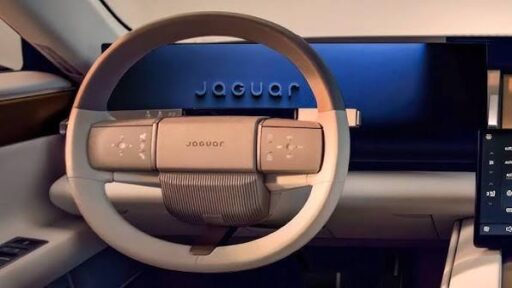
The steering wheel continues the minimalist theme.
It uses a two-spoke design with touch-sensitive controls and conventional stalks positioned behind it.
Keeping physical stalks is noteworthy.
Some manufacturers have removed traditional indicator and gear controls in pursuit of extreme minimalism, often generating criticism from drivers who prefer tactile interfaces.
Jaguar appears to be taking a middle path.
The Type 01 looks futuristic, but it does not eliminate every familiar control simply for visual effect.
That may help make the car feel less intimidating once someone actually begins driving it.
Four Seats Make the Type 01 Feel More Like a Luxury GT
The Type 01 is configured around four individual seats rather than trying to maximize passenger capacity.
That decision says a great deal about the type of vehicle Jaguar is building.
This is not intended to be a practical family EV competing mainly on cargo space and rear-seat flexibility.
It is designed as a luxury grand tourer.
Giving each occupant a defined seating environment supports that positioning, while the enormous exterior dimensions provide room for a cabin that prioritizes experience over packaging efficiency.
Early reports indicate the car will be more than five meters long and positioned well above mainstream premium EVs in price, placing it closer to models such as the Porsche Taycan, Mercedes EQS and other high-end electric grand tourers.
Jaguar clearly does not want to compete by offering the most seats for the money.
It wants the Type 01 to feel special.
The Exterior Is Still Being Saved for October
As revealing as the interior photos are, Jaguar is still holding back the biggest part of the Type 01 story.
The full production car is scheduled to make its official debut on October 6, 2026, in New York.
Until then, the company continues to show camouflaged prototypes and carefully selected details.
That makes the interior reveal an important preview.
It confirms that Jaguar’s radical Type 00 concept was not simply designed to generate headlines.
At least inside the Type 01, the company really is pursuing a substantially different kind of luxury car.
This Is Jaguar’s Biggest Gamble in Decades
The Type 01 is arriving under unusual pressure.
Jaguar is not merely replacing one model with another. It is attempting to reposition the entire brand around a smaller number of more expensive, all-electric vehicles.
That means every detail of the Type 01 will be judged as evidence of whether the strategy is working.
The interior shows confidence.
It rejects several familiar Jaguar cues, avoids copying the giant-screen layouts of many competing EVs and introduces unusual ideas such as the low-mounted digital rearview display and full-length central spine.
Some buyers may find the result beautiful.
Others may decide that Jaguar has moved too far away from what made its older cars appealing.
But indifference seems unlikely.
For a brand whose new philosophy is essentially built around refusing to look ordinary, that may be exactly the point.
The Type 00 concept told people what Jaguar wanted its future to feel like.
The production Type 01 is beginning to show whether Jaguar can actually build that future.