
The Great Barrier Reef experienced the most geographically widespread coral-bleaching event recorded across the reef system after exceptional ocean heat affected its northern, central and southern regions.
The record event occurred during the 2024 austral summer. Subsequent monitoring published by the Australian Institute of Marine Science confirmed that the bleaching had the largest spatial footprint ever documented on the Great Barrier Reef, with high to extreme bleaching prevalence across all three major regions.
The full consequences became clearer during surveys conducted for the 2024–2025 annual reef assessment. Scientists recorded sharp declines in living coral cover, particularly in northern and southern sections of the reef, after the bleaching combined with cyclones, flooding and crown-of-thorns starfish activity.
Although some coral survived and certain reefs remain in relatively good condition, researchers warn that repeated heat events are leaving less time for damaged coral communities to recover.
The Record Refers to the 2024 Bleaching Event
The phrase “just logged its most widespread bleaching” can give the impression that the record was set during the current 2026 summer. The record being reported was established by the 2024 mass-bleaching event and confirmed in later scientific assessments.
In 2025, the reef experienced another mass-bleaching event, making 2024 and 2025 the second pair of consecutive bleaching years recorded on the Great Barrier Reef after 2016 and 2017. The Australian Institute of Marine Science said the 2025 event was less extensive than the one in 2024 but still represented the sixth mass-bleaching event since 2016.
Conditions during the December 2025 to March 2026 summer were different. The Great Barrier Reef Marine Park Authority identified a regional bleaching event concentrated mainly in the northern reef, with localized lower levels in the far north, central and southern regions.
The all-time spatial record therefore remains associated with the severe 2024 marine heat wave.
What Coral Bleaching Means
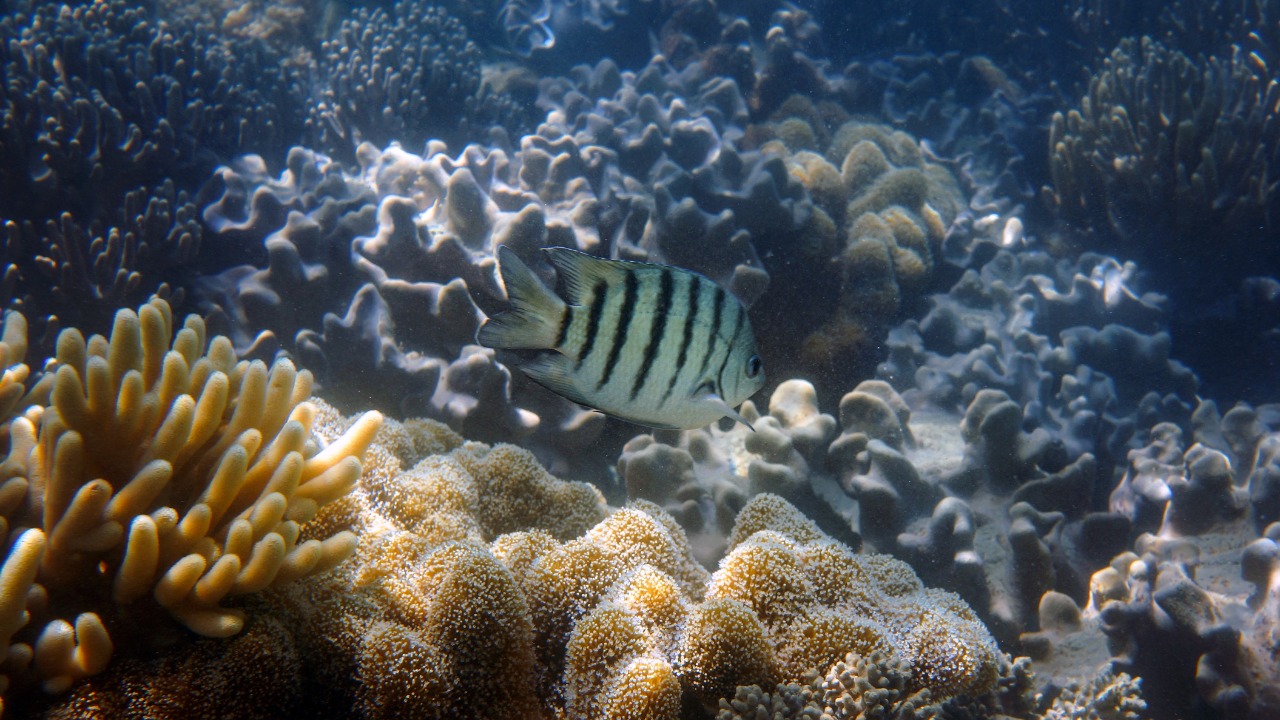
Healthy reef-building corals live in partnership with microscopic algae inside their tissues. These algae provide much of the coral’s energy and produce the colors commonly associated with a healthy reef.
When seawater remains unusually hot, the relationship becomes disrupted. The coral expels the algae, causing its pale skeleton to become visible through the tissue. This produces the white appearance known as bleaching.
A bleached coral is not automatically dead. It can recover if temperatures fall quickly enough and environmental conditions remain favorable.
However, bleaching deprives the coral of an important energy source. Prolonged or intense heat can lead to starvation, disease and death. Even corals that survive may experience reduced growth, reproduction and resistance to subsequent stress.
The Australian Institute of Marine Science explains that large-scale bleaching events are becoming more frequent as human-caused climate change raises tropical ocean temperatures.
How Extensive Was the Event?
The 2024 event affected an unprecedented portion of the Great Barrier Reef.
Aerial and in-water surveys found high to extreme bleaching prevalence across the northern, central and southern reef regions. Previous bleaching events sometimes affected one section more severely than another, but the 2024 heat stress extended across almost the entire reef system.
Earlier reporting from the Reef Authority indicated that signs of bleaching were observed on approximately 73 percent of reefs surveyed during the event. Some individual areas showed bleaching affecting a very high proportion of their coral.
The Great Barrier Reef is not a single continuous structure. It is a vast network of thousands of reefs and islands extending for more than 2,300 kilometers along Australia’s northeastern coast.
That scale means conditions can vary dramatically from one location to another. A record-breaking system-wide event does not mean every coral colony died or that every individual reef suffered the same level of damage.
It does mean that unusually warm water reached a larger portion of the ecosystem than scientists had documented during any previous Great Barrier Reef bleaching event.
Coral Cover Fell Sharply After the Heat Wave
Bleaching becomes particularly damaging when it leads to widespread coral mortality.
The Australian Institute of Marine Science reported that hard-coral cover declined by approximately 25 percent in the northern Great Barrier Reef and 30 percent in the southern region between annual survey periods. The central region recorded a decline of about 13 percent.
These were the largest annual declines recorded in the northern and southern regions since the long-term monitoring program began during the 1980s.
The losses were not caused by heat alone. Tropical cyclones, freshwater flooding and crown-of-thorns starfish also damaged reefs during the monitoring period.
However, scientists identified the 2024 marine heat wave and mass bleaching as major drivers of the overall decline.
The latest findings are available through the Australian Institute of Marine Science’s annual Great Barrier Reef condition report.
Fast-Growing Corals Suffered Heavy Losses
Much of the coral cover lost during the bleaching belonged to fast-growing branching and table-shaped corals, particularly species from the genus Acropora.
These corals can rapidly rebuild cover after a disturbance when conditions remain calm for several years. Their growth helped drive previous increases in coral cover across parts of the Great Barrier Reef.
However, they are also highly vulnerable to extreme heat, strong waves and crown-of-thorns starfish.
This creates a volatile pattern in which coral cover can rise quickly during favorable periods and then collapse when a major heat wave or cyclone occurs.
A reef dominated by fast-growing, heat-sensitive species may show impressive recovery in coral-cover measurements without necessarily becoming more resistant to future warming.
Scientists therefore examine not only the total amount of coral but also its species composition, age structure, reproductive capacity and ability to survive repeated disturbances.
Consecutive Bleaching Leaves Less Recovery Time
Historically, a damaged reef might have had a decade or more between major disturbances.
That recovery period allowed surviving colonies to grow, reproduce and supply young coral to damaged areas. Reefs could regain structure and ecological complexity before the next major event.
The Great Barrier Reef has now experienced mass bleaching in 2016, 2017, 2020, 2022, 2024 and 2025. The short gaps between recent events are increasingly concerning scientists.
Repeated bleaching can kill corals that survived the previous heat wave in a weakened state. It can also affect young corals before they become large enough to reproduce.
Even where coral cover increases between events, repeated disturbances may prevent the reef from developing the older, more diverse coral communities associated with long-term ecological stability.
The Great Barrier Reef Is Part of a Global Crisis
The record event in Australia occurred during the fourth global coral-bleaching event, which began in early 2023.
NOAA and international reef-monitoring organizations reported that bleaching-level heat stress affected approximately 84 percent of the world’s coral-reef area between January 2023 and September 2025. Mass bleaching was documented in at least 83 countries and territories.
That made it the most geographically extensive global bleaching event on record.
The crisis affected reefs across the Pacific, Atlantic and Indian oceans, including locations in the Caribbean, Florida, the Red Sea and other parts of Australia.
Unusually warm oceans were intensified by the El Niño climate pattern, but scientists emphasize that the underlying rise in ocean temperature caused by greenhouse-gas emissions has made marine heat waves more severe and more likely.
Bleaching Does Not Mean the Entire Reef Is Dead
Descriptions of the record event can sometimes create the impression that the Great Barrier Reef has completely disappeared.
That is not accurate.
The reef remains a vast and living ecosystem containing coral communities, fish, turtles, seabirds and thousands of other species. Conditions vary significantly across locations and depths, and some reefs escaped the worst damage.
Bleached reefs can also recover when temperatures return to normal and sufficient coral survives.
However, survival after one heat wave does not remove the long-term threat. A reef repeatedly exposed to severe bleaching may progressively lose coral diversity, structural complexity and its capacity to recover.
The key concern is not that every part of the Great Barrier Reef died during one summer. It is that major bleaching events are arriving faster than many damaged areas can rebuild.
Why Coral Reefs Matter Beyond Tourism
The Great Barrier Reef supports one of the world’s most diverse marine ecosystems.
Its physical structure provides habitat, feeding grounds and breeding areas for numerous fish and invertebrate species. The reef also supports commercial and recreational fishing, research, traditional cultural practices and a major tourism economy.
Healthy reefs reduce wave energy before it reaches the coastline. This can limit erosion and reduce the impact of storms on coastal communities.
When coral cover declines and reef structures erode, these ecological and protective functions may weaken.
The Great Barrier Reef also has deep cultural significance for Aboriginal and Torres Strait Islander Traditional Owners, whose relationships with the marine environment extend back thousands of years.
Can Damaged Coral Be Restored?
Scientists and conservation groups are testing several methods intended to strengthen reef recovery.
These include growing coral fragments in nurseries, distributing coral larvae, improving crown-of-thorns starfish control and identifying corals with greater tolerance to heat.
Researchers are also developing automated systems capable of deploying large numbers of coral-seeding devices over suitable areas of reef.
Such methods may help selected reefs recover, protect high-value sites or preserve genetic diversity. They remain important tools for adaptation and local conservation.
However, restoration cannot currently operate at the scale of the entire Great Barrier Reef, and newly planted coral remains vulnerable to the same rising temperatures that damaged the original colonies.
Restoration can support resilience, but it cannot substitute for reducing the greenhouse-gas emissions driving ocean warming.
What the 2026 Conditions Show
The December 2025 to March 2026 monitoring period produced a regional bleaching event in the northern Great Barrier Reef rather than another reef-wide event on the scale of 2024.
Bleaching became apparent in the north during March 2026 following prolonged summer heat exposure. The Reef Authority reported localized low bleaching in other regions and additional damage from Severe Tropical Cyclone Narelle.
This regional pattern may offer some parts of the reef more time to recover than they received during the previous two summers.
It does not indicate that the broader threat has passed. Reef health is influenced by accumulated effects from several seasons, including ocean heat, cyclones, flooding, water quality and coral predators.
Scientists will continue conducting in-water surveys to determine how much affected coral survives and whether coral cover stabilizes after the steep losses recorded in the previous assessment.
The Main Takeaway
The Great Barrier Reef’s most widespread bleaching event on record occurred during the 2024 summer and was confirmed through subsequent monitoring.
It affected all three major regions of the reef and was followed by some of the largest annual coral-cover declines observed since systematic surveys began.
Another mass-bleaching event followed in 2025, while the 2026 summer produced more regionally concentrated bleaching in the north.
The reef has not vanished, and many coral communities remain alive. Its future, however, increasingly depends on whether global warming can be limited enough to give damaged reefs meaningful time between severe marine heat waves.