
Europe’s relationship with air conditioning is changing quickly. Homes that were designed for mild summers are increasingly struggling with prolonged heat, warm nights and indoor temperatures that remain uncomfortable long after sunset.
Conventional air conditioners can provide immediate relief, but installing them across millions of European homes would create new problems. Cooling systems consume electricity during periods when power networks are already under pressure, while many models rely on refrigerants that can contribute heavily to global warming when they leak.
European researchers and climate-technology companies are therefore developing a different kind of cooling system. Instead of compressing and circulating refrigerant gas, these machines use specially engineered solid materials that heat up or cool down when stretched, compressed, magnetised or exposed to an electric field.
The technology is not yet ready to replace the split air conditioner in every home. However, its development could eventually produce quieter, more compact and potentially more efficient systems without conventional refrigerant gases.
Conventional Air Conditioning Has Barely Changed in a Century
Most modern air conditioners use vapour-compression technology.
A compressor raises the pressure and temperature of a refrigerant. The system then moves that refrigerant through a cycle of condensation and expansion, allowing it to collect heat indoors and release it outside.
The design has become far more efficient and reliable over time, but its basic operating principle remains familiar. RMI estimates that approximately 95% of today’s cooling equipment still relies on vapour compression. Its solid-state cooling analysis argues that this long-established technology is approaching practical performance limits that make revolutionary efficiency improvements increasingly difficult.
Refrigerants create a second challenge. Many hydrofluorocarbon gases have a much stronger warming effect than carbon dioxide when released into the atmosphere. Newer systems increasingly use lower-impact alternatives, but refrigerant leakage, recovery and disposal remain important environmental and maintenance concerns.
Europe Needs More Cooling Without Creating Another Climate Problem
Air conditioning remains considerably less common in Europe than in the United States. Around 20% of European households have air conditioning, compared with roughly 90% in the US, according to figures cited by Wired. Penetration is even lower in countries such as the United Kingdom, where many homes were constructed to retain heat rather than release it.
That difference is becoming harder to maintain as Europe warms. Northern and western countries that historically experienced limited cooling demand are now facing more frequent periods of dangerous indoor heat.
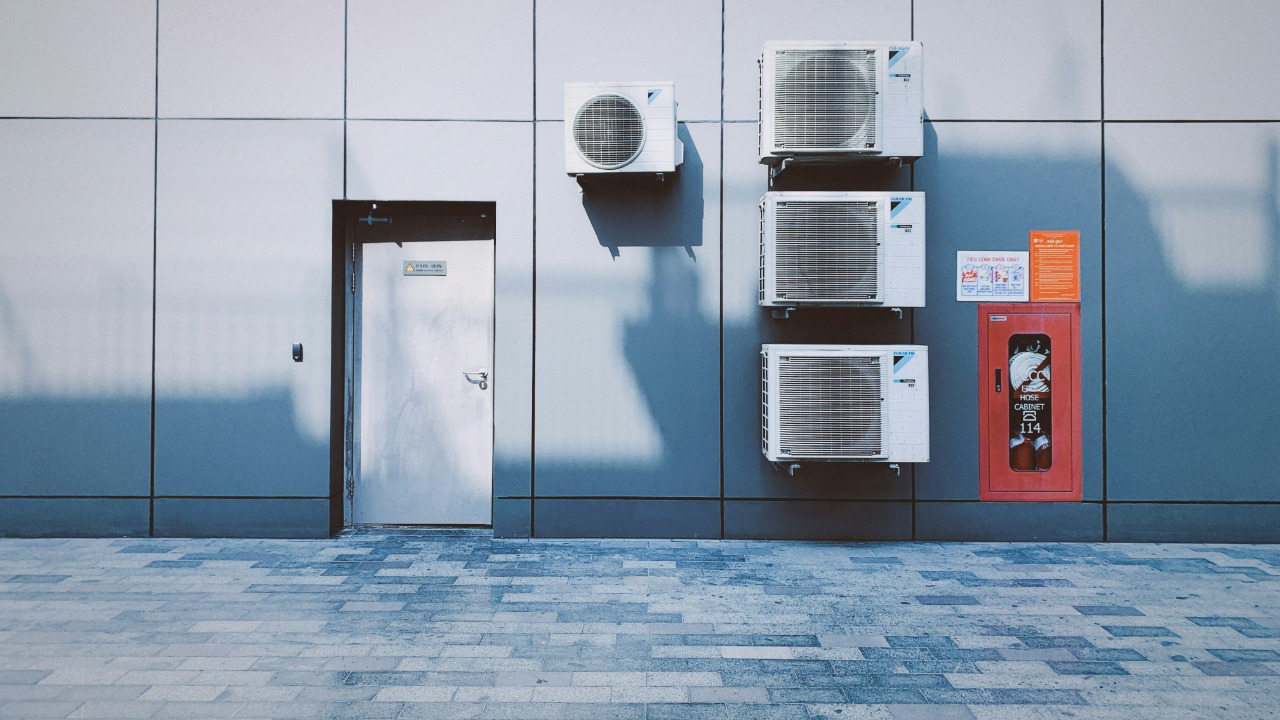
Installing conventional air conditioners everywhere could protect health and improve sleep, but it would also increase electricity demand. Outdoor condenser units release indoor heat into already hot streets, while widespread use during the same afternoon hours can create large peaks in power consumption.
Europe’s challenge is therefore not simply to install more cooling. It is to develop systems that provide cooling with lower electricity use, less refrigerant risk and better integration into older buildings.
EU Refrigerant Rules Are Accelerating the Search
European regulation is creating a strong incentive to redesign cooling equipment.
The European Union’s revised F-gas rules began prohibiting certain small split air conditioners containing high-global-warming-potential refrigerants in 2025. Additional restrictions are scheduled to affect small air-to-water systems from 2027 and air-to-air systems from 2029. From 2035, most new split systems rated at 12 kilowatts or less will be prohibited from relying on fluorinated greenhouse gases, subject to limited safety exemptions. The European Commission explains the timeline in its guidance on climate-friendly air-conditioning alternatives.
Manufacturers can respond by adopting natural refrigerants such as propane, improving system efficiency or developing equipment that avoids refrigerants entirely.
Solid-state cooling belongs to the final category. It attempts to move heat through changes inside solid materials rather than through the evaporation and compression of a gas.
Elastocaloric Systems Use Metal as the Refrigerant
One of the most promising approaches is elastocaloric cooling.
Certain shape-memory alloys change temperature when mechanical stress is applied. A nickel-titanium material may release heat when stretched or compressed and absorb heat as the stress is removed. Repeating the process while transferring heat through air or water can create a continuous cooling cycle.
The solid alloy performs part of the job normally carried out by a chemical refrigerant. It does not need to evaporate, circulate through a conventional compressor or be recovered by an engineer if the system is dismantled.
Europe’s EIC-funded SMACool project is working specifically towards a residential air-conditioning device based on shape-memory alloys. Its consortium includes universities in Germany, Italy and Slovenia alongside an Irish technology company. The project covers materials development, drive systems, simulation and the construction of an application-specific cooling device.
Fraunhofer IPM is also developing elastocaloric systems using materials such as Nitinol. The research institute describes these alloys as reversible materials capable of returning to their original form after deformation, enabling repeated heating and cooling cycles.
Other Systems Use Magnets, Pressure or Electricity
Elastocaloric technology is only one form of solid-state cooling.
Magnetocaloric systems use materials that change temperature when exposed to a magnetic field. Germany-based Magnotherm is developing this technology for commercial refrigeration, including equipment intended for food and beverage businesses. The company’s early focus on retail refrigeration illustrates how solid-state cooling may enter specialised commercial markets before appearing in ordinary homes.
Barocaloric systems create a thermal change by placing solid materials under pressure. UK company Barocal is developing equipment built around pressure-sensitive solids, while EU-funded projects are working to improve materials, heat exchangers and complete cooling systems. A Horizon Europe programme is supporting the development of barocaloric technology for commercial cooling applications.
Electrocaloric materials react to an applied electric field. The European COOLPOL project is targeting an electrocaloric air-conditioning system with one kilowatt of cooling power and a 15-kelvin operating temperature span. Achieving that objective will require advances in polymers, electronics and regenerative heat exchange rather than one material breakthrough alone.
Thermoelectric systems use an electrical current to create a temperature difference across semiconductor materials. They already exist in compact refrigerators and specialised electronics, but making them efficient and affordable enough for whole-room cooling remains difficult.
Home Cooling Could Become More Modular
Solid-state cooling could change more than the substance used to move heat.
Traditional systems often rely on one compressor serving a complete room, apartment or building zone. Some solid-state concepts could be divided into smaller modules installed closer to the area requiring temperature control.
A bedroom could receive more cooling at night while an unused living room receives less. Such room-by-room modulation could reduce the waste created when a large system operates at substantial capacity to cool only one occupied space.
Thermoelectric developer MIMiC is pursuing this distributed approach, using semiconductor modules to provide heating or cooling at individual endpoints. The company says the system can create a temperature gradient without a conventional refrigerant or compressor at each point of use.
Future residential products might consequently resemble quiet wall panels, compact fan units or integrated building components rather than today’s familiar outdoor compressor and indoor split-unit combination.
Fans, pumps and mechanical actuators may still be required, depending on the design. “Solid state” does not necessarily mean that the entire appliance contains no moving parts.
Refrigerant-Free Does Not Automatically Mean More Efficient
The strongest laboratory results can make solid-state cooling appear ready to outperform conventional air conditioning immediately. The reality is more complicated.
A caloric material may demonstrate a very high coefficient of performance when tested independently. Once it is placed inside a complete appliance, energy is also needed to operate actuators, magnets, pumps, fans, power electronics and heat exchangers.
RMI reports that some elastocaloric materials can achieve performance coefficients above 10 at material level. Early integrated systems may initially deliver a coefficient closer to 3, placing them in a range comparable with existing vapour-compression equipment rather than dramatically ahead of it.
Efficiency will therefore depend on the finished appliance, not merely the material inside it. Manufacturers must minimise friction, electrical losses, heat leakage and the energy required to stretch, compress or magnetise the active material.
Durability and Cost Remain Major Barriers
A household air conditioner is expected to operate through thousands of hours and survive many summers.
Elastocaloric and barocaloric materials must endure repeated mechanical cycling without cracking or losing performance. Magnetocaloric systems may require costly magnets or specialised materials, while electrocaloric designs can involve high electrical fields and demanding manufacturing processes.
Integrating the active material with heat exchangers is another difficult step. A prototype can successfully create a temperature change while still failing to move enough heat quickly enough to cool an occupied room.
Cost may become the decisive obstacle. Conventional air conditioners benefit from enormous global supply chains, trained installers and decades of manufacturing optimisation. New technologies must compete with that established industry while proving reliability, safety and serviceability. RMI identifies cost, system integration and material fatigue as central barriers to commercial adoption.
Homeowners Should Not Expect Refrigerant-Free Units Immediately
European solid-state cooling research is advancing, but most projects remain at prototype, demonstration or early-commercialisation stage.
Commercial refrigerators, hotel-room units, medical coolers and industrial equipment may offer easier entry points. These markets can tolerate higher initial prices when lower maintenance, precise temperature control or refrigerant elimination provides a valuable operational benefit.
Mass-market residential air conditioning will require complete products that can be manufactured at scale, installed by existing tradespeople and supported for many years.
Households needing cooling today should not postpone heat protection while waiting for the technology. Efficient reversible heat pumps, low-impact refrigerants, external shading, insulation, night ventilation and reflective materials can already reduce overheating. Passive measures remain especially important because they reduce the amount of mechanical cooling a building needs.
A Different Kind of Air-Conditioning Future
Europe may not follow the exact air-conditioning path taken by the United States or parts of Asia.
Its growing cooling demand is arriving at the same time as stricter refrigerant regulation, rising electricity concerns and substantial investment in alternative technologies. That combination gives European researchers an opportunity to reconsider how an air conditioner should work before conventional systems become nearly universal.
Solid-state cooling could eventually remove high-impact refrigerants, reduce compressor noise and enable more precise room-by-room control. It may also create appliances that provide both heating and cooling through the same reversible material process.
The transition will not happen overnight. Efficiency must be proven at system level, materials must survive years of cycling and manufacturing costs must fall substantially.
The next generation of European air conditioners is therefore not ready to transform every home yet. The important change is that cooling is no longer being treated as a problem that can only be solved by improving the same century-old compressor. Europe is testing whether the refrigerant itself can become a solid and whether that change can make comfortable homes compatible with a warming climate.