
The electric vehicle receiving Car and Driver’s highest honour for 2026 is not a luxury sedan, an electric pickup or a high-performance SUV. It is the compact and relatively affordable Chevrolet Bolt.
After evaluating the latest battery-powered vehicles for value, technology, driving enjoyment and success in fulfilling their intended purpose, Car and Driver selected the 2027 Chevrolet Bolt as its 2026 EV of the Year. The award year and model year are different because the vehicle reached customers during 2026 as a 2027 model. According to the original report inspiring the headline, the Bolt was selected after 25 electric vehicles were considered.
The decision represents an important shift in how electric vehicles are being judged. Instead of rewarding the model with the greatest horsepower, longest range or most advanced luxury cabin, the publication recognised a practical vehicle that makes modern EV ownership available at a lower price.
Why the Chevrolet Bolt Won
Car and Driver judged the competing vehicles according to the value, enjoyment and technology they offered, as well as how effectively each one completed its core mission. The Bolt stood out because it combined usable driving range, a spacious cabin, approachable controls and improved charging with a base price below $30,000. The publication described the winner as the most accessible option in the competition.
The 2026 Car and Driver EV of the Year announcement emphasised that producing an excellent affordable car can be more difficult than producing an excellent expensive one. Manufacturers can improve a premium EV by adding larger batteries, more powerful motors and costly technology. Building a lower-priced EV requires careful decisions about which features genuinely matter and which can be removed without making the vehicle feel incomplete.
That balance is where the Bolt succeeded. It is not the quickest, most luxurious or longest-range vehicle in the electric market. It instead delivers enough capability in the areas that influence everyday ownership.
A Starting Price Below $30,000 Changes the Conversation
The 2027 Chevrolet Bolt LT carries a starting manufacturer’s suggested retail price of $28,995, including the destination charge. Chevrolet describes it as America’s most affordable new electric vehicle, although transaction prices can vary according to location, equipment, dealer pricing and available incentives.
That price places the Bolt well below many of the electric vehicles typically associated with the category. Car and Driver highlighted the rear-wheel-drive Tesla Model 3 at $38,630 and the base Tesla Model Y at $41,630 as strong values, but both remained considerably more expensive than the Bolt. Rivian’s vehicles occupy a higher-priced segment and are designed around premium electric trucks and SUVs rather than entry-level urban transportation.
The award does not suggest that the Bolt is objectively better than every Tesla or Rivian in every category. A Tesla may offer more range, stronger acceleration or a broader software ecosystem, while a Rivian provides capabilities that a small front-wheel-drive hatchback cannot match. The Bolt won because Car and Driver judged it as the strongest overall product when purpose and value were considered together.
The Range Is Practical Rather Than Record-Breaking
Chevrolet gives the Bolt an EPA-estimated range of 262 miles on a full charge. That figure is far below the range of the longest-distance EVs, but it provides enough capacity for commuting, errands and occasional longer journeys without requiring daily charging. Chevrolet also states that the Bolt offers more range than any other new EV priced below $30,000.
During Car and Driver’s 75-mph highway test, the Bolt travelled 230 miles before its battery was depleted. The difference between the EPA estimate and the publication’s highway result is not unusual because sustained high-speed driving can consume more energy than the mixed driving represented by regulatory testing.
The Bolt uses a 65-kWh lithium iron phosphate battery. This battery chemistry helped Chevrolet control costs while improving the vehicle’s charging performance and efficiency. The powertrain produces 210 horsepower and sends power to the front wheels.
Charging Is Much Faster Than Before
Slow public charging was one of the previous Bolt’s most significant weaknesses. The revived model raises its peak DC charging rate to 150 kW, more than two and a half times the rate of the older vehicle. Chevrolet says the battery can move from 10% to 80% in approximately 25 minutes under suitable public fast-charging conditions.
Car and Driver recorded 38 minutes when charging from 10% to 90%, with an average rate of 94 kW during that session. The difference reflects the additional time required to charge the final portion of an EV battery, when the charging rate typically slows to manage heat and protect battery health.
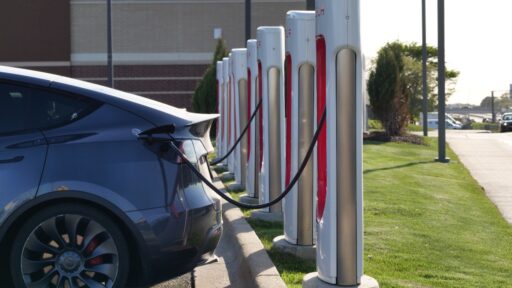
The Bolt is also the first Chevrolet equipped with a native North American Charging Standard port. This provides access to compatible NACS public chargers without requiring the type of adapter used by some earlier EVs. The official Chevrolet Bolt overview presents this charging access as one of the vehicle’s main practical upgrades.
It Is Not Fast by Modern EV Standards
The Bolt demonstrates how unusual electric-car performance has become. Its 210-horsepower motor takes the vehicle from zero to 60 mph in 6.7 seconds, according to Car and Driver’s testing. That result is modest beside high-performance EVs, but it remains entirely suitable for city traffic, motorway merging and routine overtaking.
Car and Driver also praised the vehicle’s light and responsive steering, manageable size and more entertaining handling than its tall hatchback shape might suggest. The Bolt’s appeal is therefore not based on extreme acceleration. It comes from being easy and reasonably enjoyable to operate during ordinary driving.
This approach separates the Bolt from an industry that has often used dramatic acceleration figures to justify high prices. Chevrolet appears to have focused its spending on range, charging, cabin space and usability rather than chasing sports-car performance.
The Interior Prioritises Space and Familiar Controls
Despite its compact external dimensions, the Bolt provides a relatively generous rear passenger area. Its tall roof and hatchback shape create useful room for passengers while retaining a small footprint suited to crowded roads and parking spaces.
The interior includes an 11.3-inch central infotainment display and an 11-inch driver information screen. Chevrolet retained physical controls for commonly used features such as climate settings and audio volume, avoiding the touchscreen-only approach adopted by several newer electric vehicles.
The cabin is not especially luxurious. Car and Driver identified extensive hard plastic, but also praised the storage areas, clear layout and straightforward operation. Available equipment includes wireless phone charging, a panoramic roof and GM’s Super Cruise hands-free driver-assistance system. Chevrolet also lists more than 20 standard safety and driver-assistance technologies.
The Bolt Still Has Important Weaknesses
The most obvious technology limitation is the absence of Apple CarPlay and Android Auto. General Motors has replaced smartphone projection in its newer EVs with an integrated Google-based infotainment system. Applications can be downloaded through the vehicle, but drivers who prefer their phone’s familiar interface may find this approach restrictive.
The redesigned 2026 Nissan Leaf illustrates the trade-off. An Edmunds comparison published by the Associated Press found that the Leaf offered up to 303 miles of EPA-estimated range, larger available screens, wireless Apple CarPlay and Android Auto, and more cargo space. The Bolt countered with a lower starting price, quicker tested charging, more rear legroom and more agile city handling. Edmunds ultimately gave the vehicles equal overall scores.
The Bolt is also a limited-run model, according to Chevrolet. That description may create uncertainty for buyers interested in its long-term place within the company’s EV range, although standard warranty and service obligations still apply to vehicles sold.
Why This Award Matters for the EV Market
The Bolt’s victory suggests that the next phase of EV competition may be driven less by extraordinary specifications and more by accessibility. Many early electric vehicles were sold as premium technology products, making them difficult for average new-car shoppers to consider.
The Bolt offers a different argument. It provides 262 miles of rated range, substantially improved fast charging, practical interior space and modern safety technology for less than $30,000 before optional equipment. Those qualities make electric driving relevant to buyers who care more about monthly costs and everyday usefulness than brand prestige or extreme horsepower.
Tesla helped establish the modern electric vehicle market, and Rivian demonstrated that electric trucks and adventure-focused SUVs could be highly desirable. Chevrolet’s achievement is different. The Bolt makes the case that the most important EV may be the one that more households can realistically purchase.
That is why Car and Driver’s 2026 winner is neither a Tesla nor a Rivian. The Chevrolet Bolt did not win by offering the most of everything. It won by offering enough of almost everything at a price the electric market has struggled to match.