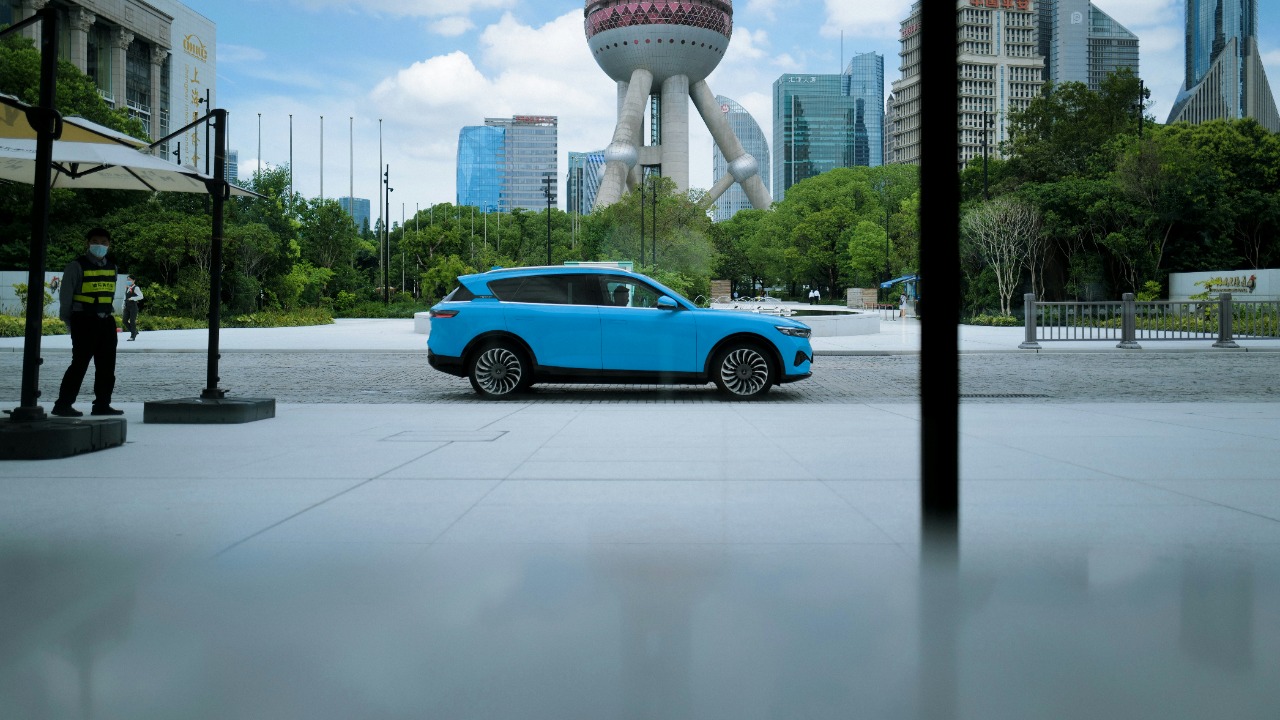

Chinese EVs have become impossible for the global auto industry to ignore.
Companies such as BYD, Geely, XPeng, Nio and others are producing EVs with increasingly competitive range, technology and pricing. China has also become the world’s largest EV market, and the International Energy Agency says 70% of battery-electric cars sold in China in 2025 were already cheaper than the average conventional car.
American consumers, meanwhile, continue to complain about one of the biggest barriers to EV adoption: price.
That creates an obvious question.
If Chinese manufacturers can offer capable electric cars for substantially less money, why shouldn’t Americans be allowed to buy them?
The case for entry is stronger than it might initially appear.
But so is the case against it.
The United States currently imposes major tariffs and national-security restrictions that make direct Chinese EV entry extremely difficult. Commerce Department rules also restrict connected-vehicle software and hardware linked to China because regulators fear sensitive vehicle data or remote systems could be accessed by foreign adversaries.
So should America open the door?
Here are five arguments for doing exactly that—and four reasons policymakers remain deeply reluctant.
Reason 1: Chinese EVs Could Make Electric Cars Much Cheaper
Affordability is probably the strongest argument for allowing Chinese EVs into the United States.
China has spent years driving down the cost of batteries, manufacturing and EV components.
The IEA reported that average global battery prices fell another 8% in 2025, helped by manufacturing improvements, battery chemistry changes and intense competition.
Chinese manufacturers sit at the center of much of that competition.
The difference becomes particularly obvious at the inexpensive end of the market.
American EV buyers still face a relatively limited selection of genuinely low-cost models, while Chinese consumers can choose from numerous compact electric cars that cost substantially less.
Opening the market could force EV prices downward.
That matters because someone choosing between a $25,000 gasoline hatchback and a $45,000 EV may admire the electric model without being able to afford it.
Make the EV $25,000 too, and the decision changes dramatically.
Reason 2: Competition Could Force U.S. Automakers to Improve Faster
American automakers have historically become better when they face serious competition.
Japanese manufacturers forced Detroit to take reliability and fuel efficiency more seriously.
Korean manufacturers later demonstrated that inexpensive vehicles could offer long warranties and increasingly sophisticated features.
Chinese EV makers could create a similar shock.
Ford CEO Jim Farley has repeatedly spoken publicly about the strength of China’s electric-car industry, while U.S. automakers are increasingly studying Chinese manufacturing costs and technology.
That concern is not theoretical.
Chinese brands are already expanding aggressively outside their home market, while China’s domestic EV industry has developed through intense competition in batteries, software, charging and manufacturing.
Allowing that competition into the U.S. could pressure domestic manufacturers to develop smaller, cheaper and technologically stronger EVs instead of relying so heavily on expensive SUVs and trucks.
Consumers usually benefit when automakers become uncomfortable.
Reason 3: Americans Would Get More Choice
The U.S. car market offers plenty of large vehicles.
What it lacks is variety at the inexpensive electric end.
Chinese companies produce tiny city EVs, compact sedans, wagons, family crossovers, luxury vehicles and performance models across a remarkably wide range of prices.
That could give American consumers choices domestic manufacturers currently do not prioritize.
Someone living in Manhattan may not need a 6,000-pound electric pickup.
She may want an efficient compact EV capable of handling commuting and groceries for less than $25,000.
The Chinese market demonstrates that such cars can exist.
The IEA’s Global EV Outlook 2026 shows how China’s combination of expanding model availability and falling battery costs has accelerated EV adoption.
More competition would not guarantee every Chinese model succeeded in America.
It would allow consumers to decide.
Reason 4: Cheaper EVs Could Accelerate Electrification
EV adoption becomes much easier when environmental benefits and financial benefits point in the same direction.
An expensive EV asks someone to pay more today in exchange for potential savings later.
An affordable EV changes the equation.
If Chinese competition pushed electric-car prices closer to conventional-car prices, more buyers could adopt EVs without needing substantial subsidies.
That could reduce gasoline consumption and transportation emissions faster than restricting the market to more expensive vehicles.
The U.S. EV market has recently faced weaker demand, particularly after the elimination of federal EV purchase credits. Reuters reported that North American EV sales were down in July 2026 while European demand continued growing.
Lower vehicle prices could compensate for some of that lost incentive.
Consumers may not need a $7,500 tax benefit if manufacturers can reduce the sticker price by a similar amount through competition.
Reason 5: Chinese EV Technology Could Raise Consumer Expectations
Chinese automakers are competing on much more than price.
Fast charging, advanced infotainment, battery technology, driver-assistance features and highly integrated vehicle software have become major battlegrounds.
Some Chinese EV interiors look closer to consumer-electronics products than traditional cars.
That creates pressure on everyone else.
Once buyers experience features such as sophisticated rear-seat displays, rapid charging or advanced voice interfaces at mainstream prices, those technologies stop feeling like luxury options.
They become expectations.
Chinese automakers have already demonstrated this effect in other international markets.
Allowing them into the United States could accelerate the rate at which premium EV technology becomes standard equipment.
But those benefits come with serious risks.
Reason 1 Against: Connected Cars Are Basically Computers on Wheels
Modern EVs collect enormous quantities of information.
They can contain cameras, microphones, GPS systems, cellular connections and sophisticated software capable of receiving remote updates.
That makes a connected vehicle fundamentally different from importing a washing machine.
The U.S. Commerce Department concluded that certain Chinese- or Russian-linked connected-vehicle technologies could create national-security risks because foreign entities might potentially access vehicle information or systems remotely.
The resulting rules prohibit certain Chinese-connected software beginning with 2027 model-year vehicles and impose hardware restrictions later in the decade.
Those concerns cannot simply be dismissed as protectionism.
Imagine millions of vehicles continuously collecting location information about American drivers.
Some belong to military personnel.
Others travel near sensitive facilities.
Connected vehicles could potentially reveal patterns that have intelligence value.
The policy question is therefore not merely whether BYD can build a good car.
It is whether the United States is comfortable with the software ecosystem inside millions of those cars.
Reason 2 Against: U.S. Manufacturing Jobs Could Take a Serious Hit
Cheap imports create winners and losers.
Consumers may receive lower prices.
Domestic manufacturers face much greater pressure.
The American automotive industry supports enormous numbers of manufacturing, supplier and logistics jobs.
If Chinese vehicles entered at prices Detroit struggled to match, domestic factories could face severe pressure.
Chinese manufacturers have benefited from years of industrial policy, scale and supply-chain investment. Critics in the United States and Europe argue that government support has helped Chinese companies produce vehicles at prices competitors cannot easily replicate.
That concern helped drive the U.S. decision to impose a 100% Section 301 tariff on Chinese EVs, a rate that remains a major barrier to direct imports.
Protecting inefficient companies indefinitely can hurt consumers.
Allowing an abrupt wave of low-cost imports can also damage industrial capacity that may be difficult to rebuild.
Reason 3 Against: America Could Replace Oil Dependence With Battery Dependence
EVs reduce petroleum dependence.
But they create new supply-chain dependencies.
China dominates significant portions of battery manufacturing, mineral processing and component production.
The IEA’s 2026 research continues to show China’s extraordinary position throughout the battery supply chain, while the country’s competitive manufacturing base helps explain why Chinese EVs can be so inexpensive.
Depending heavily on another country for critical transportation technology creates strategic risk.
A future trade conflict could disrupt battery supplies.
Export controls could affect components.
Political tensions could make replacement parts more difficult to obtain.
Washington therefore sees domestic battery and vehicle production as more than an economic-development program.
It is also resilience policy.
Reason 4 Against: Extremely Cheap Competition Could Destroy Rivals Before the Market Stabilizes
China’s EV industry is fiercely competitive.
That is partly why innovation has happened so quickly.
It has also created serious overcapacity and price wars.
China introduced new EV export-permit requirements beginning in 2026 as officials attempted to encourage healthier development of the sector amid concerns about aggressive domestic competition.
If heavily capitalized manufacturers enter another country and price vehicles aggressively, competitors can be pushed out before anyone knows whether those prices are sustainable over the long term.
Once domestic competition disappears, consumers may become dependent on a smaller group of foreign suppliers.
The theoretically cheapest market today is not necessarily the healthiest market ten years from now.
The Better Question May Be How Chinese EVs Enter America
The debate does not necessarily need to end with either unrestricted imports or a permanent ban.
There is a middle path.
Chinese automakers could potentially manufacture vehicles inside the United States under strict cybersecurity, ownership and supply-chain requirements.
President Trump has publicly expressed openness to Chinese manufacturers building vehicles in America, even while his administration maintains restrictions on Chinese connected-car technology.
That model could capture some benefits of Chinese competition while addressing concerns about jobs and sensitive technology.
Manufacturing plants could employ American workers.
Software could be locally controlled and independently audited.
Data could remain inside the United States.
Supply chains could gradually become more diversified.
The difficult question would be how much Chinese ownership or technology Washington was willing to permit.
Chinese EVs Would Probably Be Great for American Buyers—and Terrifying for American Automakers
That is ultimately why this debate is so difficult.
From a purely consumer perspective, allowing Chinese EVs into America has obvious attractions.
Prices could fall.
Choice could increase.
Technology could improve faster.
American manufacturers would face stronger pressure to innovate.
EV adoption could accelerate.
But national policy cannot look only at next year’s vehicle prices.
Cars are becoming connected computing platforms.
Auto factories support strategically important industrial capacity.
Battery supply chains are increasingly geopolitical.
And China is both America’s largest manufacturing competitor and one of the most important players in the technologies powering the next generation of transportation.
That is why Chinese EVs remain largely outside the U.S. market even while drivers elsewhere are increasingly buying them.
The United States is effectively paying a price to protect domestic industrial and security interests.
Whether that price is worth paying is the real argument.
Consumers may eventually look across the border at affordable, feature-packed Chinese EVs and understandably ask:
Why can’t we buy those here?
American policymakers have an equally important question:
What happens if one day almost everyone does?