
Electric vehicles have spent years fighting the same problem in the United States: price.
Consumers may like instant torque, home charging and lower fuel costs, but none of those advantages matter much when an electric SUV costs thousands more than the gasoline vehicle sitting beside it.
Kia may finally be attacking that problem directly.
The 2027 Kia EV3 is arriving in the United States with entry-level pricing around the $31,000 mark, making it one of the most affordable new electric SUVs in the country. Recent pricing reports put the entry model just above $31,000 once destination charges are included, substantially below the roughly $35,000 target Kia had previously discussed.
That price becomes more interesting when the rest of the vehicle is considered.
Higher-range versions can travel approximately 321 miles on a charge, the EV3 has a native NACS charging port, and Kia has packed many of the technologies associated with its more expensive EV6 and EV9 into a much smaller package.
The EV3 therefore isn’t simply another inexpensive EV.
It could become an important test of whether Americans actually want smaller electric vehicles when the price finally starts making sense.
The EV3 Is Kia’s New Entry Point Into Electric Cars
Kia already sells some impressive electric vehicles in America.
The EV6 combines long range with excellent fast-charging performance. The three-row EV9 provides the space and presence expected from a large family SUV.
Neither has traditionally been positioned as a truly inexpensive entry into EV ownership.
The EV3 changes that.


6
Kia describes the EV3 as its most accessible electric model, designed to package technology and styling inspired by the larger EV9 into a compact SUV.
That positioning could be exactly what the U.S. EV market needs.
Instead of asking buyers to spend luxury-car money to experience an electric drivetrain, Kia is moving closer to the price range occupied by ordinary compact crossovers.
The Cheapest EV3 Comes With a Catch
The headline price is excellent, but buyers should understand what they receive at the bottom of the range.
The entry-level Light model uses the smaller battery.
According to recently announced U.S. specifications, it delivers an estimated 221 miles of range.
That is enough for many commuters.
Someone driving 30 miles per day could theoretically cover several days of normal commuting between charges.
But 221 miles is not particularly generous for drivers who regularly take long highway trips.
That is where the more expensive EV3 versions become considerably more interesting.
The front-wheel-drive Wind and Land models use the extended-range battery and are rated at approximately 321 miles.
That crosses an important psychological barrier.
A 300-plus-mile EV starts feeling less like a vehicle that requires constant range planning and more like a conventional car that happens to run on electricity.
More Than 300 Miles Could Be the EV3’s Real Selling Point
Price attracts attention.
Range may sell the vehicle.
When Kia originally presented the U.S.-market EV3, it promised certain configurations would deliver around 320 miles of estimated driving range. The production specifications have essentially delivered on that promise.
That puts the EV3 into an interesting position.
Affordable electric vehicles have traditionally required compromise.
The buyer could get a low price but limited range.
Or he could get long range by spending considerably more.
The EV3 begins narrowing that gap.
The extended-range Wind costs more than the base Light, but it still places 300-plus-mile EV ownership within reach of buyers who might previously have considered only gasoline or hybrid crossovers.
That could matter more than any futuristic feature Kia adds to the dashboard.
Charging Isn’t as Fast as an EV6
There is one technical compromise worth understanding.
The EV3 does not use the same high-performance 800-volt electrical architecture that makes vehicles such as the Kia EV6 exceptionally fast at compatible DC chargers.
Instead, the EV3 operates on a lower-voltage architecture.
That means it will not produce the spectacular charging figures associated with Kia’s more expensive electric models.
But it is hardly slow.
Kia says the smaller-battery Light can charge from 10% to 80% in as little as 29 minutes under appropriate fast-charging conditions.
The larger battery takes only slightly longer according to published U.S. specifications.
For a budget-oriented electric crossover, that is a reasonable trade-off.
A driver stopping for food or coffee during a road trip could recover a substantial amount of range before continuing.
Kia Made One Very Smart Charging Decision
The EV3 arrives with a native NACS charging port.
That is the connector design originally popularized by Tesla and increasingly adopted across the American automotive industry.
Kia says the EV3 also supports Plug & Charge through Kia Charge Pass in the Kia Access app.
That could make public charging much less intimidating for first-time EV owners.
Charging infrastructure has historically been one of the weakest parts of the American electric-car experience.
Different connectors, apps, networks and payment systems created unnecessary friction.
NACS adoption is gradually simplifying that landscape.
For a vehicle specifically intended to attract new EV buyers, making charging easier is arguably just as important as adding another 20 miles of battery range.
The EV3 Doesn’t Look Like a Cheap Economy Car
Affordable vehicles frequently advertise their price through their appearance.
Kia has taken a different approach.
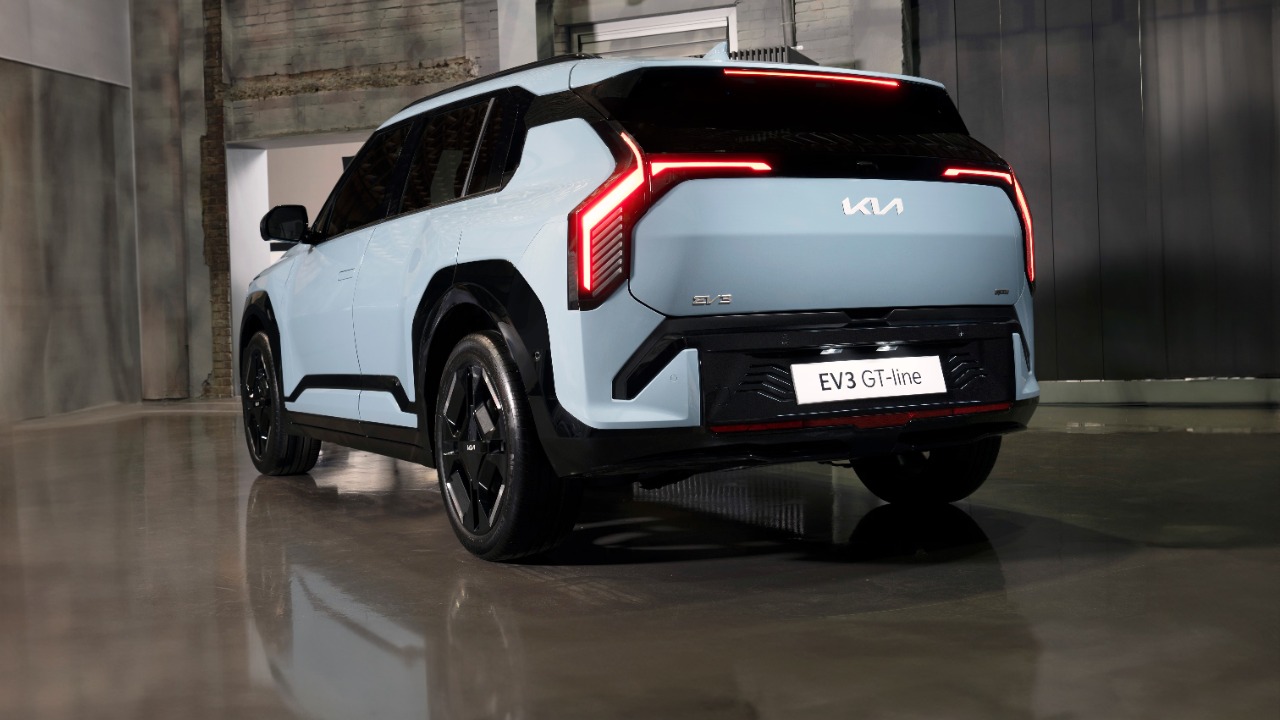
The EV3 borrows heavily from the company’s much larger EV9.
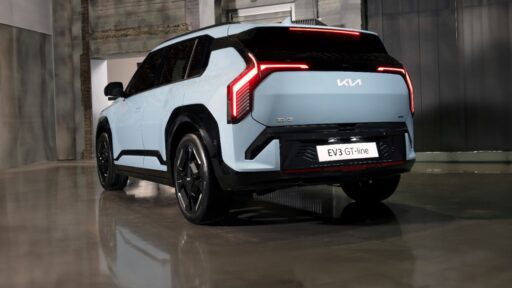
It has an upright, boxy shape, geometric bodywork and Kia’s distinctive Star Map lighting design.
That gives it considerably more visual presence than its compact dimensions might suggest.
The same philosophy continues inside.
The cabin includes Kia’s Connected Car Navigation Cockpit, over-the-air update capability and available digital services. Kia is also offering an AI-based voice assistant intended to provide more natural interaction with the vehicle.
These features matter because inexpensive EVs cannot succeed merely by being inexpensive.
They still need to feel desirable.
If buyers perceive an affordable EV as something they purchase only because they cannot afford a better vehicle, demand will remain limited.
Kia appears determined to avoid that problem.
It Also Has Some Surprisingly Premium Technology
Depending on trim, EV3 buyers can access technology that would have sounded unusual in an entry-level crossover only a few years ago.
Kia lists up to 27 available collision-avoidance and driver-assistance features for the vehicle.
Available equipment includes Highway Driving Assist 2 and Remote Smart Parking Assist, while Digital Key 2.0 can allow compatible smartphones to function as vehicle keys.
Vehicle-to-Load capability is another interesting feature.
V2L allows electricity stored inside the EV’s large traction battery to power external devices.
That can make the vehicle useful during camping trips, outdoor activities or certain power outages.
Again, these technologies are not necessarily what someone expects from the least expensive EV in a manufacturer’s lineup.
All-Wheel Drive Is Available, but Range Falls
Drivers living in colder climates or simply wanting additional traction can choose all-wheel-drive versions.
There is an efficiency penalty.
Published U.S. specifications put the extended-range front-wheel-drive Wind and Land at approximately 321 miles, while corresponding AWD configurations fall to around 280 miles.
That illustrates an important EV purchasing decision.
More motors generally mean more performance and traction, but they can also increase weight and energy consumption.
A driver living somewhere with mild weather may find the front-wheel-drive EV3 more compelling because maximizing range provides greater everyday benefit than having all-wheel drive.
Someone regularly driving through snow may reach the opposite conclusion.
At least Kia gives buyers the choice.
The EV3 Could Put Pressure on Every Affordable EV
The EV3 is entering the market at an interesting moment.
Automakers are finally acknowledging that EV adoption cannot depend entirely on $50,000 and $60,000 vehicles.
The revived Chevrolet Bolt is targeting the affordable end of the market, while Ford and other manufacturers are developing lower-cost electric platforms.
Kia itself recently reduced the starting price of the 2026 EV6 to $37,900 before destination charges, explicitly positioning that change alongside the arrival of the EV3 as part of an effort to make electric vehicles more attainable.
Competition around $30,000 could transform the EV market more dramatically than another six-figure electric performance SUV ever could.
That is where enormous numbers of ordinary car buyers actually shop.
Mexican Production Could Become Important
Kia is also making an important manufacturing move.
The company is investing hundreds of millions of dollars to produce electric vehicles in Mexico, with EV3 production included at its Nuevo León facility.
Manufacturing closer to the U.S. market can potentially reduce logistical costs and improve supply flexibility.
But North American EV manufacturing has become increasingly entangled with trade rules, tariffs and domestic-content requirements.
Those policies can change quickly.
For buyers, the important point is that Kia appears to view the EV3 as more than a limited imported experiment.
Regional manufacturing suggests the company expects the compact EV to play a meaningful role in its North American strategy.
The Cheapest EV3 May Not Be the One Most People Should Buy
The approximately $31,000 entry price will dominate advertisements.
Yet the Wind FWD may be the more interesting version for many buyers.
The reason is simple.
Moving beyond the entry model provides the larger battery and approximately 321 miles of range.
That transforms how the vehicle can be used.
The cheaper Light makes sense as an urban or commuter vehicle, particularly for someone who can charge at home.
The extended-range version becomes much easier to imagine as someone’s only car.
It can commute during the week.
It can handle weekend journeys.
It can cover substantial highway distances between charging stops.
That versatility may justify the higher purchase price.
Kia May Have Finally Hit the Price EV Buyers Were Waiting For
The EV3 does not solve every obstacle facing electric cars.
Apartment dwellers still need reliable charging.
Public fast-charging infrastructure still varies dramatically by region.
Cold weather still affects EV range.
And the cheapest EV3 does not provide the 300-plus-mile range advertised for the larger-battery versions.
But the fundamental equation is changing.
Kia is offering an electric SUV around the $31,000 mark while retaining recognizable SUV styling, modern technology, useful fast charging and the option of more than 300 miles of driving range.
That is much closer to what mainstream EV adoption was always supposed to look like.
Not a $100,000 technological showcase.
Not a stripped-down compliance car with barely enough range to leave the city.
Just a relatively affordable compact SUV that happens to be electric.
If the EV3 sells strongly, its biggest impact may have little to do with Kia itself.
It could force competitors to answer an uncomfortable question:
If Kia can build a genuinely useful electric SUV around this price, why are so many other EVs still so expensive?