
The Audi ZERØ appears to be the kind of vehicle that could roll out of an experimental city in a retro science-fiction film. It combines a spherical cabin, exposed tubular forms and polished metallic surfaces in a body that looks simultaneously futuristic and strangely old-fashioned.
Its name and four-ring badge suggest that Audi has produced an unusually radical micro-EV. That impression is misleading.
The ZERØ is an independent design exercise created by automotive designer Wini Camacho. Audi did not commission, approve or announce the project, and no production programme exists behind it. The vehicle has been shown through computer-generated images and videos rather than as a functional prototype. (bgr.com)
That freedom allowed Camacho to ignore many conventions of contemporary vehicle design. It also produced a machine that works far more convincingly as visual experimentation than as an answer to real urban transport.
One Sphere and Four Tubes Form the Entire Car
The ZERØ begins with an extremely simple geometric formula: one sphere and four tubes.
The sphere forms the passenger compartment. Two tubular structures appear to support or contain the wheels, while the remaining forms extend towards the front and rear. Rather than covering those components with a familiar car-shaped body, the design allows the primary volumes to become the vehicle’s identity. (designboom.com)
Camacho imagined the design as both the enclosed ZERØ CØupé and the open ZERØ RØadster. Published specifications place it at approximately 3.1 metres long and 1.85 metres wide, making it short enough for dense urban environments but surprisingly broad for something described as a microcar. (t3.com)
Descriptions of the seating arrangement are inconsistent. T3 and BGR describe a single-seat or centrally controlled cabin, while another design publication calls it an ultra-compact two-seater. That uncertainty is a useful reminder that the ZERØ is not a fully defined engineering proposal. Its purpose is to communicate form rather than settle practical questions about passengers, luggage or mechanical packaging.
Its Vintage Influence Comes From the Silver Arrows Era
Although the ZERØ looks like an imagined vehicle from the future, its metallic finish and dramatic proportions echo the aerodynamic racing machines associated with Auto Union during the 1930s.
Auto Union was formed from Audi, DKW, Horch and Wanderer in 1932. Its Grand Prix cars adopted a then-unusual mid-engine layout and lightweight construction, while the Type C used a six-litre, 16-cylinder engine producing approximately 520 horsepower. Audi’s own historical account says the Type C could exceed 340 kilometres per hour in normal racing bodywork and reach even greater speeds in specialised aerodynamic form. (audi.com)
The ZERØ does not directly reproduce the Type C. Instead, it borrows the emotional language associated with that period: exposed mechanical confidence, smooth silver surfaces and the belief that extreme geometry can represent technological progress.
This makes the design retro-futuristic rather than traditionally retro. It does not resemble an old production Audi in the way a modern Volkswagen Beetle resembles its predecessor. It looks more like an alternative version of automotive history in which 1930s streamlining evolved directly into compact electric transport.
The Interior Rejects the Screen-Heavy EV Trend
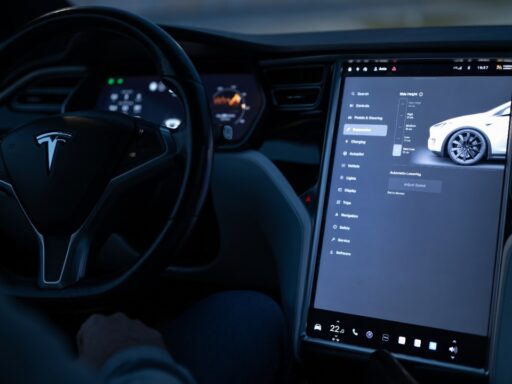
Many modern electric cars attempt to appear advanced by filling their cabins with displays. The ZERØ moves in the opposite direction.
Its interior is organised around a central steering unit, an analogue-style instrument display and physical controls integrated into one concentrated structure. The approach treats the driving interface as an object rather than a collection of touch-sensitive surfaces spread across the dashboard. (bgr.com)
That aspect of the project is more convincing than its exterior architecture. Drivers frequently need to operate climate, navigation and vehicle controls without looking away from the road. Clearly separated physical inputs can provide tactile information that a completely flat touchscreen cannot.
The problem is not the idea of centralising the controls. It is the absence of evidence showing whether the arrangement could support the visibility, ergonomics, safety systems and accessibility required in a production vehicle.
A beautiful steering module in a rendering does not reveal where an airbag would fit, how the steering column would collapse in a crash or whether different drivers could reach every function comfortably.
The ZERØ Is Compact Without Being Practical
A city vehicle should be small for a reason. Its limited dimensions should make parking easier, reduce energy use or allow more vehicles to occupy the same amount of road space.
The ZERØ achieves visual compactness, but its proportions raise questions. At 3.1 metres, it is short. At 1.85 metres, it is not especially narrow. A car can therefore occupy relatively little kerb length while still demanding substantial road and parking width.
The spherical cabin and tubular body also leave no obvious space for ordinary cargo. T3 noted that the design appears to provide nowhere for shopping, while Moss and Fog described its impracticality as intentional rather than accidental. (mossandfog.com)
That weakness matters because small vehicles must work especially hard to use their limited volume efficiently. A micro-EV that carries only a driver and almost nothing else may serve a narrow commuting role, but it cannot easily replace a bicycle, public transport journey or conventional small car for broader household use.
It Is an EV Concept Without an EV Specification
The project is described as electric, yet the published material does not identify a battery capacity, motor output, charging speed, estimated range or target weight.
There is no visible explanation of where a substantial traction battery would sit inside the geometric structure. The tubes could theoretically contain structural or drivetrain components, but the concept has not been presented with engineering diagrams proving that possibility.
This absence is not unusual for an independent design study. The ZERØ is exploring what a vehicle could look like after conventional bodywork is removed. It is not attempting to demonstrate a production-ready electrical platform.
The distinction becomes important when online coverage treats every polished digital model as a future product. A rendered EV does not face battery cooling, crash testing, weather sealing, tyre loads, manufacturing tolerances or repair costs. Its geometry exists under ideal visual conditions.
Audi Already Has a More Credible Version of Radical Simplicity
The ZERØ becomes less persuasive when compared with Audi’s actual design direction.
Audi’s official Concept C is also a minimalist electric sports car influenced by the company’s history. It uses an upright front frame inspired partly by the 1936 Auto Union Type C, combines coupé styling with a retractable hardtop and places physical controls inside a restrained cabin. Audi describes the design philosophy as “radical simplicity.” (audi-mediacenter.com)
The difference is execution. Concept C remains dramatic, but it still has recognisable doors, lights, mirrors, seating, body structure and usable proportions. Audi has said it previews a planned production vehicle and has even developed the concept with road approval, allowing it to be driven rather than merely viewed. (audi.com)
Both vehicles pursue reduction. The official Audi reduces unnecessary visual decoration while preserving the architecture of a viable car. The unofficial ZERØ reduces the car until many of its practical qualities disappear with the styling.
That Does Not Make the Project Worthless
Conceptual design does not need to reach production to have value.
The ZERØ asks a legitimate question: does an electric vehicle need to resemble a petrol-powered car? Batteries and motors create different packaging opportunities from large combustion engines, fuel tanks, exhaust systems and multi-speed transmissions.
Much of the automotive industry has answered that question conservatively. Manufacturers often use electric platforms to produce familiar SUVs and saloons because buyers understand them and factories can manufacture them.
Camacho’s project rejects that commercial caution. It treats the electric drivetrain as permission to reconstruct the vehicle from elementary shapes.
The result may never pass through an Audi factory, but parts of its thinking could influence more realistic products. A concentrated physical control system, exposed structural components or clearer separation between the passenger cell and drivetrain could all be explored without reproducing the complete vehicle.
A Memorable Design That Should Remain a Thought Experiment
The Audi ZERØ succeeds at attracting attention. Its polished spherical cabin and exposed tubes create a silhouette that could not be mistaken for another electric crossover.
It also demonstrates why automotive design cannot be judged through appearance alone.
A useful micro-EV needs efficient packaging, manageable width, storage, safety equipment, realistic entry points and a drivetrain that can be manufactured and maintained. The ZERØ has not shown how it would satisfy those demands.
Its vintage Silver Arrows mood and analogue interior give it character, but the same reduction that makes the design memorable removes much of what would make it usable.
As a digital sculpture, the ZERØ is provocative. As a potential urban car, it is a pipe dream. Its strongest contribution may be encouraging real manufacturers to think more boldly—without asking drivers to live inside one sphere supported by four tubes.