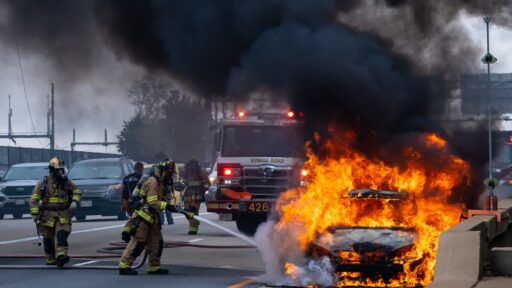
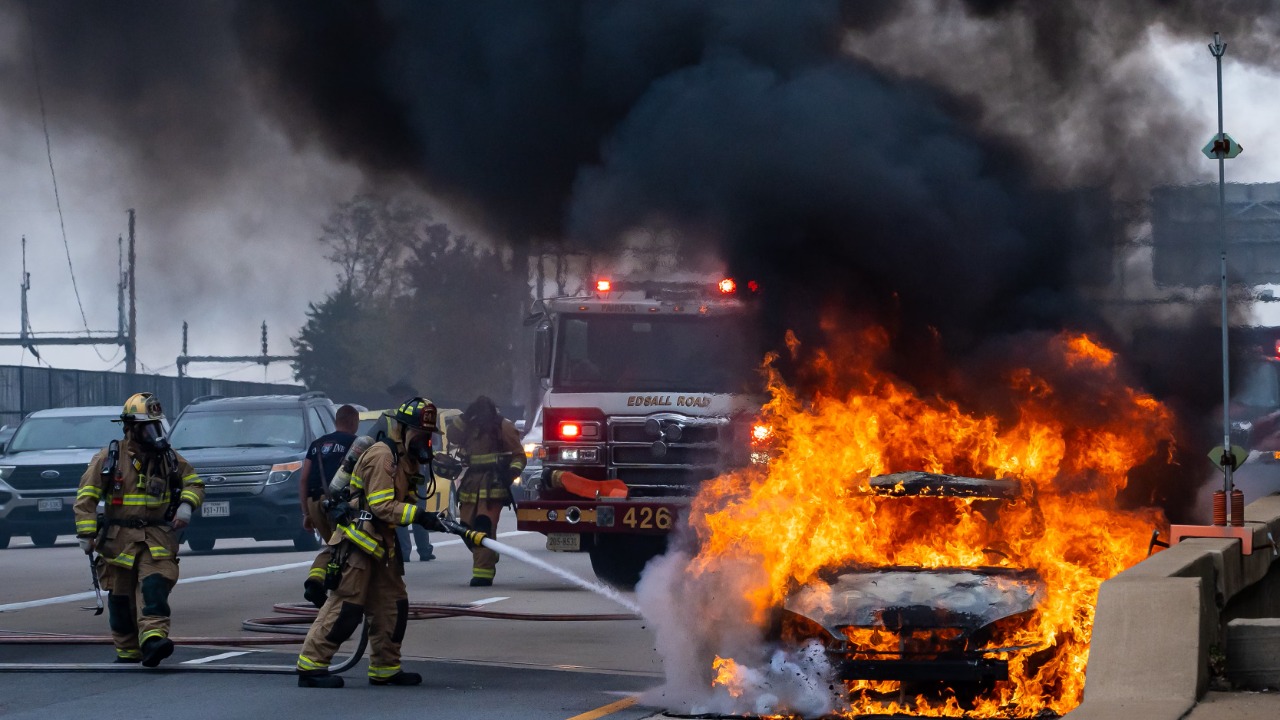

When a gasoline-powered car catches fire, firefighters generally concentrate on knocking down the visible flames, cooling nearby components and preventing fuel from spreading. An electric vehicle fire can demand a different strategy when the high-voltage battery becomes involved.
The flames outside the car may disappear relatively quickly, yet damaged battery cells can remain dangerously hot beneath the passenger compartment. Firefighters may therefore continue applying water long after the visible fire appears to be under control.
The large volume is not used because electricity somehow makes water ineffective. Water is actually one of the most useful agents for controlling a lithium-ion battery fire. The challenge is delivering enough of it to the correct part of a sealed battery pack and continuing until the internal temperature falls below the level at which thermal runaway can spread or restart.
The National Transportation Safety Board’s investigation into electric-vehicle battery fires concluded that high-voltage battery fires can require sustained quantities of water because the primary objective is both extinguishment and deep cooling.
Thermal Runaway Can Spread From Cell to Cell
An electric vehicle battery contains hundreds or thousands of individual lithium-ion cells arranged into modules and enclosed inside a strong protective pack. During normal operation, battery-management systems monitor temperature, voltage and charging conditions.
A severe collision, manufacturing defect, internal short circuit, overheating event or water intrusion can damage a cell. Once that cell becomes hot enough, its internal materials can begin reacting uncontrollably and releasing additional heat. This process is known as thermal runaway.
The heat from one failing cell can then raise the temperature of neighboring cells until they also enter thermal runaway. The result resembles a chain reaction moving through part of the battery pack. Cells may vent flammable gases, produce intense heat and ignite at different times rather than burning simultaneously.
The National Fire Protection Association’s electric-vehicle safety information explains that damaged lithium-ion cells can experience uncontrolled increases in temperature, creating fire, toxic-gas and reignition hazards.
Water Is Needed Mainly for Cooling
A common misconception is that water cannot be used because lithium batteries react violently with it. Electric vehicles normally use lithium-ion cells rather than blocks of exposed metallic lithium. Firefighters equipped and trained for the incident can use water to fight the fire and, more importantly, remove heat from the battery.
Water has a high heat-absorbing capacity. When applied continuously, it can cool damaged cells and reduce the chance that thermal runaway will spread into undamaged modules. It can also cool the battery enclosure, vehicle body and nearby property.
Dry chemical agents, carbon dioxide and foam may reduce visible flames around the cabin, tires or exterior. However, they generally provide less sustained cooling than water. A fire can therefore appear extinguished while reactions continue inside the battery.
The NFPA’s lithium-ion battery guidance specifically states that firefighters should use water against lithium-ion battery fires. The purpose is not only to cover the flame but also to control the continuing heat generated within the cells.
The Battery Pack Is Designed to Keep Water Out
The same construction that protects an EV battery during rain, road use and ordinary collisions can make a battery fire more difficult to control.
Most passenger EV packs are installed beneath the floor and protected by metal casings, structural supports and water-resistant seals. These barriers are designed to prevent road debris, dirt and moisture from reaching the cells.
During a fire, those protections can also prevent hose water from reaching the hottest area. Firefighters may spray large amounts onto the vehicle while only a limited portion actually penetrates the damaged pack. Water striking the top or side of the car may cool the exterior without reaching cells burning beneath the floor.
The 2025 CTIF operational guide for electric-vehicle emergencies describes water as highly effective for cooling and limiting thermal propagation, while noting that delivering it directly inside the battery casing can be extremely difficult.
Real Incidents Show How Widely Water Use Can Vary
There is no fixed quantity of water required for every electric car fire. The amount depends on battery size, cell chemistry, state of charge, crash damage, pack design, access to the battery and whether thermal runaway has spread through multiple modules.
In four battery-fire investigations reviewed by the NTSB, responders used amounts ranging from approximately 300 gallons to more than 20,000 gallons. One incident required unusually large quantities because firefighters initially struggled to direct water onto the underside of the battery. Once the vehicle was elevated and water reached the pack more directly, the fire could be controlled more effectively.
The same NTSB report cited fire-service guidance suggesting that a high-voltage battery fire could require more than 2,600 gallons, depending on the battery’s size and location. These figures are incident examples and planning guidance, not a rule that applies to every EV fire.
Tesla’s Model 3 Emergency Response Guide gives a model-specific estimate of approximately 3,000 to 8,000 gallons applied directly to the battery to extinguish and cool a battery fire fully. It also tells responders to establish an additional water supply early and monitor battery temperature for possible reignition.
Reignition Extends the Emergency
A lithium-ion battery can retain significant electrical and chemical energy even after the vehicle has been switched off or severely damaged. The NTSB describes this remaining energy as stranded energy.
A damaged cell may continue heating without producing obvious flames. Hours later, that heat can trigger another cell, causing smoke or fire to return. In documented cases, damaged EV batteries have reignited after the initial fire was extinguished, during recovery or after the vehicle had been transported.
In one NTSB-investigated crash, a battery fire reignited approximately 45 minutes after it had been declared extinguished. The agency has also documented cases in which damaged batteries reignited days after the original incident.
This risk explains why firefighters may continue applying water after the flames are gone. Thermal cameras, infrared equipment, smoke, hissing and changes in temperature can help responders evaluate the battery, but it may remain difficult to determine precisely what is happening inside a sealed pack.
The NHTSA electric and hybrid vehicle safety page advises that damaged lithium-ion vehicles should not be stored in a garage or close to buildings, other vehicles or combustible materials because delayed fire remains possible.
Fire Blankets Cannot Remove the Internal Heat
Fire blankets are sometimes promoted as a way to contain a burning electric vehicle. A blanket can reduce visible flames and limit radiant heat from materials burning inside the cabin. However, covering the vehicle does not necessarily stop thermal runaway inside the battery.
Lithium-ion cells can release flammable gases as they heat. Restricting ventilation without cooling the pack may allow those gases to accumulate. In 2025, the NFPA and several fire-service organizations issued a joint notice about potential risks involving EV fire blankets, including the possibility of an explosion hazard when a battery is involved.
A blanket may still have specific tactical uses, but it does not replace the need to cool a battery undergoing thermal runaway.
Firefighters Are Testing More Direct Cooling Methods
Fire departments and equipment manufacturers are developing tools intended to deliver water more efficiently. Underbody nozzles can be positioned beneath the vehicle to cool the battery casing without placing firefighters directly beside the car. Other systems are designed to penetrate or access a pack and inject water closer to the affected cells.
Direct application may significantly reduce the time and water required, but piercing a battery is not a universal solution. Pack structures differ between manufacturers, and an incorrectly placed tool could expose responders to electrical hazards, flammable gases or sudden reactions.
Vehicle-specific emergency response guides are therefore essential. The NTSB has repeatedly recommended standardized rescue information showing responders where the battery, high-voltage cables, shutdown points and safe water-application areas are located.
Better Battery Design Could Reduce the Challenge
Future EVs may become easier to manage through improved cell chemistry, stronger thermal barriers and battery designs that slow propagation between modules. Some manufacturers have also explored dedicated access points that allow firefighters to introduce water directly into the pack.
The objective is not simply to make batteries impossible to ignite. It is also to ensure that a damaged battery fails more slowly, gives clearer warnings and can be cooled without using extraordinary amounts of water.
Electric-vehicle fires are not all identical, and a fire involving only tires, upholstery or external components may be handled much like another vehicle fire. The unusually high water demand occurs primarily when the high-voltage pack enters thermal runaway.
At that point, firefighters are not merely extinguishing what can be seen. They are trying to stop an internal chain reaction inside a sealed, energy-dense structure. Until water reaches the hottest cells and removes enough heat, the fire may remain capable of returning.