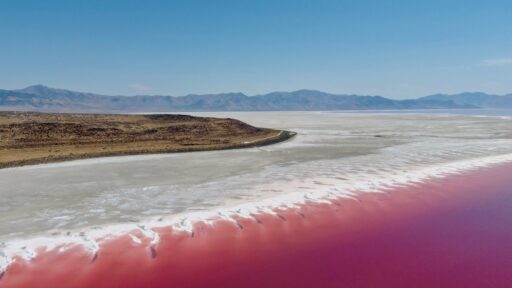
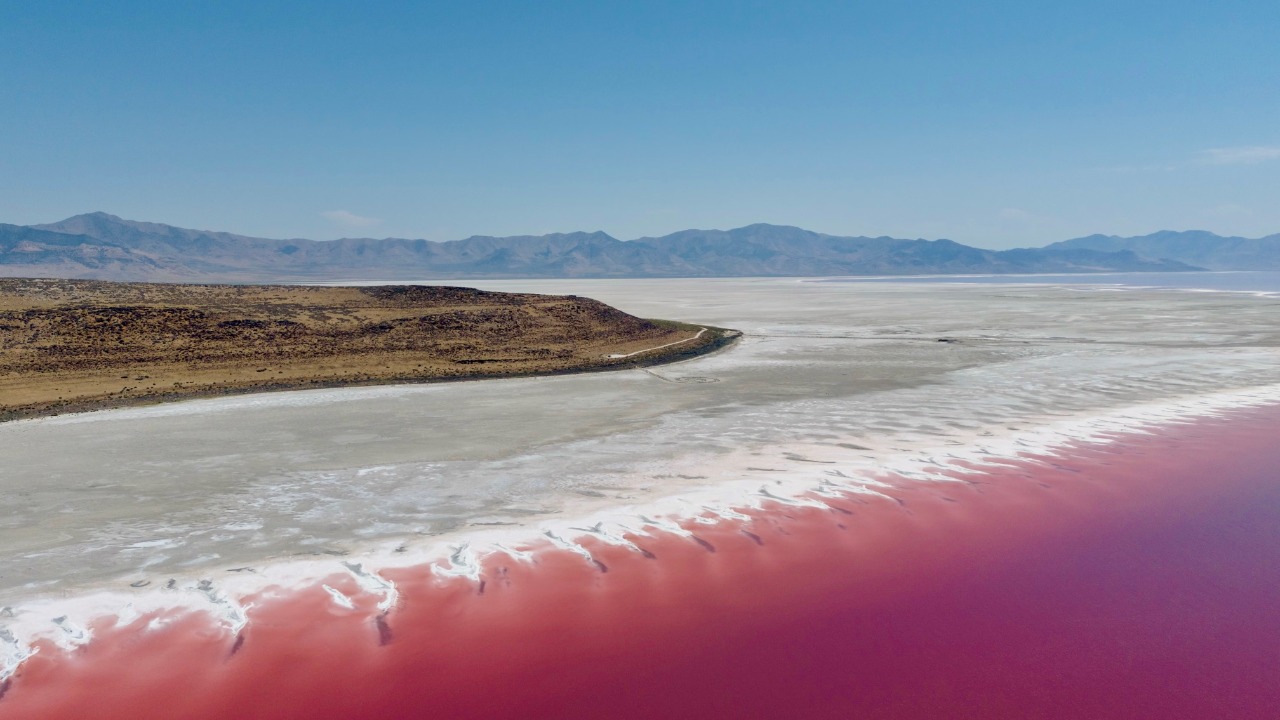

The shrinking Great Salt Lake is exposing hundreds of square miles of lakebed that can release dust containing arsenic, lead and other potentially harmful metals into communities across northern Utah.
Wind can carry the particles from the dry lakebed toward Salt Lake City and other populated areas along the Wasatch Front. Utah officials estimate that more than 2.66 million people live downwind of the lake, while the state’s environmental agency describes the region’s roughly 2.5 million residents as directly exposed to dust from its dry portions.
Recent studies have strengthened concern that the problem extends beyond breathing a visible dust cloud. Metals carried from the lakebed can settle onto soil, enter homes, adhere to vegetables and become available for ingestion, particularly among young children.
Researchers have found elevated levels of arsenic, uranium and other elements on leafy vegetables experimentally exposed to Great Salt Lake dust. Some contaminants remained after the vegetables were thoroughly washed.
The findings do not prove that Utah families are already experiencing a widespread wave of arsenic-related disease. The US Geological Survey says the health science is still developing and that no formal assessment of the full human-health impact has been completed because important data gaps remain.
They do show that the drying lake is creating credible exposure pathways that scientists and public-health officials can no longer treat as a distant or theoretical problem.
More Than 800 Square Miles of Lakebed Have Been Exposed
The Great Salt Lake has retreated dramatically as water flowing toward it has been diverted for agriculture, cities and industry, while drought and higher temperatures have placed additional pressure on the basin.
Utah’s Division of Water Resources says the lake’s retreat has exposed more than 800 square miles of lakebed. Much of that surface remains protected by crusts that resist wind erosion, but the crusts are fragile and do not cover every area.
Dust hotspots are most likely to form where the protective crust has broken down, fine sediment is abundant and vegetation is absent.
Farmington Bay and Bear River Bay are considered especially important because rivers deposited fine material in those areas and because they are relatively close to large population centers.
When strong winds cross those exposed surfaces, they can lift the fine sediment and carry it into cities, agricultural areas and residential neighborhoods.
The official Utah Division of Water Resources overview of Great Salt Lake dust explains how the lakebed’s condition, wind direction and declining water elevation influence dust generation.
The Dust Can Contain Arsenic, Lead and Cadmium
Great Salt Lake dust is not composed of one uniform chemical mixture.
It includes naturally occurring minerals, salts and sediments, along with pollution accumulated through more than a century of mining, smelting, oil refining, agricultural runoff, wastewater discharge and other human activity.
USGS researchers collected dust at 17 sites across northern Utah and tested it for priority pollutants including arsenic, lead and cadmium. Their work found that dust originating from the Great Salt Lake playa is likely an important contributor of pollutant metals reaching nearby communities.
Industrial areas and other desert surfaces can also contribute metals and airborne particles, meaning not every polluted dust event can be attributed entirely to the Great Salt Lake.
That distinction is important. Utah has many potential dust sources, including dry lakes, deserts, mines, quarries and disturbed land.
Scientists must analyze the chemical composition and physical characteristics of dust to determine where it came from.
The Great Salt Lake is nevertheless a growing concern because its exposed lakebed is expanding near densely populated counties and contains sediment that was deposited while the area remained underwater.
Arsenic Does Not Disappear When the Water Recedes
Arsenic occurs naturally in some rocks and soils, but industrial activity can increase its concentration or change how it is distributed.
While the lakebed remains covered by water or protected by a stable surface crust, much of the sediment stays in place.
As the shoreline retreats, newly exposed sediment can dry. Wind erosion can then break the surface into particles small enough to become airborne.
The arsenic does not need to exist as a separate visible substance. It can be chemically associated with dust particles that people inhale or swallow.
Health effects depend on the amount, chemical form, exposure route and length of exposure. A person encountering one brief dust storm does not automatically receive a dangerous arsenic dose.
Concern grows when people experience repeated exposure over years, especially when dust accumulates in homes, soil, food or places where young children play.
Children May Face the Greatest Ingestion Risk
The USGS study assessed potential dust-ingestion risks across six age groups.
Researchers found that children younger than six could face particular health hazards when their intake of soil and dust is higher than typical levels. Children have smaller bodies and frequently place their hands or objects in their mouths, increasing the amount of settled dust they may swallow relative to their body weight.
A child does not need to stand outdoors during a visible dust storm to be exposed.
Particles can settle on playground equipment, floors, toys, patios, hands and garden soil. Dust carried indoors on shoes, pets, clothing or through open windows can remain after the outdoor air appears clear.
The USGS emphasizes that dust ingestion can occur through contaminated fruits and vegetables as well as ordinary hand-to-mouth behavior.
Exposure to heavy metals during early childhood can be especially concerning because children’s brains and bodies are still developing.
The study did not conclude that every child living near the lake is receiving a toxic dose. It identified circumstances in which exposure could exceed health-based levels of concern and showed why better monitoring is necessary.
A New Study Found Metals on Leafy Vegetables
Researchers from Utah State University and the University of Utah examined what happened when cabbage plants were exposed to dust collected from Farmington Bay.
They applied the dust either directly to the leaves or to the soil surrounding the plants. A separate group was kept free of the dust for comparison.
Leaves exposed directly to the lakebed dust showed elevated concentrations of uranium, lithium, beryllium, arsenic and antimony.
Applying the dust to the soil did not produce the same increase for many of those elements, suggesting that direct deposition onto edible leaves may be an important pathway.
Some of the contamination remained even after thorough washing.
The result does not mean vegetables grown anywhere in northern Utah are unsafe to eat. The work was an experimental study designed to identify possible pathways and determine which metals could remain available after contact with crops.
It does mean that washing produce may not always remove every metal once fine dust has adhered to a leaf or entered its tissues.
The full research summary is available through the University of Utah’s report on Great Salt Lake dust and food-crop exposure.
More Than One-Third of Modeled Scenarios Raised Concern for Children
The researchers also examined how dust-related metals might enter the human body through inhalation, ingestion and skin contact.
More than one-third of their modeled exposure scenarios exceeded levels of concern for children.
A modeled scenario is not the same as a documented case of poisoning. Researchers use assumptions about dust concentration, contact frequency, body weight and the fraction of a metal that can be absorbed to estimate possible risk.
The results identify conditions that deserve closer study.
They do not prove that every Utah child is exposed at those levels or that illness will occur.
The findings are still significant because they suggest that scientists cannot evaluate the lake’s dust only by measuring the total amount of airborne particulate matter. They must also determine what is in the dust and how much of each contaminant can enter the body.
Dust Can Reach Utah Cities Quickly
Great Salt Lake dust does not necessarily remain close to the shoreline.
Utah officials say winds exceeding 25 miles per hour can carry dust to Salt Lake, Davis, Weber, Tooele and Box Elder counties in less than an hour. Cache and Utah counties can be reached within approximately two hours.
Dust events commonly occur when cold fronts cross the basin. Strong south or southwest winds may last for 12 to 18 hours before shifting direction for several more hours.
That changing wind pattern means communities on different sides of the lake can become downwind during the same weather system.
Salt Lake City is not the only community at risk.
Residents of Davis, Weber, Box Elder and Tooele counties may experience direct lakebed dust, while particles can also move farther into northern and central Utah.
The source of a specific dusty day can be difficult to identify without atmospheric modeling and chemical analysis because Utah has several dry and disturbed landscapes capable of producing plumes.
Smaller Particles Can Travel Much Farther
Large dust particles classified as PM10 generally settle within hours or days.
Finer particles known as PM2.5 can remain suspended for much longer, potentially traveling hundreds or thousands of miles before rain or other processes remove them from the atmosphere.
Particle size affects where the dust travels and how it enters the body.
Larger particles often become trapped in the nose and upper airways, although they can still irritate the respiratory system and be swallowed.
Fine particles can penetrate deeper into the lungs and are associated more broadly with cardiovascular and respiratory harm.
The chemical composition of a dust plume may also vary by particle size. Some contaminants can become concentrated on finer material capable of remaining airborne longer.
Utah’s current monitoring and modeling projects are intended to distinguish dust coming from the Great Salt Lake from particles produced by mines, quarries, other dry lakes and the wider desert landscape.
A July Dust Event Renewed the Concern
A major dust plume crossed the Salt Lake and Utah valleys on July 8, 2026, after thunderstorm outflow winds moved across northern Utah.
Researchers discussing the event said particulate levels reached approximately four times the healthy threshold at one point, although analysis was still needed to determine precisely how much of the dust came from the Great Salt Lake and how much originated from other regional sources.
The event made the lakebed threat visible to residents who watched the sky turn brown and saw dust accumulate across the valley.
A visible plume can create immediate breathing problems for people with asthma, chronic lung disease or other health vulnerabilities.
The long-term concern is less dramatic but potentially more consequential: repeated smaller events may deposit metal-containing dust even when the sky does not resemble a major storm.
Scientists Have Not Yet Measured the Full Disease Burden
Research has established that Great Salt Lake sediments contain potentially harmful elements, that lakebed dust reaches populated areas and that children can face elevated modeled exposure under certain conditions.
Scientists have not yet completed the type of long-term epidemiological work needed to calculate how many illnesses or deaths can be attributed specifically to that dust.
The USGS says no formal evaluation of the lake dust’s overall impact on human health has been completed because of gaps in exposure and monitoring data.
Researchers still need better information about how frequently different communities receive lakebed dust, the concentration of metals in each event, how much enters homes and bodies, and whether those exposures produce measurable changes in health.
This uncertainty should not be confused with proof of safety.
Environmental-health agencies often act before a complete disease count becomes available when exposure pathways and hazardous substances have already been identified.
Not Every Part of the Lakebed Produces Dust Equally
Approximately 76 percent of the exposed lakebed may have some protection from natural surface crusts, according to Utah’s Division of Water Resources.
These crusts can bind sediment and reduce wind erosion.
They are vulnerable to drying, cracking, vehicles, livestock, construction and other disturbance. Once damaged, the finer material underneath may become available for transport.
Some areas contain more clay and silt than others, making them more capable of producing dust.
The location of future hotspots will depend on lake elevation, shoreline changes, vegetation, sediment composition and land use.
A falling lake does not instantly turn every exposed acre into an active dust source. It enlarges the area that could become emissive as the sediment dries and protective surfaces deteriorate.
The Lake’s Decline Is Driven Heavily by Water Use
Drought and climate change influence the Great Salt Lake, but water diversion is central to its decline.
Water that historically flowed through rivers and streams into the lake is consumed upstream by farms, households, cities and industries.
The Great Salt Lake has no river outlet. Its level reflects the balance between water entering the basin and water lost through evaporation.
When more water is removed before reaching the lake, its shoreline retreats.
Hotter conditions can increase evaporation and reduce the amount of mountain snowmelt that reaches rivers, worsening the imbalance.
Utah’s environmental agency warns that lake levels will continue declining without strategic reductions in agricultural and human consumptive water use.
That assessment makes clear that dust control cannot depend only on spraying or stabilizing isolated areas. Keeping more water in the lake is a fundamental part of reducing the amount of exposed sediment.
Restoring Water Is the Most Durable Dust Control
Scientists can identify hotspots and use engineering measures to limit dust from selected areas.
Possible interventions include applying water, encouraging vegetation, installing barriers, creating rough surfaces or using soil-stabilizing treatments.
These approaches can be expensive when applied across hundreds of square miles.
Some may also affect wildlife habitat, water chemistry or the lake’s natural surface.
USGS researchers say increasing lake levels or implementing targeted dust controls could reduce metal exposure, with lake restoration providing a meaningful benefit to children and nearby communities.
Keeping sediment underwater prevents it from becoming airborne in the first place.
That does not remove historical pollution from the lakebed, but it reduces the opportunity for wind to carry it into residential areas.
Air Monitoring Is Being Expanded
Utah’s Division of Air Quality is developing a modeling system to estimate how much PM2.5 and PM10 comes from the Great Salt Lake compared with other sources.
The work combines field measurements with atmospheric transport models and information about mining, quarries, land use and dry lake surfaces.
The USGS research has also informed plans for additional active air samplers needed for more complete health evaluations.
Better sampling is essential because an air-quality monitor reporting high particulate levels does not automatically reveal the dust’s source or chemical content.
Scientists need filters that can be collected and analyzed for arsenic, lead, cadmium and other elements.
Repeated measurements across different seasons and wind directions can show which neighborhoods receive the greatest lakebed contribution.
What Families Can Do During Dust Events
Residents should follow Utah air-quality alerts and reduce prolonged outdoor activity when particulate levels are high.
Children, older adults, pregnant people and anyone with asthma, heart disease or lung disease may need to be especially cautious.
Windows and doors can be kept closed during severe dust events. Air-conditioning systems should be set to recirculate when appropriate, and high-efficiency indoor filtration can reduce particles entering living spaces.
A well-fitting N95 or similar respirator provides more protection from fine airborne particles than a loose cloth or surgical mask.
Outdoor toys, furniture and play areas can be wiped down after a major dust event rather than cleaned by dry sweeping, which can lift particles back into the air.
Shoes can be removed at the entrance to reduce tracked-in soil, and floors can be cleaned with damp methods or a vacuum equipped with a high-efficiency filter.
These measures reduce general dust exposure but cannot solve the lakewide environmental problem.
Gardeners Should Wash Produce Carefully
Home gardeners should continue washing locally grown fruits and vegetables thoroughly.
Leafy produce can be rinsed under clean running water while the leaves are separated and gently rubbed. Outer leaves that have accumulated visible dust may be removed.
Soap, bleach and household cleaning products should not be applied to food.
The experimental cabbage study found that washing did not remove every elevated element, so cleaning cannot guarantee complete removal when contaminants have adhered strongly or entered plant tissue.
The research does not justify abandoning Utah gardens or assuming all local produce is contaminated.
It supports expanded field studies that measure crops grown under real conditions at different distances from the lake.
Gardeners may also reduce direct soil ingestion by washing hands after working outdoors and discouraging young children from placing dusty objects or unwashed hands in their mouths.
Families Should Not Panic Over One Dust Storm
Health risk depends on dose and duration.
Seeing one plume does not mean a family has received a life-threatening amount of arsenic.
Most environmental-metal concerns involve repeated or chronic exposure, although very dusty events can cause immediate respiratory irritation.
Anyone experiencing severe breathing difficulty, chest pain or worsening asthma during a dust storm should seek medical care.
Families concerned about long-term exposure should speak with healthcare professionals rather than ordering unvalidated home tests or attempting aggressive “detoxification” treatments.
Blood or urine testing for metals has limitations and should be interpreted in the context of symptoms, exposure history and established medical guidance.
The Threat Extends Beyond Human Health
Dust from the exposed lakebed can darken mountain snow.
Darker snow absorbs more sunlight and melts faster, potentially reducing the amount of water available later in the season and contributing to a cycle in which the lake receives less inflow.
The lake also supports brine shrimp, insects and millions of migratory birds.
Changes in salinity and water depth threaten the food web, mineral industries, recreation and wildlife habitat.
The dust problem is therefore one part of a connected ecological and economic crisis.
Allowing the lake to decline may create higher healthcare costs, damage snowpack, disrupt industry and require expensive dust-control projects.
The Headline Needs Careful Wording
Saying the drying lake is “lifting arsenic-laced dust toward Utah families” captures the central concern.
Exposed lakebed sediments contain arsenic and other metals, and wind transports some of that material toward populated communities.
The wording should not imply that every dust particle contains a dangerous arsenic concentration or that each family receives the same exposure.
Dust composition varies across the lakebed and mixes with material from other sources.
Researchers are still determining the doses reaching individual communities and the health effects produced over time.
A precise description is that the shrinking Great Salt Lake is increasing the potential for metal-containing lakebed dust to reach Utah homes, children, gardens and food systems.
The Main Takeaway
More than 800 square miles of the Great Salt Lake’s former bed have been exposed as the lake has declined. Strong winds can lift sediment from vulnerable areas and carry it into northern Utah communities in less than an hour.
The dust can contain arsenic, lead, cadmium and other contaminants associated with natural geology and a long history of mining, refining, wastewater discharge and agricultural activity.
USGS research found that children younger than six may face particular risk from ingesting dust under higher-exposure conditions. The agency says Great Salt Lake playa dust is likely an important contributor of priority pollutants in nearby communities.
Separate research showed that arsenic, uranium and other metals could accumulate on leafy vegetables exposed to Farmington Bay dust, with some contamination remaining after washing.
Scientists have not yet established the full human disease burden, and the evidence does not show that every Utah family is receiving a harmful dose.
The warning is still substantial. The exposure routes are real, the contaminated sediment is present and the source area will continue expanding unless more water reaches the lake.
Air filters, masks and household cleaning can reduce individual exposure during dust events. Restoring the Great Salt Lake to a healthier level is the more durable way to prevent arsenic-bearing sediment from becoming airborne at all.