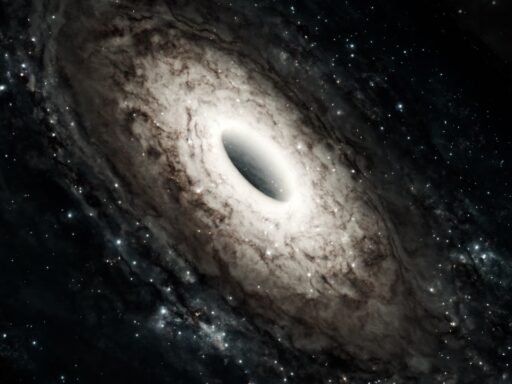

A newly analyzed quasar from the early universe appears to be consuming matter at a rate that defies the standard rules of black hole growth. The object, powered by a supermassive black hole identified as UHZ1, seems to be feeding about 13 times faster than the theoretical limit that should cap how quickly such giants can gain mass. If the measurement holds, it could force a rethink of how the first cosmic structures formed so quickly after the Big Bang.
The discovery turns a long-standing puzzle into a concrete challenge: either the physics of accretion is incomplete, or the early universe offered growth channels that current models do not yet capture. Astronomers now have one of the most extreme test cases yet for the foundations of black hole theory.
How astronomers realized this quasar was breaking the growth limit
The quasar in question sits in a universe less than a billion years old, when galaxies and black holes were just starting to assemble. Observations of the object, powered by the black hole UHZ1, show that it shines with extraordinary luminosity for its age and estimated mass. By comparing that brightness to models of how matter falls into a black hole, researchers concluded that UHZ1 is accreting material about 13 times faster than the so-called Eddington limit would normally allow. That limit reflects a balance between the inward pull of gravity and the outward pressure of radiation from infalling gas.
According to reporting on black hole UHZ1, the team used high-energy data to estimate both the mass of the central object and the rate at which it is swallowing matter. The numbers do not line up with standard expectations. Rather than operating near the Eddington rate, which is already an extreme regime, the quasar appears to be far beyond it. That conclusion rests on the link between the quasar’s X-ray output and the amount of gas spiraling into the black hole.
Further analysis described in a separate study of this cosmic giant reinforces the picture of a system that is both very young and already surprisingly massive. The quasar’s redshift places it in the early universe, while its inferred mass suggests that it has already grown into a supermassive black hole. That combination is what makes the implied feeding rate so extreme. To reach such a mass so early, the object either had to start from an unusually heavy seed or sustain super-Eddington accretion for an extended period.
Researchers have long suspected that some early quasars might briefly exceed the Eddington limit, but UHZ1 appears to push that idea to a new level. The reported factor of 13 is not a minor deviation. It suggests that the physical processes that regulate accretion, such as radiation pressure and the structure of the surrounding disk, may behave differently in dense, gas-rich environments shortly after the Big Bang. Alternatively, the geometry of the inflowing material could channel matter in ways that let it slip past the usual radiation bottleneck.
Why a super-Eddington quasar reshapes the story of the early universe
The significance of UHZ1 goes beyond one exotic object. Cosmologists have struggled to explain how supermassive black holes with hundreds of millions or even billions of solar masses appeared so quickly in the early universe. Standard models that start with stellar-mass black holes and limit their growth to the Eddington rate have trouble reaching those sizes in the available time. A quasar apparently feeding 13 times faster than that limit offers a concrete mechanism to close the gap.
Reporting on this ancient black hole frames the result as direct evidence that early black holes could grow through sustained super-Eddington accretion. If such episodes were common, even for a few tens of millions of years, they would dramatically accelerate the buildup of mass in the universe’s first galactic cores. That would help explain why astronomers already see massive quasars at redshifts greater than 7, when the universe was only a small fraction of its current age.
The finding also feeds into a broader debate about how the first black hole seeds formed. One camp argues that they began as the remnants of the first generation of stars, with masses of tens or hundreds of solar masses. Another proposes that they formed directly from the collapse of enormous gas clouds, creating black holes that started out with tens of thousands or even hundreds of thousands of solar masses. If UHZ1 really is accreting at 13 times the Eddington limit, then even relatively small seeds could reach supermassive scales quickly, which strengthens the case for rapid growth channels.
At the same time, the result pressures the physics of accretion disks. The Eddington limit is not a law of nature in the same sense as conservation of energy, but it has been a reliable guideline across many systems, from X-ray binaries to nearby active galactic nuclei. A sustained violation by a factor of 13 demands either unusual geometry, such as thick, funnel-shaped disks that trap and redirect radiation, or new ingredients in the model, such as powerful magnetic fields that help channel inflowing gas. Some theoretical work has explored such super-Eddington states, but UHZ1 provides a rare observational anchor.
The quasar also affects how astronomers interpret the background light from the early universe. If many young black holes were growing this quickly, their radiation would have contributed significantly to the heating and ionization of the intergalactic medium. That would influence the timing and structure of the epoch of reionization, which researchers are now probing with radio telescopes and deep galaxy surveys. In that sense, a single extreme object can ripple into the broader narrative of how the first stars, galaxies, and black holes transformed the cosmos.
What researchers will test next about this extreme quasar
The immediate priority for astronomers is to confirm and refine the measurements that point to such extraordinary growth. That means obtaining deeper observations across multiple wavelengths and using independent methods to estimate the black hole’s mass and accretion rate. Future high-resolution spectroscopy will help pin down the properties of the gas near the event horizon, including its temperature, density, and velocity. Any revision to those parameters could either soften or strengthen the case for a 13-fold Eddington violation.
Teams are also likely to search for additional examples of similarly extreme quasars in the same epoch. The techniques used to identify UHZ1 can be applied to larger samples of high-redshift quasars, especially in deep survey fields that combine X-ray, optical, and infrared data. If UHZ1 turns out to be unique, it might represent a rare, short-lived phase. If several more objects show comparable feeding rates, then super-Eddington growth may be a standard stage in early black hole evolution rather than an odd exception.
On the theoretical side, modelers are already revisiting simulations of black hole accretion in dense, early-universe environments. They can adjust assumptions about disk structure, radiation transport, and magnetic fields to see which combinations reproduce a factor-of-13 growth rate without contradicting other observations. The goal is not to discard the Eddington framework entirely, but to understand under what conditions it breaks down. That work will also feed back into models of galaxy formation, since rapidly growing black holes can drive powerful outflows that shape their host galaxies.
New facilities will sharpen the picture. Next-generation X-ray observatories are designed to capture faint, distant sources like UHZ1 with far greater sensitivity. Combined with high-resolution imaging and spectroscopy from large ground-based telescopes, they will allow astronomers to map the environment around the quasar in detail. That includes the distribution of gas in the host galaxy, the presence of any jets, and the interaction between the black hole’s radiation and nearby star formation.