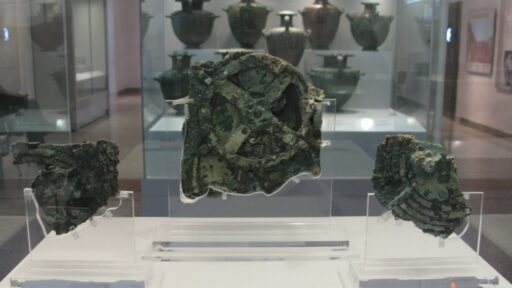
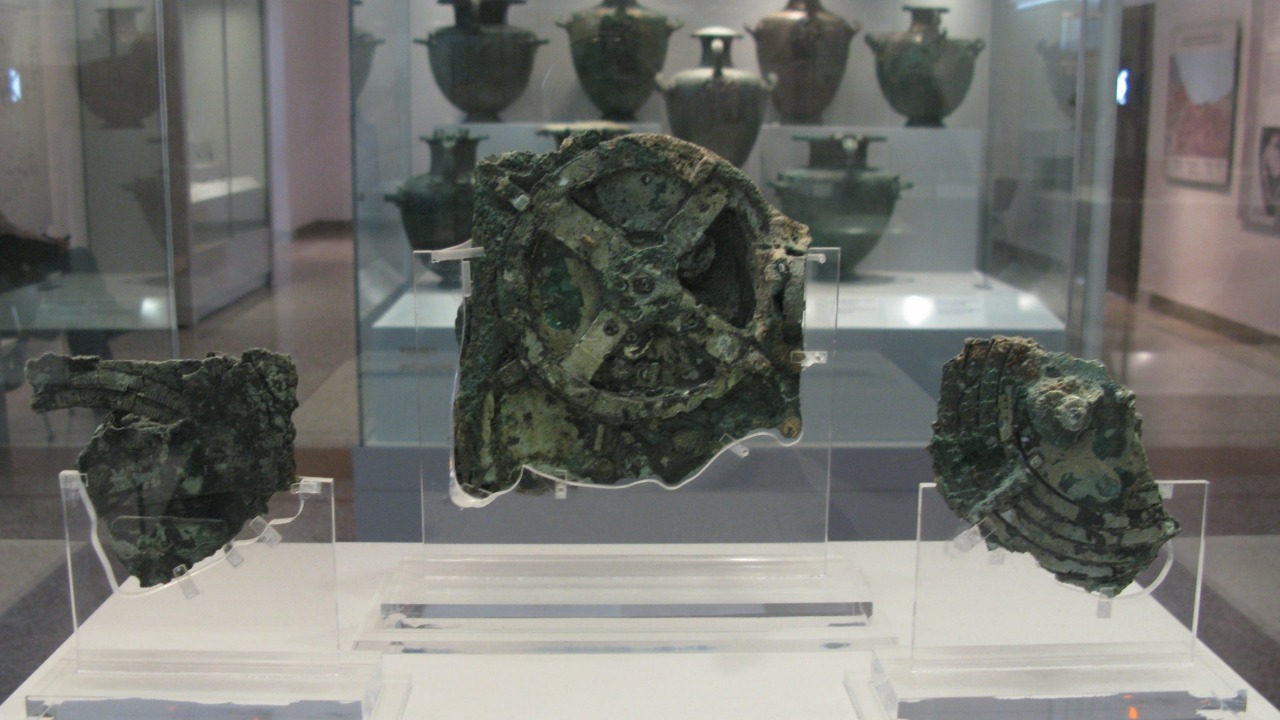

When sponge divers stumbled on a shipwreck off the Greek island of Antikythera in the early twentieth century, they pulled up bronze statues, jewelry, and a lump of corroded metal that looked like scrap. Inside that lump sat a device that would force historians to rethink what ancient engineering could do. The Antikythera Mechanism did not use electricity or silicon chips, yet it processed data, predicted future events, and displayed results in a way that looks strikingly like an analog computer.
Over the past few decades, researchers have slowly reconstructed how this intricate system of gears turned astronomical cycles into readable information. Their work shows that people in the ancient Mediterranean were not only observing the heavens, but also encoding that knowledge into precision machines that could be carried, consulted, and updated.
Reconstructing a gear‑driven “computer” from a corroded lump
The Antikythera Mechanism was recovered from a Roman era shipwreck that sank while carrying luxury goods, statues, and possibly high value scientific instruments. What initially appeared as a featureless clump of bronze turned out, under careful cleaning, to contain more than 30 interlocking gears, dials, and inscribed scales. Detailed imaging has since revealed that the device once sat inside a wooden case about the size of a shoebox, with at least two main faces covered in pointers and concentric rings.
High resolution X‑ray scans and surface imaging allowed researchers to read faint Greek inscriptions and trace the teeth of hidden gears. Those scans showed that turning a side crank drove a central gear train, which in turn moved multiple pointers across circular scales. One dial tracked the position of the sun through the zodiac, another showed the phase and position of the moon, and additional indicators followed longer planetary cycles. The surviving fragments suggest that the original mechanism contained at least 37 bronze gears, cut with a precision that rivals high quality clockwork from much later centuries.
Modern reconstructions, based on those scans and inscriptions, indicate that the device encoded several astronomical cycles at once. By aligning gear ratios with known periods such as the Metonic cycle of roughly 19 years and the Saros cycle of roughly 18 years, the mechanism could predict eclipses, track lunar phases, and map the motion of celestial bodies against the backdrop of constellations. One study of the gearing has shown that the lunar display even corrected for the moon’s varying speed along its orbit by using a pin and slot mechanism, a sophisticated feature that anticipates later mechanical innovations.
Researchers now argue that the Antikythera Mechanism functioned as a highly specialized calculator. A user could input a date by turning the crank to a desired position on the calendar scale. The gears would then compute the corresponding positions of the sun and moon, identify upcoming eclipses, and display them on multiple dials at once. That coordinated output, driven by a single input motion, is why many historians describe the device as the earliest known analog computer and why one analysis in archaeological research treats it as a benchmark for ancient engineering.
From curiosity to paradigm shift in the history of technology
Early interpretations of the Antikythera Mechanism treated it as an isolated marvel. As imaging improved and more text became legible, that view shifted. The inscriptions on the back plates read like a user manual, explaining which dials showed eclipses, which tracked the Olympic cycle, and how to interpret the markings. That level of documentation suggests a device meant to be operated, not just admired.
The shift from curiosity to paradigm shift came as scholars realized that the mechanism combined theoretical astronomy with precision craftsmanship. The gear ratios align closely with values derived from Hellenistic mathematical astronomy, including sophisticated models of lunar motion. At the same time, the physical gears had to be cut and assembled by artisans who understood tolerances, lubrication, and long term durability in a marine environment. This partnership between scientific theory and workshop practice challenges older narratives that separated abstract Greek thought from practical technology.
Another change in understanding concerns scale and context. The shipwreck carried multiple high status objects, which implies that the mechanism was valuable and possibly rare. Yet its inscriptions refer to well known cycles and games, which points to a broader culture of astronomical literacy. Some historians now argue that similar devices may have existed in libraries, temples, or the homes of wealthy patrons, even if they have not survived. The Antikythera Mechanism then becomes a surviving representative of a wider tradition of mechanical astronomy rather than a one off miracle.
Continued reconstruction work has also revised assumptions about ancient mechanical limits. The device uses differential gearing, compound trains, and noncircular components to translate uniform crank motion into complex celestial patterns. Those design choices show that ancient engineers were comfortable with abstracting natural cycles into mechanical relationships. In other words, they were already thinking in terms of models, inputs, and outputs, even if they did not describe their work with modern computational language.
Why an ancient analog computer speaks to the present
The modern fascination with the Antikythera Mechanism is not only about its age or intricacy. It also reflects current debates about what counts as a computer and how societies embed knowledge into tools. The device performs a function that looks familiar to anyone who has used a smartphone astronomy app. It takes a user’s chosen time, processes that input through a model of the heavens, and returns a visual representation of future celestial events.
That similarity has encouraged computer scientists and historians of technology to rethink linear stories about innovation. Instead of a straight line from abacus to mechanical calculators to electronic computers, the Antikythera Mechanism suggests a more fragmented history, with peaks of sophistication that can be lost and later rediscovered. Its existence complicates assumptions that high precision gearing and complex computation only emerged in medieval or early modern Europe.
The device also matters for what it reveals about the social uses of computation. The inscriptions reference eclipse predictions and athletic games, which hints at practical and cultural applications. Eclipses had religious and political significance, while games such as the Olympics structured civic life. Owning a machine that could forecast such events would have conferred authority, whether in a scholarly, religious, or political setting. In that sense, the mechanism shows how control over predictive tools can translate into social power, a theme that resonates with current discussions about algorithmic decision making.
For engineers and designers, the Antikythera Mechanism offers a case study in explainable technology. Its dials and inscriptions expose the model it uses, allowing a knowledgeable user to see how cycles relate and where predictions come from. There is no opaque code, only visible gears and labeled scales. Some modern technologists look to such transparent mechanisms as inspiration for building systems that users can interrogate and understand rather than treat as inscrutable black boxes.
Future research and the continuing mystery of ancient computation
Despite a century of study, major questions about the Antikythera Mechanism remain open. Only a portion of the original device survived the shipwreck, and the wooden case has long since decayed. Researchers continue to debate how many dials the front face originally held, how planetary motions were displayed, and whether additional pointers or inscriptions are missing. Each new imaging campaign has the potential to reveal previously unread text or hidden mechanical features inside the corroded fragments.
Future work is likely to focus on three fronts. First, improved 3D scanning and machine learning techniques may help reconstruct worn gear teeth and faint lettering, refining existing models of the device. Second, underwater archaeology at the Antikythera wreck site could uncover additional fragments that clarify the layout of the mechanism or confirm the presence of similar instruments on board. Third, comparative research on other ancient artifacts, such as geared sundials or astronomical parapegmata, might situate the mechanism within a broader family of mechanical calculators.