
Pluto was supposed to be simple: a small, frozen dwarf planet parked in the deep cold beyond Neptune. Instead, evidence now points to a hidden ocean under its crust that is stranger than the ice above it and far more dynamic than early models allowed. That buried sea, likely salty, slushy and long lived, is forcing scientists to rewrite how small worlds form, evolve and maybe even host the ingredients for life.
What lurks beneath Pluto’s frozen surface looks less like a static block of ice and more like a layered planetary system in miniature, with rock, exotic ices and liquid water interacting over billions of years. That buried ocean is not just a curiosity, but a test case for how common such hidden habitats might be across the outer solar system.
From dead iceball to buried ocean world
When Jun and other enthusiasts first amplified research suggesting that Pluto has a buried ocean beneath its frozen crust, the idea ran directly against the old picture of a frozen, geologically dead world. The emerging view is that this ocean has likely persisted for billions of years, insulated beneath a thick shell of ice and interacting with Pluto’s interior rock. That shift in thinking puts Pluto in the same broad category as other ocean worlds and raises fresh questions about how water and Callisto behave far from the Sun.
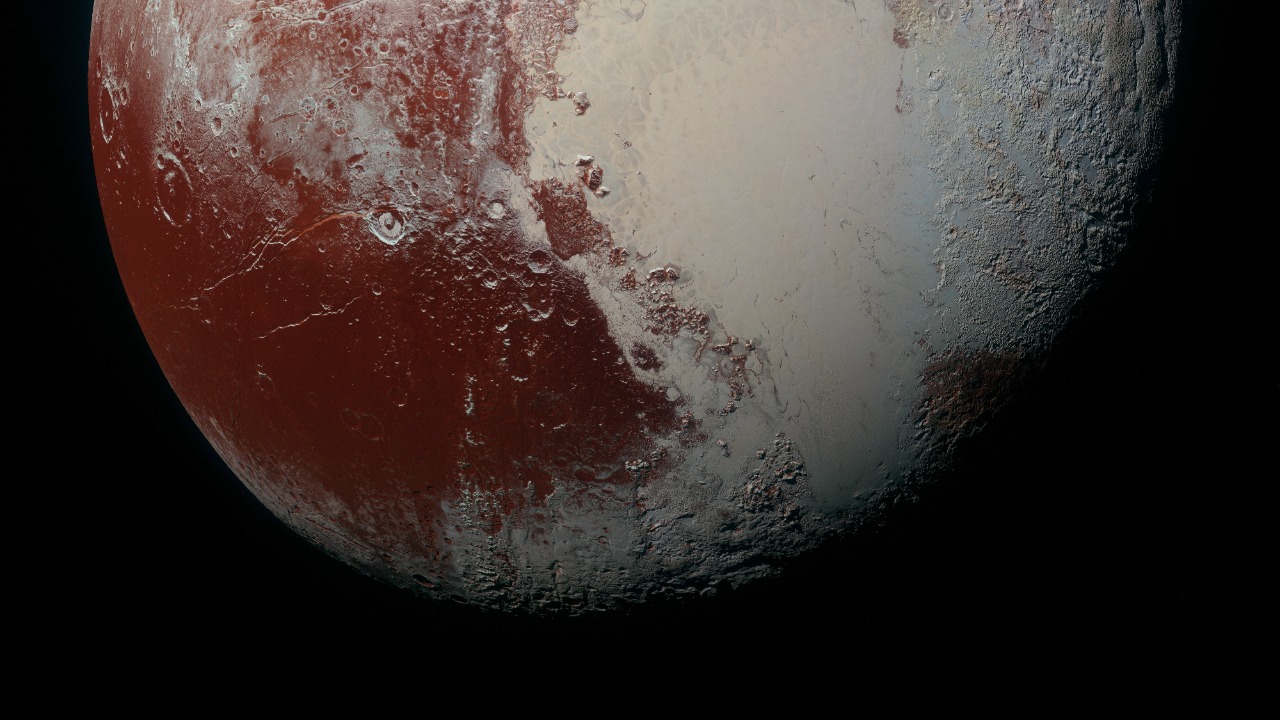
Images and gravity data from the New Horizons flyby gave researchers the first real clues that Pluto’s interior is layered rather than uniform. The contrast between rugged highlands and the smooth, bright basin of Sputnik Planitia hinted at internal activity that pure solid ice could not easily explain. That is why the suggestion that Pluto’s ocean has been stable since early in its history, rather than freezing solid, has become such a powerful organizing idea for scientists trying to understand how this distant body evolved.
Sputnik Planitia and the case for a slushy sea
The key to Pluto’s hidden ocean is a single, spectacular feature: Sputnik Planitia, a 1,000-kilometer-wide basin filled with nitrogen ice that dominates one side of the dwarf planet. Researchers studying that basin found that its weight and position would cause Pluto to reorient over time if a subsurface ocean allowed the outer shell to move. That kind of global “tipping” is easier to explain if a slushy layer of water lies beneath the thinned crust in the impact basin that created Sputnik Planitia.
Geologists have also traced how the basin’s ice appears to convect, slowly churning into polygonal cells that renew the surface. That behavior, highlighted as one of the of Pluto, points to ongoing heat flow from below, which fits neatly with the presence of liquid water sandwiched between rock and ice. For a world once dismissed as inert, the idea that its largest feature is being reshaped from beneath by a hidden ocean is a dramatic reversal.
Seismic clues and a strange rocky core
While no seismometer has ever landed on Pluto, researchers have used models of ancient impacts to infer how waves would travel through its interior. What Denton and colleagues found is that a core made primarily of serpentine, combined with a 150-kilometer-thick ocean, can focus seismic waves in ways that match observed surface structures. That work treats Pluto a bit like the northern Atlantic Ocean on Earth, where the way waves propagate reveals hidden layers beneath the water, and suggests that the dwarf planet’s interior is more complex than a simple ice-over-rock stack described by What Denton modeled.
A core rich in serpentine would also have chemical implications, because that mineral forms when water reacts with certain rocks and can release hydrogen. On Earth, such reactions help power deep-sea ecosystems that never see sunlight. If anything similar occurred within Pluto’s interior, it would mean the ocean has been in contact with reactive rock for long stretches of time, a key ingredient for complex chemistry in any hidden ocean world.
Antifreeze, insulation and a super salty brew
Keeping liquid water stable so far from the Sun requires more than just leftover heat from Pluto’s formation. Studies of its interior suggest that the ocean is not pure water, but laced with substances that act like antifreeze, lowering the freezing point and helping it stay slushy instead of turning to solid ice. One analysis framed this as Pluto Has a mixture that combines water with salts and possibly ammonia, creating a dense, briny layer that resists freezing even in deep cold.
Thermal models add another layer of protection in the form of an insulating crust. Data from New Horizons suggested that a shell of methane gas hydrates, which trap gas molecules inside icy cages, could provide ideal insulating properties above the water layer. These methane gas hydrates have low thermal conductivity, meaning they slow the loss of heat from the ocean into space. In combination with salts, they help explain how Pluto’s sea could have survived for billions of years instead of freezing solid long ago.
How thick is the ice and how deep is the water?
Pinning down the thickness of Pluto’s ice shell is central to understanding how its interior works. One study of the Sputnik Planitia region concluded that the ocean there likely lies beneath a shell of water ice 40 to 80 km thick, a relatively thin blanket by planetary standards. Their calculations showed that such a shell would be enough to keep the liquid below from leaking heat too quickly, while still allowing the outer crust to move and flex above the 40 to 80 layer.
Other work has suggested that the thickness of the ice shell has maybe doubled to about 180km, or about 110 miles, while the surviving ocean is likely a 200km layer, about 120 m in the cited metric, of liquid trapped between ice and rock. Those numbers, drawn from interior evolution models, paint a picture of a world that has cooled and changed shape over time but still retains a significant volume of liquid water. If Pluto’s crust really thickened while the ocean thinned to something like that 110 miles, 120 scale, then the dwarf planet’s internal story is one of gradual freezing from the top down, not a sudden shutoff.