
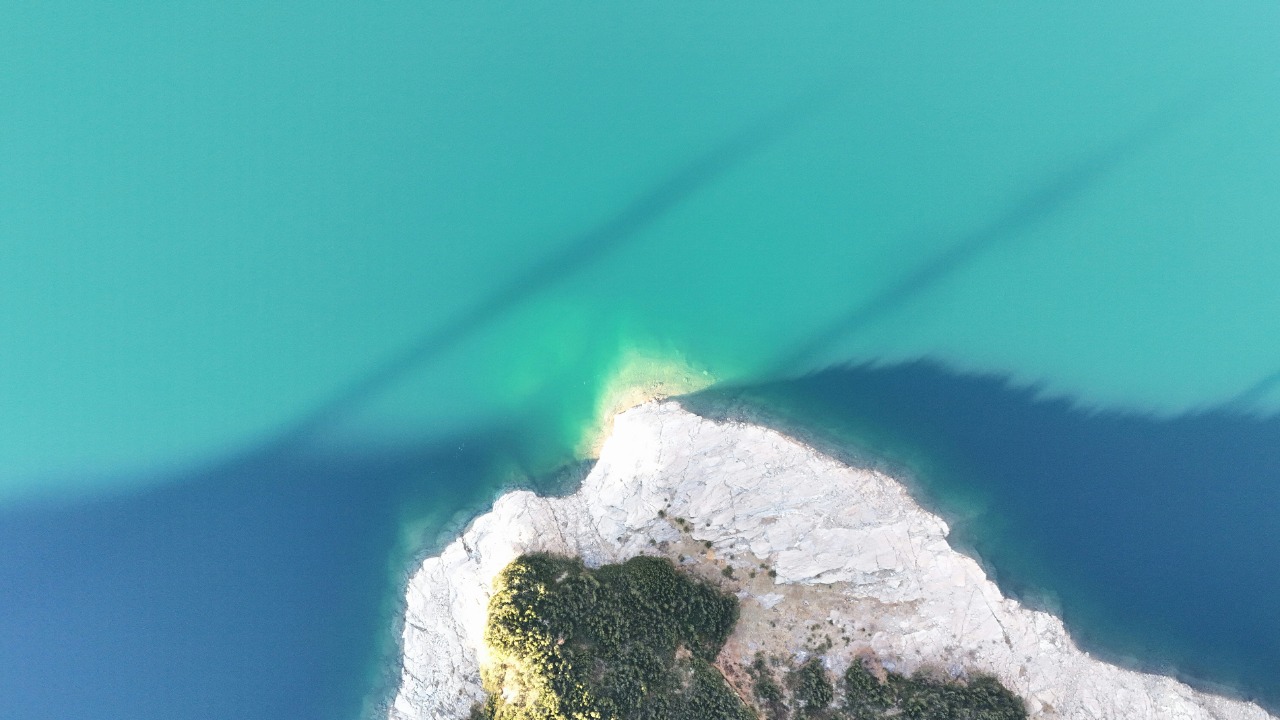

When the surface of Lake Lipno froze earlier this winter, locals expected the usual palette of white snow and dull grey ice. Instead, parts of the Czech Republic’s largest reservoir turned an almost neon green, as if someone had spilled paint beneath the frozen sheet. The culprit was not pollution in the conventional sense but a dense bloom of cyanobacteria thriving in conditions that should have shut down most biological activity.
The sight of green ice in mid-winter is more than a curiosity. It is a vivid sign of how nutrient enrichment, shifting weather patterns and the quirks of lake physics can combine to produce unexpected ecological behavior, even when a water body appears safely locked under ice.
The winter bloom that painted the ice
At first glance, the green patches on Lake Lipno looked like something trapped inside the ice itself, but the color actually came from a layer of cyanobacteria concentrated just below a thin and locally very transparent ice cover. As the microorganisms accumulated in the upper water column, they formed striking, irregular fields of pigment that were visible both from the shore and from above, turning sections of the reservoir into a mosaic of emerald stains beneath the frozen surface. Scientists from the Biology Centre of the Czech Academy of Sciences described how this accumulation depended on the unusual clarity of the ice, which allowed light to penetrate and sustain photosynthesis even in the depths of winter, a pattern they documented while examining the thin ice.
For residents used to summer algal scums, the timing was the real shock. Cyanobacteria are typically associated with warm, stagnant water, not sub-zero air temperatures and a frozen lake. Yet the organisms in Lipno exploited a narrow window of conditions: enough nutrients in the water, sufficient light filtering through clear ice, and relatively calm weather that limited mixing and allowed cells to gather in a shallow layer. The result was a bloom that did not spread across the entire reservoir but instead appeared in distinct patches, each one a visible reminder that biological processes do not simply pause when a lake ices over.
Jan’s team and the puzzle of “green ice”
The phenomenon quickly drew the attention of limnologists, including researchers led by Jan, who have been tracking cyanobacterial dynamics in Central European reservoirs. Jan and his colleagues framed the Lipno event as a case of atypical behavior under very specific conditions, rather than a new normal. In their field observations, they emphasized that the organisms involved were familiar freshwater cyanobacteria, but their vertical distribution and timing were unusual, with dense layers forming just under the ice instead of dispersing through the water column. The group highlighted this as an example of how even well-studied species can show atypical behaviour when light, temperature and nutrient levels align.
Jan’s team also stressed that the green ice should not be mistaken for a simple surface stain. The cyanobacteria were living cells, adjusting their buoyancy to remain in the narrow band of water where light was strongest and the ice above offered some protection from wind-driven mixing. That behavior, familiar from summer blooms, took on a new twist under ice cover, where even small changes in transparency could determine whether a bloom formed or faded. By treating the Lipno episode as a natural experiment, the researchers are using it to refine models of how cyanobacteria respond to winter conditions, a question that has gained urgency as shorter, milder cold seasons become more common across temperate regions.
Why this cyanobacterium can change color
One detail that fascinated both scientists and locals was the way the bloom’s color shifted. The species involved is notable because it can change colour, with the same population appearing green, brown or even yellow depending on its physiological state and the surrounding environment. Jan explained that this flexibility is tied to pigments the cells use to harvest light, which can be adjusted as conditions change. Under the clear ice of Lipno, the cells produced a vivid green that contrasted sharply with the surrounding white snow and grey water, but in other settings the same organism has been observed as a duller brown or a surprising yellow, a chameleon-like trait that helps it cope with fluctuating light and nutrient levels.
From a distance, the color shifts might look like evidence of different species, yet closer inspection shows a single cyanobacterium altering its pigment balance to optimize photosynthesis. In simple terms, the algae absorb light differently from the surrounding ice, which is why the patches stand out so clearly when viewed from above or along the shore. That optical contrast, described by Jan in interviews about the rare winter phenomenon, turns a microscopic adjustment into a landscape-scale spectacle, and it also offers a practical cue for monitoring, since shifts from green to brown or yellow can signal changes in the physiological stress of the bloom.
What Lake Lipno reveals about nutrient stress
Behind the visual drama lies a more familiar driver: nutrient enrichment. Lake Lipno, like many large reservoirs, receives inputs of nitrogen and phosphorus from its catchment, including agricultural runoff and wastewater. Those nutrients do not disappear when the lake freezes; they remain available to cyanobacteria that can tolerate low temperatures and low light. The winter bloom suggests that the reservoir’s baseline nutrient load is high enough that, once physical conditions become favorable, cyanobacteria can respond quickly, even outside the traditional summer season. That pattern echoes what researchers have seen in other eutrophic systems, where management efforts have slowed deterioration but not fully reversed the underlying enrichment.
A useful comparison comes from Lake Taihu in China, another large, shallow and eutrophic lake that has struggled with recurrent cyanobacterial blooms. There, a series of pollution control measures implemented since 2007, described by Stone and colleagues, helped stabilize water quality so it has not further deteriorated, even though the system remains vulnerable to intense blooms. In their analysis of spatiotemporal changes, the researchers showed how nutrient reductions, while essential, must be paired with an understanding of how wind, temperature and mixing patterns shape where and when cyanobacteria accumulate. Lake Lipno’s green ice fits that broader lesson: even if nutrient inputs are curbed, unusual physical conditions can still trigger blooms in unexpected seasons and locations.
Managing a future of stranger winters
For water managers and local authorities around Lake Lipno, the winter bloom raises practical questions. Recreational users may be less exposed in January than in July, but cyanobacteria capable of forming dense layers under ice can still produce toxins, and those compounds do not respect the calendar. Monitoring programs that focus only on the open-water season risk missing these off-peak events, especially when they occur in visually striking but spatially limited patches. The Lipno episode suggests that winter sampling, combined with remote sensing of color anomalies on frozen surfaces, could become an important part of early warning systems, even in regions that have historically treated the ice season as a biological pause.
More broadly, the green ice points to a future in which lakes behave in ways that challenge long-held assumptions about seasonality. Shorter, warmer winters can produce thinner, clearer ice, exactly the conditions that allowed light to penetrate and sustain the Lipno bloom. At the same time, nutrient legacies built up over decades give cyanobacteria ample fuel whenever physical conditions tip in their favor. As I look at the Lipno case alongside examples like Lake Taihu, the message is less about a single spectacular event and more about a gradual shift toward more variable, less predictable freshwater ecosystems. The surprise of green ice may fade as scientists like Jan and Stone refine their models, but the underlying drivers of nutrient stress and changing winter dynamics will remain, quietly reshaping lakes long after the color has drained from the ice.