
Tesla entered the second quarter of 2026 with a result that looked powerful at first glance. Vehicle deliveries reached a second-quarter record, total revenue climbed to an all-time quarterly high and the energy-storage business returned to strong growth. Beneath those headline figures, however, profitability weakened sharply as lower vehicle pricing, declining regulatory-credit revenue and rapidly rising investment costs placed pressure on the business.
The company’s official Q2 2026 shareholder update showed total revenue of $28.24 billion, representing a 26% increase from $22.50 billion one year earlier. Tesla also generated more than $100 billion in trailing 12-month revenue for the first time.
Revenue exceeded analysts’ average estimate of approximately $25.71 billion, but adjusted earnings reached only $0.33 per share, below the $0.51 expected by Wall Street. The combination created an unusual quarter in which Tesla sold more products and collected more revenue while delivering a substantially weaker underlying profit performance.
Record Q2 Deliveries Powered the Revenue Increase
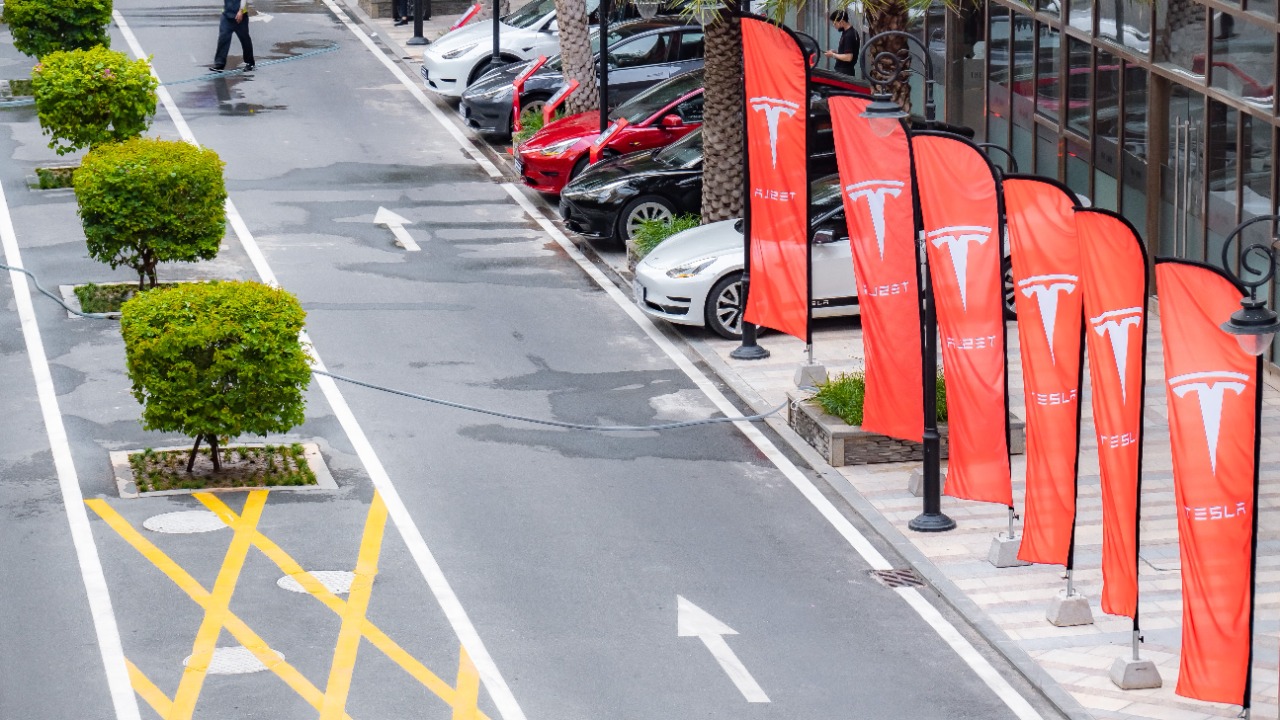
Tesla delivered 480,126 vehicles during the April-to-June quarter, an increase of 25% from 384,122 vehicles during the same period of 2025. Model 3 and Model Y deliveries accounted for 467,762 units, while Cybertruck and other models contributed 12,364 vehicles.
Total production reached 451,758 vehicles, meaning deliveries exceeded production by more than 28,000 units. That helped reduce Tesla’s global inventory from 27 days of supply in the first quarter to 15 days at the end of Q2. The full production and delivery breakdown is available through Tesla’s second-quarter operational report.
The delivery recovery followed a weaker opening quarter in which Tesla delivered 358,023 vehicles. Stronger European demand, expanded availability of lower-priced Model 3 and Model Y versions and rising fuel costs helped support the rebound. Reuters reported that improving European sales were particularly important after Tesla had faced weaker regional demand during earlier periods.
The figures revived hopes that Tesla could end a two-year period of annual delivery declines. Analysts tracked by Visible Alpha expected the company to deliver approximately 1.7 million vehicles during 2026, although the final result will depend on demand, pricing and how many vehicles Tesla assigns to its own robotaxi fleet instead of retail customers.
Automotive Revenue Grew While Vehicle Economics Weakened
Automotive revenue rose 23% year over year to $20.52 billion, but the amount Tesla earned from each delivered vehicle declined. Average vehicle revenue fell to approximately $42,730 from $45,345 a year earlier as Tesla relied on lower prices and more affordable trims to compete in the United States, Europe and China.
Tesla’s automotive gross margin excluding regulatory credits fell to 16.3%, below the 18.04% expected by analysts. The decline suggests that higher sales volume did not fully compensate for weaker pricing, product mix and manufacturing economics.
Regulatory-credit revenue also dropped by around two-thirds to $146 million. Tesla earns these credits by selling them to manufacturers that fail to meet environmental requirements, but policy changes and the wider adoption of electric vehicles have reduced that historically high-margin revenue source.
The pressure is becoming more important as Tesla faces newer and often cheaper vehicles from BYD, Geely, Volkswagen, General Motors and other manufacturers. Model 3 and Model Y continue to generate almost all of Tesla’s delivery volume, leaving the company dependent on products that now compete in increasingly crowded market segments.
Operating Profit Fell Despite the Revenue Record
Tesla generated $4.75 billion in gross profit, up 23% from the previous year. However, total GAAP gross margin slipped from 17.2% to 16.8%, while operating expenses climbed 47% to $4.35 billion.
The increase in expenses reduced operating income to just $398 million, down 57% from $923 million in Q2 2025. Operating margin fell from 4.1% to 1.4%, demonstrating how little of Tesla’s record revenue remained after production costs, research spending and other operating expenses were deducted.
GAAP net income attributable to common shareholders declined 5% to $1.11 billion. Non-GAAP net income, which removes items including stock-based compensation and investment-related adjustments, fell 17% to $1.15 billion.
The gap between revenue growth and operating-profit decline provides the clearest explanation of Tesla’s quarter. Vehicle demand improved, but the company spent significantly more to generate that growth and prepare its future businesses.
Capital Spending More Than Doubled
Capital expenditure reached $5.79 billion during Q2, an increase of 142% from $2.39 billion one year earlier. It was also more than double the $2.49 billion spent during the first quarter.
Operating cash flow improved by 85% to $4.70 billion, but it was not enough to cover Tesla’s investment programme. Free cash flow consequently turned negative by $1.09 billion, compared with positive free cash flow of $146 million during the equivalent quarter of 2025. It was Tesla’s first negative free-cash-flow quarter in more than two years.
Tesla ended June with $43.52 billion in cash, equivalents and short-term investments. That remained 18% higher than a year earlier but represented a sequential decline of approximately $1.22 billion.
Chief executive Elon Musk described 2026 as a “massive” capital-expenditure year. Tesla expects to spend more than $25 billion during the full year, nearly three times its previous annual expenditure, as it builds computing, manufacturing and energy infrastructure.
Tesla Is Funding a Business Beyond Electric Cars
The spending reflects Musk’s effort to reposition Tesla as an artificial-intelligence, robotics and energy company rather than a conventional automaker.
Cybercab production began at Gigafactory Texas during the quarter, while engineering vehicles started public-road testing. Tesla said its robotaxi service was operating in seven major metropolitan areas, with unsupervised rides expanding in Austin and launching in Miami, Orlando and Tampa.
Construction also began on Optimus humanoid-robot production facilities in Fremont after Tesla decommissioned the Model S and Model X lines. Additional spending is supporting Tesla Semi production, battery-material processing, AI computing, solar manufacturing and planned semiconductor capacity.
Full Self-Driving subscriptions provide one possible route towards higher-margin software revenue. Tesla finished the quarter with approximately 1.48 million active FSD subscriptions, up 56% year over year. The company also said more than 55% of its new North American deliveries included an FSD subscription during the quarter.
The challenge is timing. Tesla is spending billions of dollars today, but robotaxis, artificial intelligence and humanoid robots have not yet generated enough earnings to compensate for pressure on the core automotive operation.
Energy Storage and Services Provided Important Support
Tesla’s energy-generation and storage revenue increased 13% to $3.14 billion. The company deployed 13.5 gigawatt-hours of storage products, up 41% from 9.6 GWh a year earlier and representing its second-highest quarterly deployment total.
Demand for Megapack and Powerwall systems is being supported by renewable-energy development, grid stabilisation and the growing electricity needs of data centres. The energy division provides Tesla with a source of growth that is less directly exposed to consumer vehicle-pricing competition.
Services and other revenue produced the fastest increase, climbing 50% to $4.58 billion. Tesla said the division generated a record $648 million in gross profit with a 14% gross margin, supported by vehicle servicing, charging, insurance and used-car operations.
These businesses cannot yet replace automotive revenue, but they are becoming increasingly important as Tesla attempts to build a broader ecosystem around its vehicle fleet.
Investors Focused on Spending Rather Than Sales
Tesla’s shares fell more than 14% during the session following the report. The sell-off showed that investors were less impressed by record deliveries and revenue than they were concerned about weak margins, negative free cash flow and the uncertain timeline for returns from AI investments.
The company’s valuation depends heavily on the belief that robotaxis, FSD subscriptions, energy storage and Optimus robots will eventually produce much higher margins than vehicle manufacturing. Tesla’s Q2 financial outlook said it expects hardware profits to be accompanied over time by accelerating AI, software and fleet-based earnings, but it did not provide a precise timeline for that transition.
That leaves investors facing a difficult trade-off. Tesla’s automotive scale has recovered, its energy operation is expanding and major future products are moving into production. At the same time, the company is committing extraordinary amounts of capital while its established car business earns less profit from each dollar of revenue.
Tesla’s Strong Quarter Comes With a Major Financial Test
Tesla’s second-quarter results were strong in volume but weak in efficiency. Deliveries rose 25%, revenue increased 26% and energy deployments climbed 41%. Yet operating income fell 57%, operating margin dropped to 1.4% and nearly $5.8 billion in capital spending pushed free cash flow into negative territory.
The next stage will depend on whether Tesla can convert its current investments into dependable earnings. Higher FSD adoption, commercial robotaxi operations, expanding energy storage and successful Cybercab production could eventually justify the expenditure.
Until those businesses produce measurable returns, Tesla must continue relying primarily on vehicle sales to finance an increasingly ambitious technology programme. Q2 proved that the company can still generate demand and record revenue. It also showed that growth alone will not satisfy investors when profits and cash flow are moving in the opposite direction.