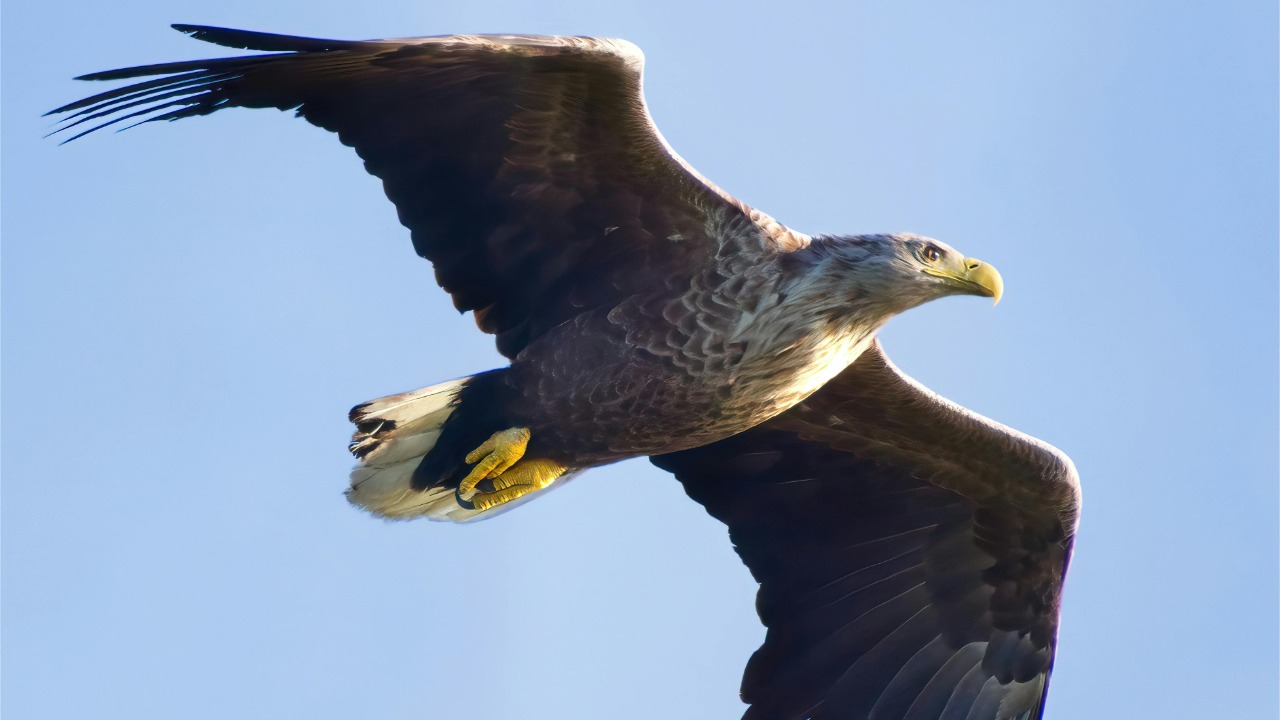

A gigantic sea eagle with a wingspan close to 8 feet has stunned birdwatchers in England after turning up thousands of miles from its usual range in northeast Asia. The sighting of the Steller’s sea eagle, one of the largest raptors on Earth, has triggered a rush of observers hoping for a glimpse of a bird that rarely appears outside Russia and Japan.
The visitor’s arrival adds a new chapter to an already extraordinary journey that has taken a single wayward eagle across continents, challenging assumptions about how far a top predator can roam and what that movement might say about a warming planet.
What happened
Witnesses in England reported a massive dark-brown eagle with bold white patches on its wings and tail and a huge yellow bill, field marks that point strongly to a Steller’s sea eagle. The species usually nests along the coasts and rivers of eastern Russia and winters in Japan and the Korean Peninsula, so any appearance in western Europe counts as a major ornithological event. The English bird matches the description of an adult, with crisp white shoulders and tail standing out against a bulky, dark body.
This is the first known sighting tied to England in the current episode, but the same individual Steller’s sea eagle is believed to have been wandering far outside its range for several years. Birders in North America began tracking an out-of-place bird after it was photographed in Alaska, then later in Texas, Quebec and the northeastern United States. Reporting on that journey described an eagle with a wingspan of about 7.9 feet and an estimated weight of up to 20 pounds, making it significantly larger than a bald eagle and one of the most imposing raptors ever seen in the region, according to a detailed account of the bird’s travels in the North American records.
The same distinctive plumage pattern, along with the scarcity of the species, led many experts to argue that all of these scattered sightings involved a single bird. That theory gained traction when a Steller’s sea eagle appeared in Nova Scotia nearly 5,000 miles from its Asian home, then continued south into New England. Observers in Massachusetts documented the bird along the Taunton River and in coastal marshes, where crowds gathered to watch it harass gulls and bald eagles. The description of that visit, including the bird’s habit of perching on tall conifers and scanning for fish, matches the behavior now reported from England.
In Maine, the same eagle drew hundreds of people to the Boothbay Harbor area, where it lingered along the shore and on nearby islands. Local birders noted that the giant raptor often shared perches with bald eagles and occasionally displaced them, a vivid illustration of its size and confidence. Coverage of the Boothbay Harbor spectacle described how visitors with spotting scopes and long camera lenses lined the waterfront to catch even a distant view of the towering sea eagle.
Earlier appearances in Massachusetts had already turned the bird into a celebrity. Reports from that period recounted caravans of birders chasing alerts across multiple towns, sometimes in winter storms, to see a raptor that in field guides is normally confined to maps of the Russian Far East. Observers described the eagle’s enormous yellow beak and bright white tail as unmistakable field marks that set it apart from any other species in the region, details that match the plumage pattern now cited in current British accounts.
Naturalists in New England had already spent time debating whether the wandering Steller’s sea eagle was hopelessly lost or simply exploring. A long-running discussion by regional experts examined how the bird repeatedly reappeared in similar coastal habitats, returning to productive fishing grounds year after year. That debate, which weighed navigation errors against deliberate exploration, now informs how scientists interpret the England report, as described in a detailed analysis of the.
Why it matters
A Steller’s sea eagle in England is remarkable on its own, but the sighting carries broader scientific and conservation weight. The species is globally rare, with estimates of only a few thousand individuals in the wild. Most breed along remote rivers and coastal cliffs in the Russian Far East, where they rely on salmon runs and coastal fish. When a bird from such a limited population travels to the opposite side of the world, every movement becomes valuable data.
For ornithologists, the eagle’s journey offers a real-world test of how large raptors respond to shifting environmental conditions. Changes in sea ice, fish stocks and storm patterns across the North Pacific and Arctic could influence migration routes and dispersal. If one Steller’s sea eagle can cross from Asia to North America and then to Europe, it raises questions about how often rare vagrants have moved similar distances in the past without being detected, and whether climate change might make such long-distance wanderings more common.
The bird’s path has also highlighted how quickly modern birding networks can mobilize. In New England, social media alerts and rare-bird hotlines helped people track the eagle from town to town. Coverage of its movements through Massachusetts and Maine described how thousands of visitors filled small coastal communities, booking hotel rooms and crowding local cafes as they waited for the eagle to reappear. One account from Maine noted that local businesses saw a noticeable midwinter boost as people traveled from multiple states to see the rare Asian raptor.
That influx of visitors has economic and logistical implications. Local authorities must manage traffic, parking and access to sensitive habitats, particularly when viewing sites sit near private land or fragile coastal marshes. At the same time, the spectacle offers an opportunity to connect the public with conservation messages about habitat protection, migratory corridors and the pressures facing seabirds and raptors worldwide.
The England sighting also speaks to the power of individual animals as ambassadors for their species. Many people who traveled to see the Steller’s sea eagle in North America later reported learning about its conservation status, the threats facing salmon runs in Russia and Japan, and the broader challenges of climate-driven ecosystem change. A single bird can turn abstract concerns about biodiversity loss into something concrete and memorable.
There is also scientific value in documenting how the eagle interacts with local species. In Maine and Massachusetts, observers watched the Steller’s sea eagle share estuaries with bald eagles, ospreys and great black-backed gulls. Those encounters created a kind of natural experiment in competition and coexistence. Similar interactions are now possible in England, where the visiting eagle may cross paths with white-tailed eagles that have been reintroduced to parts of the British coast, offering a rare chance to compare two of the world’s largest sea eagles in the same skies.
What to watch next
The key question now is whether the Steller’s sea eagle will linger in England, move on to another part of Europe or attempt a return journey toward its ancestral range. Past behavior suggests that the bird can remain in a productive area for weeks or months if fish and waterfowl are abundant. Observers in Nova Scotia, for example, watched the eagle work coastal inlets and harbors for extended periods, feeding on fish and carrion along rocky shorelines, as described in detailed coverage of the Nova Scotia visit.
Researchers will be watching for patterns in how the bird chooses its stopover sites. So far, it has shown a preference for coastal estuaries, wide rivers and working harbors where fishing activity can provide both live prey and discarded catch. If the England location offers similar conditions, the eagle may settle into a predictable routine, giving scientists and birders more chances to document its behavior and health.