
A surge protector for a modern television should generally offer at least 1,000 joules of surge protection. For a television connected to a soundbar, streaming box, gaming console or home-theatre receiver, a unit rated at 2,000 joules or higher is the safer choice.
Premium OLED televisions, expensive entertainment systems and equipment used in areas with frequent electrical storms may justify protection in the 3,000-to-4,000-joule range. A higher rating does not guarantee that the television will survive every electrical event, but it gives the surge protector greater capacity to absorb repeated spikes before its protective components wear out.
Eaton’s official guidance says sensitive electronics such as televisions and audio-video equipment typically benefit from surge protectors rated at 1,000 joules or more. It recommends ratings of 2,000 joules and above for home-theatre components and gaming consoles.
What a Joule Rating Actually Measures
A joule is a unit of energy. On a surge protector, the joule rating represents the approximate amount of surge energy the device can absorb before its protection circuitry fails.
The rating does not indicate how much electricity the television consumes. A 3,000-joule surge protector does not supply more power to a television than a 1,000-joule model, and it will not increase the television’s brightness, performance or electricity bill.
Instead, the rating describes the protector’s energy-handling capacity. A higher number generally means the internal components can survive a larger surge or a greater number of smaller surges over time. Eaton describes higher joule ratings as offering both greater protection capacity and potentially longer useful life.
A protector may absorb several minor electrical disturbances during normal use. Each event can gradually reduce its remaining capacity, even when the television continues working and no visible damage occurs.
Is 600 or 900 Joules Enough for a TV?
A 600-to-900-joule protector can provide basic protection for an inexpensive television, but it should be considered the lower end of the acceptable range.
Eaton classifies 400 to 600 joules as basic protection for lamps and small electronics, while 600 to 1,000 joules is described as moderate protection suitable for televisions and entertainment equipment. A rating above 1,000 joules provides a larger safety margin for sensitive electronics.
A 600-joule model may be reasonable for a small secondary television in a guest room. It is less appropriate for a large OLED or Mini-LED television that would cost thousands of dollars to replace.
The price difference between a low-capacity protector and a properly certified 2,000-joule model is often small compared with the value of the connected equipment.
A Television Setup Needs More Protection Than the TV Alone
The correct rating should be based on the complete entertainment system rather than only the television.
A typical media setup may contain a television, soundbar, subwoofer, streaming device, Blu-ray player, cable receiver, gaming console and network equipment. Every connected device contains sensitive electronic components, and one surge protector may be responsible for protecting the entire group.
For a television alone, 1,000 to 2,000 joules is normally reasonable. For a television with one or two inexpensive accessories, approximately 2,000 joules provides a stronger margin. A full home-theatre setup should generally use 2,500 joules or more, particularly when it includes a receiver, powered speakers or multiple consoles.
A higher rating is also sensible when the equipment is difficult to replace, contains stored data or is used in a location with frequent outages and electrical disturbances.
Joules Are Not the Only Specification That Matters
A large joule number can look impressive on packaging, but it should not be the only reason for selecting a surge protector.
One of the most important additional figures is the voltage protection or let-through rating. This indicates how much voltage may reach the connected equipment after the protector begins suppressing the surge.
Common ratings include 330, 400, 500 and 600 volts. In this case, a lower number is preferable. A 330-volt rating generally provides stronger clamping than a 500- or 600-volt rating.
UL Solutions advises buyers to look for a low suppressed-voltage rating and to select a product that has been independently certified. Its guide to power strips and surge protectors also explains that an ordinary power strip may look identical to a surge protector while offering no surge suppression at all.
For a television, a model with a 330- or 400-volt let-through rating is preferable when available.
Look for UL 1449 Certification
A reputable television surge protector should be tested to an appropriate safety standard, such as UL 1449 in the United States.
Certification does not mean that the device can stop every possible surge. It indicates that the protector has been evaluated against recognised electrical-safety and surge-performance requirements.
UL recommends checking for an authentic certification mark because testing covers concerns such as electrical shock, fire risk and safe construction. A product that displays only vague language such as “power protection” without a recognised certification or published electrical specifications should be treated cautiously.
Counterfeit and extremely inexpensive power strips may advertise large joule ratings without providing clear certification, clamping data or protection-status information.
The Protection Light Is More Important Than the Power Light
Most surge protectors contain at least two indicator lights. One shows that the strip is receiving electricity. The other confirms that its surge-protection circuitry is still functioning.
A television may remain powered even after the protective components have failed. In that situation, the device is functioning as an ordinary power strip rather than a surge protector.
A model with automatic shutoff is safer because it disconnects the outlets when the protective circuitry is no longer effective. Without automatic shutoff, a failed unit may continue supplying electricity while giving the household no obvious warning.
Eaton recommends replacing the device when its protection indicator turns off, when automatic shutoff disables the outlets or when the casing shows cracking, melting or discolouration.
Coaxial and Ethernet Connections Can Provide Another Route for Surges
A television may be connected to more than an electrical outlet. Cable television receivers, external antennas, Ethernet cables and telephone lines can also provide pathways through which excess voltage enters an entertainment system.
A surge protector with coaxial or Ethernet protection may be useful when those wired connections are present. The external cable should pass through the protector’s appropriate input and output ports before reaching the television, modem or receiver.
However, every part of the entertainment system should use a coordinated protection strategy. Protecting the television’s power cable while leaving a connected cable receiver or outdoor antenna line unprotected can still leave an electrical path into the system.
Eaton notes that surges can travel through communication cables as well as power wiring, which is why some protectors include ports for Ethernet, coaxial and telephone lines.
A Power Strip Is Not Automatically a Surge Protector
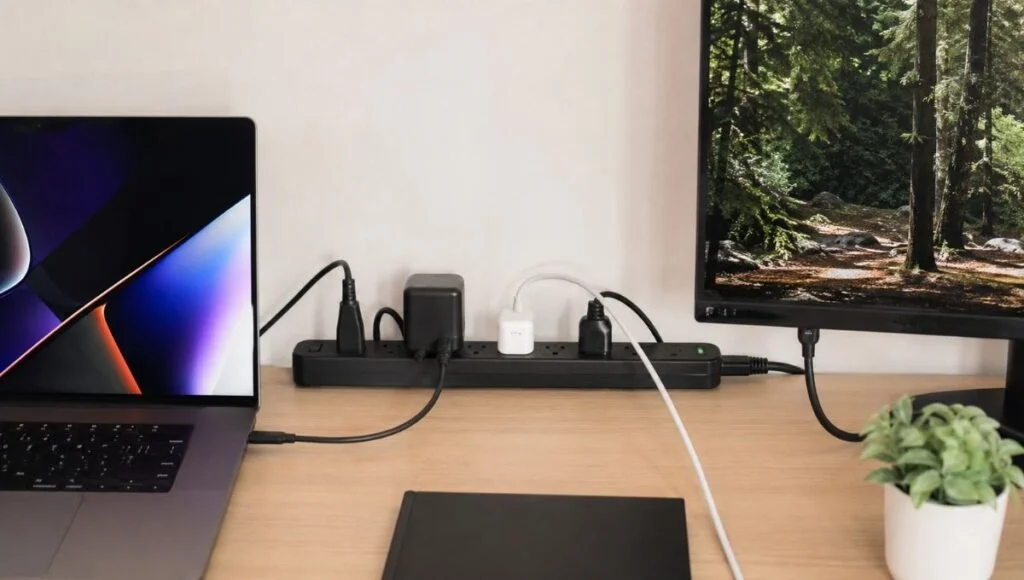
A basic power strip provides additional outlets but may contain no surge-protection components.
The presence of an on-off switch, circuit breaker or illuminated power light does not prove that surge suppression is included. The packaging or product label should explicitly state that it is a surge protective device and display a joule rating.
UL Solutions explains that an ordinary power strip is essentially an extension cord with several outlets, while a surge protector contains circuitry designed to clamp excess voltage before it reaches connected equipment.
A power strip with no stated joule rating should not be relied upon to protect a television.
Surge Protectors Do Not Last Forever
Many surge protectors use metal oxide varistors, commonly known as MOVs, to divert excess voltage away from connected electronics. These components degrade as they handle repeated electrical disturbances.
There is no universal replacement schedule because lifespan depends on the protector’s joule capacity, the frequency of surges and the severity of local electrical conditions. A high-capacity model in a stable electrical system may remain effective for years, while a lower-rated protector exposed to repeated outages may wear out much sooner.
The protection indicator should be checked regularly, particularly when the strip is hidden behind a television cabinet. Replacement should also be considered after a serious nearby lightning event, major outage or confirmed electrical surge, even when the television appears undamaged.
A new surge protector is inexpensive compared with discovering that an older unit had already exhausted its protective capacity.
No Plug-In Protector Can Guarantee Protection From Direct Lightning
Even a 4,000-joule surge protector cannot guarantee that a television will survive a direct lightning strike.
Lightning can carry far more energy than a small plug-in device is designed to manage. A point-of-use protector is most effective against common switching surges, utility disturbances and residual surge energy that reaches household wiring.
The US National Weather Service states that typical surge protectors should not be expected to protect equipment from a direct lightning strike. Electronics should be disconnected well before a thunderstorm arrives when practical, but cords should not be handled during an active storm because lightning can travel through wiring. (National Weather Service lightning guidance)
Homes in lightning-prone areas may benefit from layered protection combining a professionally installed whole-home surge protective device with certified point-of-use protectors near televisions and computers.
The Best Rating for Most Television Owners
For a basic television, a certified surge protector rated between 1,000 and 2,000 joules provides a reasonable starting point.
For a television combined with a soundbar, streaming box or gaming console, 2,000 to 3,000 joules offers better protection and longer potential service life.
For an expensive OLED television or complete home-theatre system, 3,000 joules or more is appropriate, especially in an area with unstable electricity or frequent storms.
The final choice should also include a low let-through rating, recognised safety certification, three-line protection, a visible protection-status light and automatic shutoff. Joules matter, but the strongest television surge protector is the one that combines adequate energy capacity with reliable construction and clear evidence that its protective circuitry is still active.