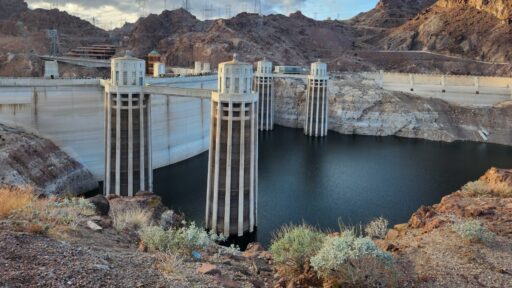
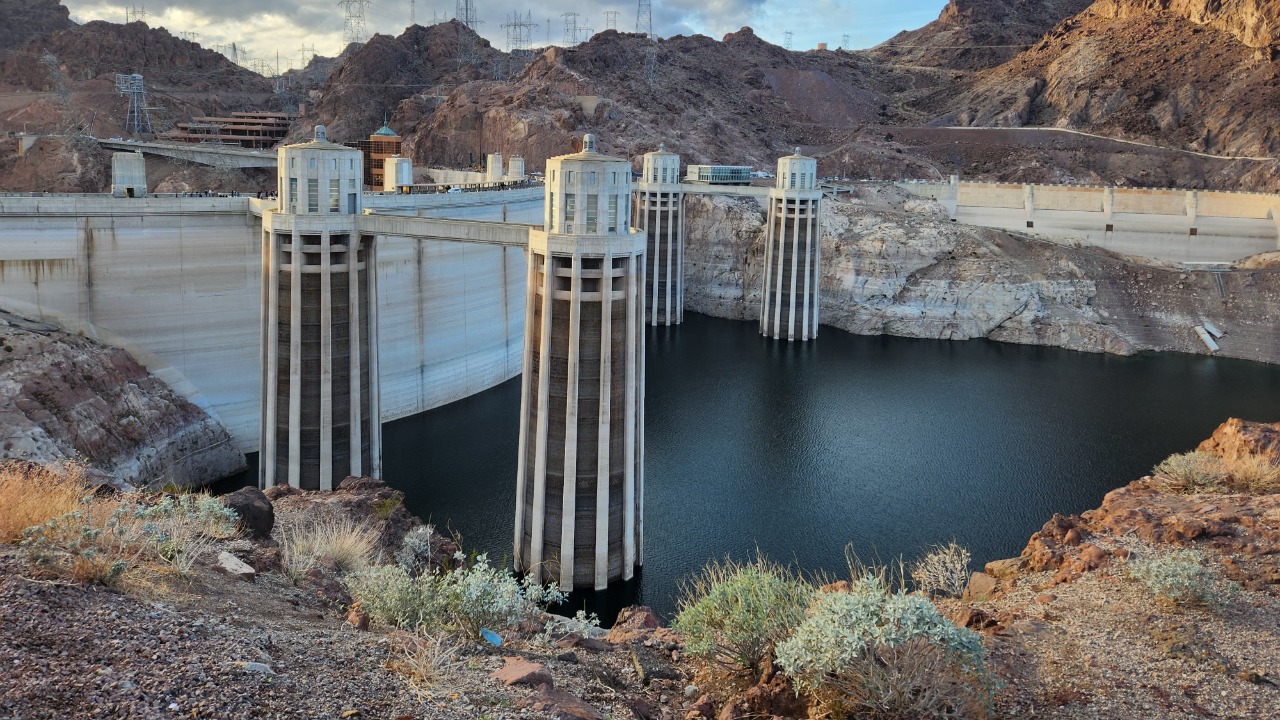

Hoover Dam could lose up to an additional 40 percent of its hydropower-generating capacity as early as fall 2026 as federal officials take emergency steps to prevent another major Colorado River dam from approaching its own power-production limit.
The US Bureau of Reclamation announced in April that it intended to reduce the amount of water released from Lake Powell into Lake Mead by approximately 1.48 million acre-feet through September 2026. The measure is designed to protect Lake Powell and preserve hydropower generation at Glen Canyon Dam, but it will send less water downstream to Lake Mead, the reservoir that powers Hoover Dam.
Federal officials acknowledged the trade-off directly. Holding more water in Lake Powell could accelerate Lake Mead’s decline and produce “up to an additional 40% reduction” in Hoover Dam’s hydropower capacity as early as this fall.
The warning does not mean Hoover Dam is expected to shut down completely, nor does it guarantee an exact 40 percent reduction. The outcome will depend on Lake Mead’s elevation, electricity demand, conservation efforts, summer heat and whether the Colorado River Basin receives meaningful precipitation.
The Crisis Begins Upstream at Lake Powell
Hoover Dam’s immediate power threat is connected to deteriorating conditions hundreds of miles upstream.
Lake Powell sits behind Glen Canyon Dam on the Arizona-Utah border. It stores water that is later released through the Grand Canyon and into Lake Mead.
After a historically dry winter and extreme March heat, the Bureau of Reclamation forecast that Lake Powell could fall below elevation 3,490 feet by August 2026 without intervention. That elevation is known as the minimum power pool because Glen Canyon Dam’s conventional turbines can no longer reliably generate electricity when the water approaches that level.
Lake Powell’s projected inflow for the water year was only 2.78 million acre-feet, approximately 29 percent of the historical average and one of the lowest forecasts on record. Colorado River system storage had fallen to about 36 percent of capacity.
Federal water managers therefore faced a difficult choice: continue releasing the previously planned amount of water into Lake Mead and risk losing hydropower at Glen Canyon Dam, or hold water in Lake Powell and worsen conditions downstream at Hoover Dam.
They chose to protect Lake Powell in the short term.
Less Water Will Flow From Lake Powell to Lake Mead
The Bureau of Reclamation originally planned to release 7.48 million acre-feet from Lake Powell during the 2026 water year.
Under the emergency response, that volume is being reduced to 6 million acre-feet through September 2026. The difference of 1.48 million acre-feet represents an enormous volume of water that will remain behind Glen Canyon Dam rather than flowing into Lake Mead.
One acre-foot is the amount of water required to cover an acre of land one foot deep. It equals roughly 326,000 gallons.
Holding back 1.48 million acre-feet therefore means that approximately 482 billion fewer gallons may reach Lake Mead than under the original operating plan.
The government is also releasing between 660,000 and 1 million acre-feet from Flaming Gorge Reservoir in Wyoming and Utah to support Lake Powell. Those actions are expected to raise Lake Powell by approximately 54 feet by April 2027 compared with what would otherwise occur.
The cost is that Flaming Gorge could fall by roughly 35 feet over the coming year, while Lake Mead receives substantially less water.
The Bureau of Reclamation’s official drought-response announcement explains the emergency actions and their projected effects across the basin.
Why Falling Water Reduces Hydropower
Hydropower output depends partly on the vertical distance between the reservoir surface and the turbines.
That distance is known as hydraulic head.
When a reservoir is full, the weight and pressure of the water help drive large volumes through the turbines. As the water level falls, pressure declines and each unit of water produces less energy.
Lower water can also prevent some generating units from operating efficiently or safely. At certain elevations, operators may need to shut turbines down because the machinery is not designed for the reduced pressure conditions.
Hoover Dam was built with 17 main generating units and historically had a maximum generating capacity of approximately 2,080 megawatts. Its power capacity has already declined significantly because Lake Mead remains far below full elevation.
The newly projected reduction would come on top of losses that have already occurred.
Capacity Is Not the Same as Actual Electricity Production
The federal warning refers to hydropower-generating capacity.
Capacity measures the maximum amount of electricity a plant can produce under available operating conditions. Actual generation measures how much electricity it produces over time.
A plant with 1,000 megawatts of available capacity does not necessarily produce 1,000 megawatts every hour. Output changes with water releases, electricity demand, maintenance schedules and operating requirements.
A 40 percent reduction in available capacity would therefore not automatically mean that every customer receives exactly 40 percent less electricity from Hoover Dam.
It would mean the dam has substantially less ability to generate power when utilities need it.
This distinction matters during periods of high electricity demand, especially hot Southwestern afternoons when air-conditioning use rises sharply.
Lake Mead Is Approaching a Critical Elevation
Lake Mead’s elevation was near 1,050 feet in late spring 2026 and had recently been falling by approximately one foot every five to seven days.
A critical threshold lies near elevation 1,035 feet.
Below that level, several Hoover Dam turbines may no longer be able to operate normally, causing a sharp loss in available generating capacity.
At the recent rate of decline, the threshold could be crossed during summer or fall. However, the timeline remains uncertain.
Arizona, California and Nevada have proposed additional conservation intended to keep Lake Mead above 1,035 feet until spring 2027. Summer rainfall, temperatures and water use will also influence the reservoir’s trajectory.
That uncertainty is why the government describes the potential decline as “up to” 40 percent and “as early as” this fall.
Hoover Dam Is Not About to Stop Producing All Power
Hoover Dam would continue producing electricity after a 40 percent reduction in generating capacity.
The warning concerns a major loss of capability rather than a complete shutdown.
The dam can generate at lower reservoir elevations because several of its turbines have been upgraded with wide-head designs that operate across a larger range of water pressures.
The Bureau of Reclamation has also announced $52 million for three additional wide-head turbines capable of generating electricity down to approximately elevation 950 feet.
Once those turbines are installed alongside five existing wide-head units, Hoover Dam will be more resilient at low water levels.
However, the installation timeline was not publicly confirmed in the reporting available in June. Even after the upgrades, capacity losses at very low reservoir elevations would remain substantial.
“Dead Pool” Is a More Extreme Threat
Lake Mead would reach a condition known as dead pool if the water became too low to flow through Hoover Dam’s river-outlet structures.
That level is around elevation 895 feet.
The current warning does not suggest Lake Mead will reach dead pool this fall.
The nearer concern is the loss of turbines and generating capacity around elevation 1,035 feet. Water could still pass through the dam and continue downstream even if some power units became unavailable.
Headlines suggesting Hoover Dam is about to run completely dry or stop releasing water exaggerate the immediate forecast.
The situation is serious because of the speed and scale of the capacity reduction, not because a total shutdown has been forecast for fall 2026.
The Emergency Plan Protects Glen Canyon at Hoover’s Expense
The Colorado River’s two largest reservoirs function as one connected system.
Lake Powell stores water in the Upper Basin, while Lake Mead stores water farther downstream in the Lower Basin.
When more water is released from Lake Powell, Lake Mead benefits. When water is retained upstream, Lake Mead declines more quickly.
The 2026 emergency response demonstrates the difficulty of managing both reservoirs during severe drought. There is not enough water to protect every reservoir, power plant, community and ecosystem simultaneously.
Federal managers are moving water from Flaming Gorge to support Lake Powell while reducing Lake Powell releases to support Glen Canyon Dam.
That strategy transfers a significant portion of the immediate risk downstream to Lake Mead and Hoover Dam.
The Associated Press overview of the emergency reservoir operations describes how protecting Lake Powell creates consequences for Flaming Gorge, Lake Mead and regional electricity customers.
Hoover Dam Power Serves Public Utilities
Electricity from Hoover Dam is allocated to public power systems, municipalities, irrigation districts and tribal entities in Arizona, California and Nevada.
California receives the largest overall share, while Nevada and Arizona also receive significant allocations.
The electricity is valued not only because it is renewable but also because federal hydropower has historically been relatively inexpensive.
When Hoover Dam produces less electricity, its customers generally must obtain replacement power from the wider wholesale market.
That replacement may come from natural gas plants, solar facilities, battery storage or other generators. It is usually more expensive than the contracted federal hydropower.
Electricity Bills Could Rise
A reduction at Hoover Dam is unlikely to cause widespread blackouts by itself because the Western power grid has many other generating resources.
The more immediate effect is financial.
Utilities that receive less federal hydropower may need to purchase replacement electricity at market prices. Those costs can eventually be passed to households, businesses and public institutions through higher rates.
Some public utilities elsewhere in the Colorado River system have already raised rates as federal hydropower declined. The Associated Press reported that Heber Light & Power in Utah implemented several increases, including a recent 13 percent rise, partly because it had to replace reduced federal hydropower with more expensive market purchases.
The exact effect of Hoover Dam’s decline will differ by utility. No customer depends entirely on Hoover power, and the dam represents only one part of the Western electricity system.
Small public utilities and rural cooperatives may nevertheless feel the cost more sharply than large regional power companies with diverse energy portfolios.
Hydropower Helps Stabilize the Grid
Hydropower has qualities that are not fully captured by its annual energy production.
Dam operators can often increase or decrease generation quickly, helping the electric grid respond to changing demand.
This flexibility is valuable in a system containing large amounts of solar power. Solar output drops in the evening just as household electricity use may remain high, creating a need for resources that can increase output rapidly.
Hydropower can help fill that gap.
Losing generating capacity at Hoover Dam reduces the amount of flexible, dispatchable electricity available to grid operators.
Natural gas plants and batteries can provide similar balancing services, but replacement resources may cost more or produce additional greenhouse-gas emissions.
The Reservoirs Supply More Than Electricity
The Colorado River provides water to approximately 40 million people across seven US states and Mexico. It also supports agriculture, tribal communities, industry, wildlife habitat and recreation.
Hydropower is therefore only one part of the crisis.
Lake Mead supplies major urban areas including Las Vegas, Phoenix and Southern California. Colorado River water also irrigates farms that produce vegetables, livestock feed and other crops.
As the reservoirs decline, governments must balance water deliveries, electricity production, environmental requirements and recreational access.
The emergency plan may keep power flowing at Glen Canyon Dam while reducing Hoover Dam’s output, lowering boating access at Lake Mead and creating additional pressure for water conservation downstream.
Arizona, Nevada and Mexico Already Face Reductions
Lake Mead entered 2026 under a Level 1 Shortage Condition.
Earlier federal projections called for Arizona to contribute 512,000 acre-feet in water reductions, equal to approximately 18 percent of its annual Colorado River apportionment.
Nevada was assigned 21,000 acre-feet, about 7 percent of its allocation, while Mexico was expected to contribute 80,000 acre-feet, approximately 5 percent of its annual allotment.
California did not receive a mandatory shortage reduction under the same tier because its Colorado River rights have higher legal priority.
However, California has participated in compensated conservation programs that leave additional water in Lake Mead.
Further declines could intensify disputes over how future reductions should be divided among agricultural users, growing cities, tribes and states.
The Current Colorado River Rules Are Expiring
The emergency is unfolding during a major legal and political transition.
Rules that have guided Lake Powell and Lake Mead operations for roughly two decades are scheduled to expire at the end of 2026.
The seven Colorado River Basin states have struggled to reach agreement on a replacement system.
Upper Basin states include Colorado, New Mexico, Utah and Wyoming. Lower Basin states include Arizona, California and Nevada.
The two groups disagree over how mandatory reductions should be measured and distributed during dry years.
The federal government is preparing to determine post-2026 operating rules if the states cannot reach a consensus.
The falling reservoirs make those negotiations more urgent because the existing system was not designed for conditions this severe or persistent.
Drought Is Only Part of the Problem
The Colorado River Basin has experienced more than two decades of unusually dry conditions.
Higher temperatures worsen the shortage by increasing evaporation and drying soils. When snow melts, dry ground absorbs more water before it can reach streams and reservoirs.
Research has found that human-caused climate change has intensified the Southwestern megadrought and reduced Colorado River flows.
Water use also remains a central factor. For much of the last century, the river was legally divided using assumptions based on an unusually wet historical period.
The system was promised more water than it regularly produces under modern climate conditions.
Cities have reduced per-person water use in many areas, but agriculture still accounts for the majority of consumptive Colorado River use.
Long-term stability will require reductions that reflect the river’s actual supply rather than continuing to depend on emergency reservoir transfers.
Lake Powell and Lake Mead Have Not Fully Recovered
Wet winters in 2023 and other temporary improvements raised reservoir levels and reduced the immediate risk of infrastructure failure.
Those gains did not end the broader shortage.
A few good snow seasons cannot fully reverse decades of declining storage, especially when water releases and consumption continue.
Lake Powell was recently near 23 percent of full capacity, while the total Colorado River system stood near 36 percent.
The white mineral “bathtub rings” visible around both reservoirs show how far their surfaces have fallen from historical highs.
The 2026 emergency developed after the driest winter on record and unusually hot March conditions caused runoff forecasts to collapse.
Conservation Could Delay the 40% Reduction
The Hoover Dam forecast is not fixed.
Lower Basin conservation could keep Lake Mead above the most damaging turbine threshold for longer.
Arizona, California and Nevada have discussed leaving additional water in the reservoir. Federal compensation programs have also paid users to reduce consumption temporarily.
Cooler temperatures and a strong summer monsoon could slow evaporation or add limited inflow.
Those measures may postpone the decline until spring 2027, according to reporting on the reservoir’s recent trajectory.
However, conservation that merely delays the threshold by several months does not solve the long-term imbalance.
The reservoir will remain vulnerable unless water use falls enough to match the river’s reduced supply over many years.
Why “As Soon as This Fall” Matters
Hydropower demand is often high during summer because of air-conditioning use.
The largest capacity loss may occur after the summer peak, but utilities purchase and plan electricity months or years in advance.
An autumn reduction would affect winter and future-year energy planning. It could also leave less low-cost hydropower available when maintenance or unexpected outages affect other generators.
The timing coincides with the beginning of the new federal water year on October 1 and the expiration of existing operating rules at the end of 2026.
That combination makes fall a critical period for both water policy and electricity planning.
What Residents Should Expect
The warning does not mean residents in Las Vegas, Phoenix or Southern California should expect their electricity to turn off when Lake Mead crosses one elevation.
The Western grid combines power from many sources and across a large geographic area.
A Hoover Dam reduction would be managed through replacement purchases and adjustments among utilities.
Some customers could eventually face higher electricity costs, particularly where utilities depend heavily on federal hydropower contracts.
Water users may also see more conservation campaigns, restrictions or financial incentives intended to keep additional water in Lake Mead.
The largest consequences may initially appear in utility budgets, wholesale electricity contracts and reservoir operations rather than as an immediate household outage.
The Main Takeaway
The Bureau of Reclamation has warned that Hoover Dam could experience up to an additional 40 percent reduction in hydropower-generating capacity as early as fall 2026.
The risk is a consequence of emergency action intended to protect Lake Powell and Glen Canyon Dam. Federal managers plan to reduce Lake Powell releases to Lake Mead from 7.48 million to 6 million acre-feet through September while moving water from Flaming Gorge Reservoir into Lake Powell.
That strategy may preserve hydropower upstream but accelerate Lake Mead’s decline.
The 40 percent estimate is a potential capacity reduction rather than a guaranteed drop in actual electricity production. Hoover Dam is not forecast to shut down completely, and conservation could delay the most serious effects.
The warning nevertheless shows how the Colorado River’s water crisis has become an energy problem.
When reservoirs fall, dams lose both water storage and the pressure required to generate electricity efficiently. Utilities must then replace low-cost renewable hydropower with more expensive alternatives.
The emergency plan can move the immediate risk from one reservoir to another, but it cannot create new water. Without sustained reductions in consumption and operating rules built for a hotter, drier climate, both Lake Powell and Lake Mead will remain dangerously exposed.