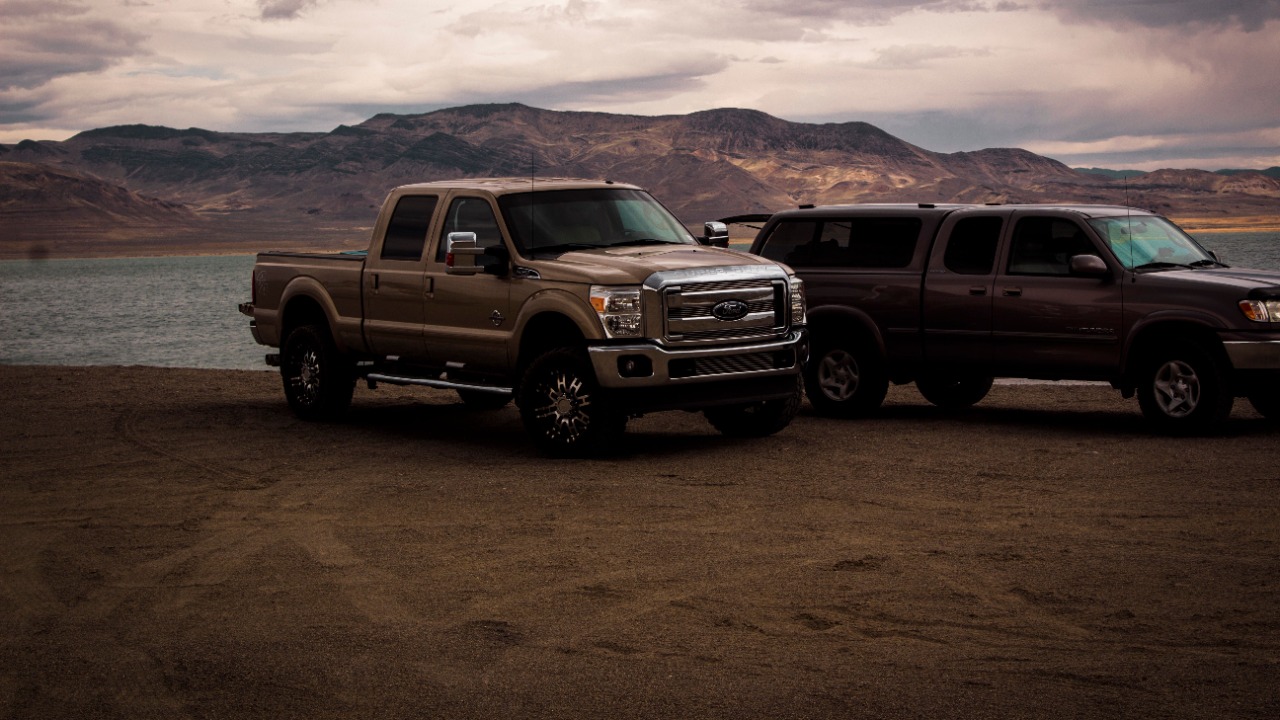

The electric pickup market looked almost experimental only a few years ago.
Today, Americans can already buy battery-powered trucks from Ford, Chevrolet, GMC, Rivian and Tesla, with ranges stretching beyond 400 miles, towing capacities well above 10,000 pounds and acceleration that would embarrass many sports cars.
But the market has also become a good example of how quickly EV plans can change.
Ford has adjusted its F-150 Lightning lineup. General Motors has expanded the Silverado EV and Sierra EV. Tesla continues changing Cybertruck pricing. And Ram made perhaps the biggest reversal of all: its planned battery-only 1500 REV was canceled in 2025, while the gasoline-generator-equipped Ramcharger was renamed Ram 1500 REV and is now the truck Ram expects to bring to market.
That means some older “coming in 2026” lists are already outdated.
Here are eight electric or electrified pickups that matter in the American market in 2026—and what buyers should understand before assuming every one of them works the same way.


1. Ford F-150 Lightning: The Electric Truck That Looks Most Like a Normal Truck
Ford took perhaps the safest possible approach to its first mass-market electric pickup.
Instead of making the F-150 Lightning look like a concept vehicle from 2040, it made it look like an F-150.
That turned out to be one of its greatest strengths.
Someone climbing out of a gasoline F-150 does not need to learn an entirely different kind of pickup. The cab is familiar. The bed remains useful. The driving position feels like a truck. Accessories and work-oriented features make sense to traditional pickup buyers.
The difference sits underneath.
Dual electric motors provide four-wheel drive, instant torque and up to 580 horsepower in extended-range configurations. Ford rates certain versions at up to 320 miles of EPA-estimated range, while properly equipped trucks can tow as much as 10,000 pounds.
The Lightning also has one feature gasoline pickups physically cannot duplicate as easily: a huge enclosed front trunk.
Without an engine occupying the nose, Ford created what it calls the Mega Power Frunk, providing weather-protected cargo space where an engine would normally sit.
That makes the Lightning unexpectedly practical for tools, groceries and luggage.
The Lightning Can Also Become a Giant Power Source
Ford’s Pro Power Onboard system allows the truck to supply electricity to tools and other equipment.
With the appropriate home-energy equipment, certain Lightning configurations can also provide backup power to a house during an outage.
That changes the usual relationship between home and vehicle.
Normally:
House charges truck.
During an emergency:
Truck can help power house.
For someone living in an area with storm-related outages, that can turn the battery from transportation hardware into household energy storage.
But Towing Remains the Lightning’s Weak Point
The problem with every battery-electric truck becomes obvious once a large trailer is connected.
Aerodynamic drag increases dramatically.
Weight increases.
Energy consumption rises.
Range falls.
A Lightning that comfortably covers hundreds of miles unladen may need substantially more charging stops when towing a large camper or equipment trailer.
Ford’s own Intelligent Range system accounts for factors including trailer use and temperature because the range difference can be significant.
That does not make the Lightning bad at towing.
Its electric motors provide enormous low-speed torque.
The problem is towing distance, not pulling ability.
This distinction will appear repeatedly throughout the electric-truck market.
Ford Is Updating the Lightning for 2026
Ford has announced a new STX trim for the 2026 F-150 Lightning, replacing the previous XLT position in the range.
The STX adds all-terrain tires, unique wheels and off-road-oriented equipment while targeting approximately 290 miles of EPA range.
That tells us something interesting about the maturing EV market.
Manufacturers are no longer merely trying to prove an electric pickup can exist.
They are creating different versions for different truck buyers.
Work trucks.
Luxury trucks.
Off-road trucks.
Eventually, an electric pickup lineup may become as varied as gasoline F-150 configurations already are.
2. Rivian R1T: The Pickup Designed as an EV From Day One
The Rivian R1T took the opposite approach from Ford.
It does not try to feel like an electric version of an existing truck.
The entire vehicle was designed around an electric platform.
That allowed Rivian to rethink packaging.
One of the most famous examples is the Gear Tunnel, a storage compartment running laterally through the body behind the rear seats.
There is no equivalent on a conventional pickup because drivetrain and chassis components normally occupy that space.
The R1T also combines adjustable air suspension, sophisticated off-road software and multiple motor configurations.
For 2026, Car and Driver continues to rank the R1T at the top of its electric-pickup class, praising its combination of performance, packaging and truck usefulness.
Range Can Exceed 400 Miles
Depending on battery and drivetrain configuration, the R1T can exceed 400 miles of rated range.
Chevrolet’s own competitive comparison lists the R1T Dual with Max Battery at about 420 miles, while Rivian continues offering different battery and motor combinations rather than forcing every buyer into one specification.
That flexibility matters.
Someone using an R1T mainly around town does not necessarily need the largest available battery.
Someone planning long-distance wilderness travel might.
Bigger batteries increase range.
They also increase price and weight.
The R1T Is Ridiculously Fast for a Pickup
Electric motors changed the definition of truck performance.
Traditional pickup performance once meant torque and towing.
Now an electric truck can do both while accelerating like a supercar.
High-output R1T configurations can reach 60 mph in roughly the mid-two-second range.
That is absurd performance for something with:
A pickup bed.
Off-road suspension.
Four doors.
Serious towing capability.
No conventional transmission.
Rivian did not simply electrify a truck.
It helped create a new category where outdoor utility and supercar acceleration exist in the same vehicle.
Rivian’s Biggest Question Is the Company, Not the Truck
The R1T itself is extremely capable.
The harder question concerns scale.
Ford and GM can spread engineering, manufacturing and service costs across millions of vehicles.
Rivian cannot.
That helps explain why the R1T remains relatively expensive.
It also makes service-network coverage and long-term corporate strength reasonable considerations for someone planning to own the truck for 10 or 15 years.
The product is compelling.
The company is still proving it can grow sustainably enough to support that product at mass-market scale.
3. Tesla Cybertruck: The Pickup That Refuses to Look Like Anything Else
There is no mistaking a Cybertruck for another vehicle.
Tesla abandoned almost every conventional pickup styling rule.
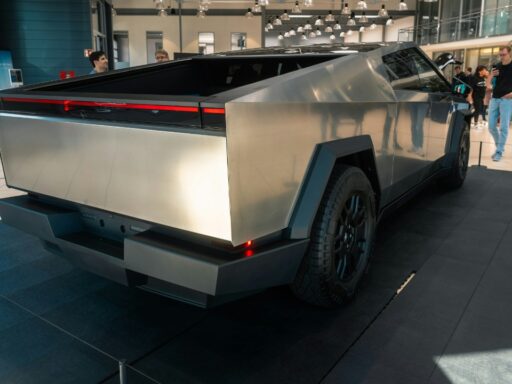
Flat stainless-steel panels.
Sharp angles.
A dramatically sloping roof.
No conventional painted exterior.
The result looks closer to a science-fiction prop than an F-150 competitor.
That has become both its biggest marketing advantage and one of its largest limitations.
Some buyers love it precisely because it looks like nothing else.
Others would never consider owning one for exactly the same reason.
The Cybertruck Is More Than Styling
Underneath the body are several genuinely interesting technologies.
The truck uses steer-by-wire, meaning the steering wheel does not require a traditional continuous mechanical steering connection in the way conventional vehicles do.
Rear-wheel steering dramatically reduces the effective turning circle.
High-output versions provide extreme acceleration.
And Tesla rates all-wheel-drive versions to tow as much as 11,000 pounds.
The long-range version has a lower maximum towing rating of 7,500 pounds, demonstrating again why buyers need to check the exact configuration rather than treating “Cybertruck” as one specification.
Tesla Is Still Changing Cybertruck Pricing
Cybertruck’s commercial story has been much less straightforward than its unveiling suggested.
Tesla originally promised aggressive pricing years before production.
Real-world prices landed much higher.
The company has subsequently changed trims, incentives and pricing repeatedly.
Most recently, Tesla raised U.S. prices by $5,000 on two Cybertruck versions on August 25, 2026, with the dual-motor model moving to $74,990 and the all-wheel-drive version to $84,990.
That makes Cybertruck pricing unusually fluid compared with traditional pickup lines.
Anyone shopping one should check Tesla’s current configurator rather than relying on even a month-old article.
Recalls Have Also Followed the Cybertruck
The Cybertruck’s unconventional engineering has attracted enormous scrutiny.
Tesla has issued multiple recalls since deliveries began, involving various components and production issues.
That does not automatically make it uniquely unreliable—new vehicle platforms frequently experience early problems—but it complicates the narrative that Tesla had simply reinvented the pickup and solved everything legacy manufacturers were doing wrong.
Radical engineering creates opportunities.
It also creates new things that need to be tested in real-world ownership.
4. GMC Sierra EV: The Luxury Electric Pickup That Can Approach 500 Miles
General Motors has taken a different path.
Rather than produce one electric pickup and badge-engineer it across brands, GM is using a shared electric architecture to create distinct Chevrolet, GMC and Hummer interpretations.
The GMC Sierra EV sits toward the premium end.
For 2026, GMC expanded the lineup substantially.
The luxurious Denali is now joined by Elevation and AT4 trims, making the Sierra EV available to buyers who want something less expensive or more off-road focused.
The range figure is the headline.
GMC says certain AT4 and Denali configurations with the Max Range battery can reach 478 miles of GM-estimated range.
That is enough to challenge one of the biggest assumptions about electric trucks:
That every EV pickup is limited to around 300 miles.
The AT4 Makes the Sierra EV More Than a Luxury Truck
The first Sierra EV arrived heavily focused on premium buyers.
That made sense for an expensive new technology, but it left a gap.
Pickup buyers also want off-road configurations.
The 2026 AT4 addresses that with more rugged equipment and positioning.
That matters because electric drivetrains are naturally interesting for off-road driving.
Electric motors can control torque extremely precisely.
There is no need to wait for an engine to reach a particular rpm.
One-pedal driving can provide excellent low-speed control.
The challenge is still weight.
Large batteries make electric full-size trucks extremely heavy, which can become a disadvantage on soft terrain.
Four-Wheel Steering Is More Useful Than It Sounds
A full-size pickup with a giant battery can become enormous.
Parking one should be miserable.
GM addresses this with available four-wheel steering.
At lower speeds, the rear wheels can turn opposite the fronts, reducing the turning circle.
On compatible Sierra and Silverado versions, GM also provides diagonal-style maneuvering functions that can move the truck at an angle.
It sounds like a party trick.
In a tight parking lot or narrow trail, it can genuinely make a large pickup easier to position.
5. Chevrolet Silverado EV: The Range King for Buyers Who Actually Need a Truck
The Chevrolet Silverado EV shares considerable hardware with the Sierra EV but targets a broader market.
This is GM’s attempt to turn electric pickups from premium curiosities into actual work vehicles.
Commercial versions are already being sold.
Retail versions now cover different price and capability points.
For 2026, Chevrolet advertises a starting price of $55,895 on its consumer site, with maximum GM-estimated range reaching 478 miles on certain configurations.
Commercial versions go even farther.
Chevrolet lists an EPA-estimated 493 miles for certain 2026 Silverado EV work-truck configurations.
That is astonishing for a full-size electric pickup.
Silverado EV Can Add More Than 100 Miles in 10 Minutes
Range alone does not solve road-trip anxiety.
Charging has to be fast too.
Chevrolet says the Silverado EV can gain roughly 74 to 120 miles of GM-estimated range in 10 minutes, depending on configuration, using available 350-kW DC fast charging.
The commercial version can add approximately 124 miles in 10 minutes under specified conditions.
That is where GM’s large high-voltage battery architecture begins making sense.
The battery is enormous.
But it can also accept enormous charging power.
The Midgate Is One of Its Smartest Truck Features
The Silverado EV includes an available Multi-Flex Midgate that opens the rear of the cab into the bed.
Combined with the tailgate, Chevrolet says this can accommodate objects up to 10 feet 10 inches long.
That is a clever use of EV packaging.
The truck does not simply replace gasoline with batteries.
Its architecture creates opportunities for different cargo configurations.
For contractors, kayakers, cyclists or anyone frequently carrying long items, that flexibility could be more useful than another touchscreen feature.
It Can Tow 12,500 Pounds
Chevrolet rates properly equipped versions at up to 12,500 pounds of towing capacity.
Again, that proves electric trucks generally do not struggle to generate enough force to pull a trailer.
Instant motor torque makes them extremely capable.
The unresolved challenge is how far they can tow before needing to recharge.
A 493-mile empty-truck rating does not mean 493 miles with a large travel trailer behind it.
Aerodynamics still wins.
6. GMC Hummer EV Pickup: The Electric Supertruck That Makes Almost No Attempt to Be Sensible
The GMC Hummer EV is technically a pickup.
It is also a demonstration of what happens when engineers decide efficiency is not the highest priority.
The 2026 Hummer EV Pickup 3X can provide up to 363 miles of estimated range and uses three electric motors in its higher-output configuration.
Depending on configuration, output can become enormous.
So can the vehicle itself.
The Hummer EV weighs thousands of pounds more than many ordinary pickups.
Its battery pack is huge.
Its dimensions are imposing.
Its price can cross six figures easily.
This is not an electric truck designed around minimal energy consumption.
It is an electric truck designed around spectacle.
Watts to Freedom Turns a Giant Truck Into a Launch-Control Machine
GMC’s aptly named Watts to Freedom mode prepares the Hummer EV for maximum acceleration.
The truck lowers itself.
Conditions the battery.
Optimizes the drivetrain.
Then launches with acceleration that would have sounded impossible for a Hummer two decades ago.
That performance is largely unnecessary.
It is also central to the vehicle’s personality.
Hummer was never about subtlety.
Electrification did not change that.
CrabWalk Is Actually Useful Off-Road
The Hummer’s rear steering enables CrabWalk, allowing all four wheels to turn in the same direction so the vehicle can move diagonally at low speed.
The feature became famous because it looks ridiculous in demonstrations.
But imagine an obstacle on a narrow trail.
Moving sideways slightly without performing a multi-point turn can genuinely help.
The 2026 truck also offers up to 350-kW DC fast charging in appropriately equipped configurations.
That is important because replenishing such an enormous battery at a slow charger would otherwise take a very long time.
The Hummer Shows the Contradiction Inside Electric Trucks
EVs are often promoted around efficiency and environmental benefits.
The Hummer EV asks a different question:
What if electricity is used to make something extraordinarily powerful instead?
Huge battery.
Huge mass.
Huge output.
Extreme acceleration.
Serious off-road equipment.
It produces no tailpipe emissions while driving, but its material and energy requirements are much larger than those of a lightweight EV.
That does not make the Hummer pointless.
It shows that “electric” describes a powertrain, not a philosophy.
EVs can be economical commuters.
They can also be 9,000-pound supertrucks.
7. Ram 1500 REV: The Truck That Changed Completely Before Reaching Customers
This is where older 2026 electric-truck lists need a major correction.
The original Ram 1500 REV was supposed to be a fully battery-electric pickup.
Ram announced massive battery options, 800-volt charging and up to around 500 miles of targeted range.
That vehicle is dead.
Stellantis canceled development of the all-electric Ram pickup in September 2025, citing slowing demand for full-size battery-electric trucks in North America.
But the REV name survived.
Ram transferred it to a completely different truck.
Today’s Ram 1500 REV Is the Former Ramcharger
The truck previously called the Ram 1500 Ramcharger has been renamed Ram 1500 REV.
It is not a pure battery EV.
Instead, it is a range-extended electric vehicle.
A 92-kWh battery powers electric motors that drive the wheels.
A 3.6-liter Pentastar V6 gasoline engine sits onboard too.
But the gasoline engine does not mechanically drive the wheels.
Instead, it operates a generator that produces electricity when the battery needs additional energy. Ram says the system uses a 130-kW generator and targets up to 690 miles of total driving range.
That distinction makes the truck extremely interesting.
Is It an EV or a Hybrid?
Technically, arguments will continue.
The wheels are always driven electrically.
That makes the driving system EV-like.
But gasoline still enters the vehicle.
The engine burns that gasoline.
Tailpipe emissions still occur when the generator operates.
So it cannot provide the zero-tailpipe-emission operation of a pure BEV over the entire 690-mile trip.
A useful description is:
Electric truck with an onboard gasoline range extender.
It behaves like a battery EV while sufficient charge remains.
When the battery falls, the generator extends the journey.
The REV Directly Attacks Electric Truck Towing Anxiety
This may be the smartest reason for the design.
Imagine towing a camper across rural America.
A pure battery truck’s range falls dramatically.
Fast chargers suitable for a truck-and-trailer combination may be inconveniently located.
Disconnecting a trailer to reach a charger can be frustrating.
The Ram REV offers another answer.
Use electricity for ordinary daily driving.
Charge at home.
But when towing long distance, the gasoline generator can continue producing electricity.
Ram targets:
690 miles of total range
14,000 pounds of maximum towing
and
2,625 pounds of maximum payload.
If those production figures hold, that combination could make the truck extremely attractive to buyers who like electric driving but are not ready to trust charging infrastructure with heavy towing.
But It Also Carries Two Power Systems
Nothing comes free.
A pure EV has a battery and motors.
A gasoline truck has an engine, fuel system and transmission.
A range-extended truck carries:
A large battery.
Electric motors.
A gasoline engine.
Fuel tank.
Generator.
Cooling systems for both.
That adds complexity and mass.
The REV sacrifices some of the mechanical simplicity usually promoted as an EV advantage.
It gains range flexibility in return.
Whether that trade proves attractive may tell the industry more about what American truck buyers actually want than any survey ever could.
8. What Happened to the Ram 1500 Ramcharger?
Technically, the eighth truck in Morning Overview’s original list no longer exists under that name as a separate pickup.
The article listed both the battery-electric Ram 1500 REV and the Ram 1500 Ramcharger as future vehicles.
Since publication, Ram’s product strategy changed.
The battery-only REV was canceled.
The Ramcharger was renamed REV.
So those two entries have effectively collapsed into one.
That means a current 2026 list should replace the duplicate with another actual electric pickup rather than pretending both Ram trucks are still arriving.
One obvious candidate is already in showrooms:
the 2026 GMC Hummer EV Pickup, which the original Morning Overview list fortunately also included.
That leaves the current U.S. pure-electric pickup market centered heavily around six established nameplates:
F-150 Lightning
Rivian R1T
Tesla Cybertruck
Chevrolet Silverado EV
GMC Sierra EV
GMC Hummer EV Pickup
with the range-extended Ram 1500 REV joining as a different interpretation of electrified trucking.
What About Scout Terra?
Scout’s Terra is one of the most interesting electric pickups headed toward the U.S., but it does not belong on a 2026 showroom list.
Scout is developing the Terra in both battery-electric and range-extended forms, with an 800-volt architecture planned for the BEV.
But production is expected later than 2026.
That makes it important to the future of the segment, not a truck American shoppers should expect to buy immediately this year.
The same warning applies to many concept vehicles announced with ambitious launch schedules.
An unveiling is not production.
A reservation page is not a dealership.
And in the EV market, dates can change dramatically.
Ram just demonstrated that.
Why Have Electric Pickup Plans Been So Difficult?
Pickup trucks create almost the hardest possible EV engineering problem.
They are large.
Heavy.
Often aerodynamically inefficient.
Expected to tow.
Expected to haul.
Expected to operate in heat and cold.
Expected to travel far from urban charging networks.
And buyers compare them with gasoline trucks capable of refueling in minutes almost anywhere in America.
An efficient electric sedan might consume roughly 25 kWh per 100 miles.
A giant electric pickup can require dramatically more.
Then attach a tall travel trailer.
Energy consumption rises further.
The obvious solution is a larger battery.
But a larger battery creates:
More cost.
More weight.
More charging time.
More raw-material demand.
Engineers therefore enter a difficult loop.
Huge Batteries Solve Range and Create Other Problems
The Silverado EV demonstrates both sides perfectly.
Its enormous battery allows certain versions to approach 500 miles.
Excellent.
But the truck can weigh more than 8,000 pounds, depending on configuration.
That extra weight affects:
Tire wear.
Handling.
Efficiency.
Crash energy.
Manufacturing cost.
Material consumption.
Engineering is always a trade-off.
There is no free 500-mile electric pickup.
Someone has to carry the battery.
Towing Is Still the Electric Pickup’s Hardest Test
EV pickups can often tow impressive maximum weights.
Lightning: up to 10,000 pounds.
Cybertruck AWD: 11,000 pounds.
R1T: roughly 11,000 pounds.
Silverado EV: up to 12,500 pounds.
Ram’s range-extended REV targets 14,000 pounds.
Again, pulling force is not the issue.
A tall trailer dramatically increases aerodynamic drag.
At highway speed, pushing air becomes one of the largest energy demands on the vehicle.
That affects gasoline trucks too.
The difference is that a gas truck can recover hundreds of miles of range in five minutes at a fuel station.
An EV may need a much longer charging stop.
Ram’s range extender exists specifically because that problem remains unresolved for many truck buyers.
Home Charging Is Where Electric Pickups Make the Most Sense
Road trips dominate EV discussions.
Daily life looks very different.
Suppose someone drives 45 miles each day.
Returns home.
Plugs the truck in overnight.
Leaves the next morning with a charged battery.
That owner may almost never visit a public charging station.
For contractors, home owners and suburban commuters, this can be extremely convenient.
No weekly gas station stop.
No standing beside a pump.
No wondering whether prices increased overnight.
The vehicle charges while its owner sleeps.
This is where an electric pickup’s experience can be significantly better than a gasoline truck.
Electric Pickups Can Also Power Tools and Houses
Large batteries create another opportunity.
These trucks carry dozens or hundreds of kilowatt-hours of energy.
That electricity does not necessarily have to stay inside the battery until the motors need it.
Ford offers Pro Power Onboard.
GM offers substantial offboard power and vehicle-to-home capability on suitable Silverado EV configurations. Chevrolet advertises up to 10.2 kW of offboard power and compatible home backup functionality.
GMC offers similar Energy Transfer functionality.
For a contractor, the truck can become a mobile power station.
For a homeowner, it can become emergency backup.
For campers, it can replace a portable generator for many tasks.
That is something electric pickups can genuinely do better than most conventional trucks.
Which Electric Pickup Has the Longest Range?
Among current U.S. offerings, Chevrolet and GMC lead the headline range contest.
The 2026 Silverado EV commercial configuration reaches as high as 493 miles EPA-estimated, while consumer Silverado EV and Sierra EV models can approach the upper-400-mile range depending on trim and battery.
Rivian can exceed 400 miles.
Ford remains closer to the low-300-mile range.
Cybertruck varies by version.
Hummer EV reaches into the mid-300s despite its enormous size.
But the longest-range truck is not automatically the best truck.
Range needs to be weighed against:
Price.
Battery size.
Efficiency.
Charging speed.
Payload.
Towing.
Size.
Daily use.
A buyer driving 30 miles per day gains little practical value from paying thousands more for another 150 miles of battery.
Which One Charges Fastest?
GM’s newest large electric trucks have a major advantage here.
Silverado EV can use available 350-kW DC fast charging, with Chevrolet claiming as much as around 120 miles added in 10 minutes depending on configuration.
Hummer EV can also reach up to 350 kW in appropriate configurations.
The Lightning uses a lower-voltage architecture and generally charges more slowly.
Again, the practical charging experience depends on finding a station actually capable of delivering the truck’s maximum.
A 350-kW truck plugged into a 150-kW charger is a 150-kW truck for that session.
Which One Is Best for Traditional Truck Buyers?
Probably the F-150 Lightning.
Its great advantage is familiarity.
It looks like a normal pickup.
Feels like a normal pickup.
Carries Ford’s enormous truck heritage.
Uses a familiar cab and bed philosophy.
Someone who wants an EV but does not want an EV to become their entire personality may appreciate that.
The Silverado EV is more radical underneath and in its body architecture.
The Cybertruck is radical everywhere.
The Lightning is deliberately conventional.
Which Is Best for Adventure?
The Rivian R1T remains exceptionally compelling.
Adjustable suspension.
Useful storage.
Strong off-road capability.
Long range.
Enormous performance.
Compact dimensions relative to full-size Detroit trucks.
It was designed for the buyer who might commute Monday through Friday and disappear into the mountains on Saturday.
That identity remains unusually clear.
Which Is the Most Excessive?
Hummer EV.
There is barely competition.
Its enormous battery, extreme weight, Watts to Freedom acceleration, rear-wheel steering and removable roof panels make it less a rational transportation appliance than an engineering demonstration.
Some buyers will consider that ridiculous.
Others will consider that precisely the point.
Which Could Be the Most Important?
The Ram 1500 REV may ultimately be the most interesting experiment.
Not because it is the purest EV.
Because it isn’t.
Ram effectively looked at the problem electric pickup buyers keep mentioning—long-distance towing—and decided not to pretend charging infrastructure had already solved it.
Drive electrically around town.
Plug in at home.
Use the battery first.
When necessary, let gasoline create more electricity.
It is less elegant than a pure battery vehicle.
It may be much easier for conventional truck owners to accept.
The Electric Pickup Market Is Entering Its Reality Check
The first generation of electric trucks was built around enormous expectations.
Ford increased Lightning production aggressively.
Tesla predicted huge Cybertruck volumes.
Ram announced a battery-electric 1500.
Automakers assumed pickup buyers would move quickly toward batteries.
Reality became more complicated.
Prices remained high.
Towing range worried customers.
Charging infrastructure remained uneven.
EV demand grew more slowly in the full-size-truck segment than some manufacturers expected.
Ram canceled its pure BEV pickup entirely in response to that changing market.
That does not mean electric trucks failed.
It means the market is becoming more realistic.
Electric Trucks Are Not Replacing Gasoline Pickups Overnight
The U.S. pickup market is enormous.
Millions of buyers have different requirements.
A homeowner charging nightly may love a Lightning.
A contractor traveling locally may find Silverado EV offboard power invaluable.
An adventure buyer may prefer Rivian.
Someone towing a fifth-wheel hundreds of miles through rural states may still choose diesel.
Someone wanting electric driving without giving up gasoline flexibility may become a Ram REV customer.
There does not need to be one winner.
Electrification can expand the choices available rather than immediately eliminating every other powertrain.
The Original Eight-Truck List Already Shows How Fast This Market Changes
Morning Overview’s August 12 list captured the state of the market at one point, naming the Lightning, R1T, Cybertruck, Sierra EV, Silverado EV, Hummer EV, battery-electric Ram REV and Ramcharger.
But one of those vehicles had already become an historical footnote.
The battery-only Ram 1500 REV was canceled in 2025, and its name transferred to the former Ramcharger.
That is a useful warning whenever reading about upcoming EVs.
Specifications can change.
Launch dates can move.
Names can change.
Entire programs can disappear.
The trucks physically sitting in American driveways tell us much more than concept announcements do.
So Which Electric Pickup Should You Actually Buy?
For a familiar everyday pickup experience, the F-150 Lightning remains one of the easiest transitions from gasoline.
For performance, off-road ability and clever packaging, the Rivian R1T remains exceptional.
For maximum range and serious work capability, the Chevrolet Silverado EV is arguably the most impressive current option.
For a more luxurious interpretation of that GM technology, there is the GMC Sierra EV.
For someone who wants nothing remotely conventional, there is the Tesla Cybertruck.
For sheer excess, the GMC Hummer EV Pickup wins without trying.
And for drivers who want electric propulsion but refuse to depend entirely on charging stations during long towing trips, the forthcoming Ram 1500 REV range extender may become the most pragmatic experiment of all.
Electric pickups are no longer theoretical.
Several are already on American roads.
The more interesting question in 2026 is no longer:
Can someone build an electric pickup?
The industry has answered that.
The question now is:
Which kind of electric pickup actually fits the way Americans use trucks?
And judging by the dramatically different strategies from Ford, GM, Rivian, Tesla and Ram, the automakers themselves are still figuring that out.