
A car’s old 12-volt outlet looks almost prehistoric next to modern USB-C charging.
It was originally designed for cigarette lighters. Yet with the right adapter, that same socket can charge a modern iPhone or Android phone surprisingly quickly.
So why does plugging a phone into the 12V outlet sometimes result in painfully slow charging?
In many cases, the 12V socket itself has plenty of power available. The real bottleneck is the adapter plugged into it, the USB cable attached to that adapter, or the charging standard supported by the phone.
BGR notes that typical automotive 12V outlets are commonly rated around 10 to 20 amps, while cheap or older USB car adapters may provide only a small fraction of the power the outlet can supply.
That means replacing the little adapter could make a much bigger difference than anything involving the car itself.
Your 12V Outlet Can Usually Deliver Far More Power Than a Phone Needs
A 12V automotive outlet can theoretically provide substantial power.
A socket protected by a 10-amp circuit, for example, is associated with roughly 120 watts at 12 volts. A 20-amp circuit corresponds to considerably more.
That does not mean someone should assume every car outlet is safe to use at its theoretical maximum. The vehicle manual specifies the actual permitted load, and the fuse protects the circuit.
But it demonstrates the important point:
A smartphone needing 20W, 30W or even 40W is generally not challenging the raw capacity of a properly functioning 12V accessory socket.
The adapter is what converts the vehicle’s DC power into the voltage and current the USB device can actually use.
If that adapter is weak, the phone charges slowly even though the outlet behind it has much more power available.
That Ancient USB Adapter May Be the Real Culprit
Many people have a car charger that has been living in the center console for years.
Perhaps it has one USB-A port.
Maybe the label says 5V/1A.
That is approximately 5 watts.
A modern phone designed to accept several times that amount will still charge from a 5W adapter.
It will simply take much longer.
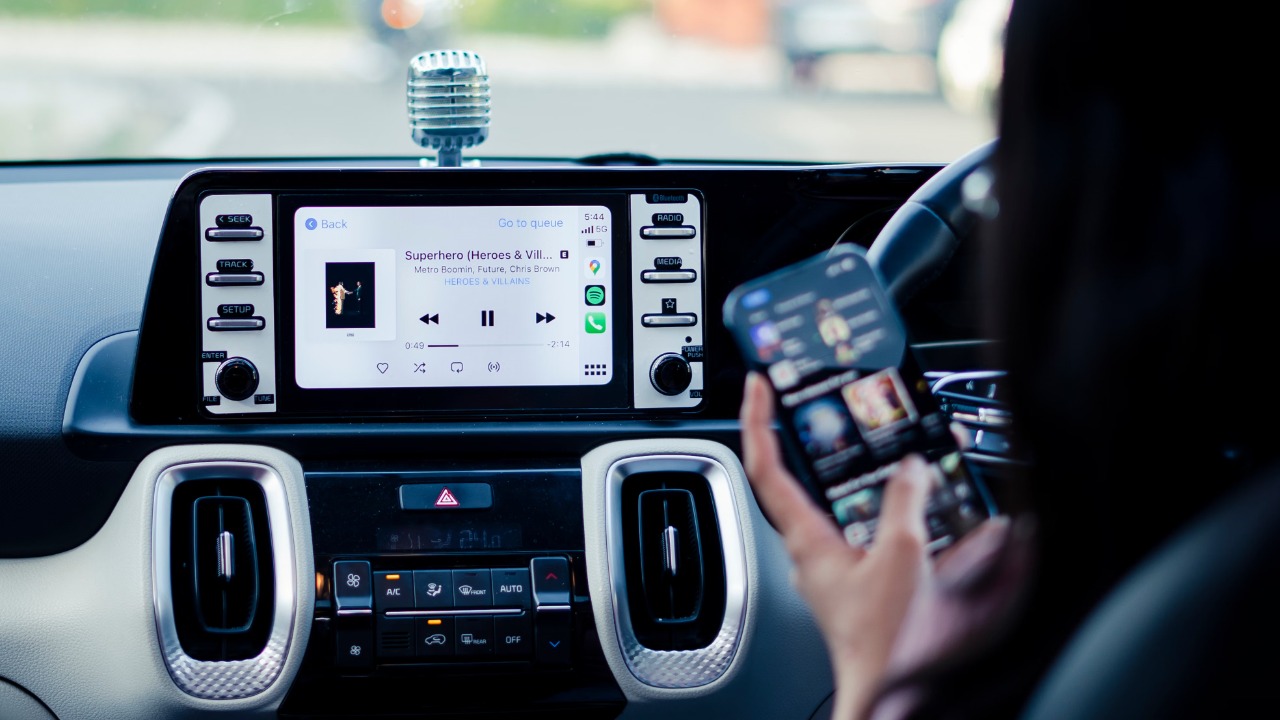
The problem can become particularly obvious while using navigation.
Google Maps or Apple Maps keeps the screen active.
GPS is operating.
Cellular data is active.
Bluetooth may be streaming audio.
The phone is generating heat.
A weak charger might barely provide more power than the phone is consuming.
The battery percentage can therefore rise incredibly slowly—or remain almost unchanged.
Look at Watts, Not Just the Number of USB Ports
Two car chargers can look almost identical while delivering completely different performance.
One may contain two ports capable of only modest charging.
Another may offer USB-C Power Delivery capable of 30W, 45W or substantially more.
Watts provide a useful shorthand for charging capacity because electrical power is calculated from voltage multiplied by current.
BGR explains that modern chargers increasingly advertise wattage because USB charging standards dynamically negotiate different voltages and currents depending on the attached device.
So when comparing car adapters, do not assume:
Two USB ports = faster charger.
Look at the actual output specifications.
USB Power Delivery Can Make an Enormous Difference
USB Power Delivery, usually abbreviated USB-PD, is one of the most important modern fast-charging standards.
Compatible charger and device communicate with each other to determine an appropriate charging voltage and current.
This allows USB-C to deliver substantially more power than old-fashioned 5V USB charging.
BGR specifically recommends looking for car adapters supporting technologies such as USB-PD or Qualcomm Quick Charge when charging modern smartphones.
A proper USB-C PD car charger can therefore turn the same old 12V outlet into something much closer to the fast wall charger someone uses at home.
The outlet did not become faster.
The conversion hardware became smarter.
Your Phone Determines the Maximum Too
Buying a 100W car charger does not mean a phone suddenly charges at 100W.
The device controls how much power it accepts.
A phone supporting a maximum of 25W may draw roughly that amount even if connected to a 65W adapter.
Likewise, different manufacturers use different charging protocols.
Some Android manufacturers support extremely high proprietary charging speeds only with compatible chargers and cables.
Others rely largely on USB Power Delivery.
Current iPhones have their own maximum charging behavior too. BGR’s testing of the iPhone 17 found the standard model peaking around 36W under appropriate conditions, meaning a suitably capable 40W-or-higher charger can make sense even though a 100W adapter will not force 100W into the phone.
The charger provides capacity.
The phone decides what to consume.
The Cable Can Ruin an Otherwise Perfect Setup
This may be the most overlooked part.
Imagine someone buys a high-quality 45W USB-C PD car charger.
Then connects the phone using an old cable pulled from a drawer.
Charging is still slow.
The charger gets blamed.
But USB cables are not all equal.
Some are designed mainly for low-power charging.
Others support 60W.
Some support 100W or more.
Damaged cables can also create additional resistance or unreliable connections.
BGR recommends using a quality cable with sufficient power capability rather than assuming every USB cable can deliver the same charging performance.
For an iPhone using relevant Apple connectors, appropriate certified cables can also reduce compatibility problems.
A Damaged Cable May Still “Work”
This makes diagnosis tricky.
A damaged cable does not necessarily stop charging completely.
It may still display the charging icon.
But internal conductor damage or a poor connector can limit performance.
That creates the frustrating situation where someone says:
“It can’t be the cable. It charges.”
Charging and fast charging are not the same thing.
Try another known-good cable before replacing the car charger or assuming the vehicle has an electrical fault.
It is one of the cheapest troubleshooting steps available.
Using Multiple Ports Can Reduce Charging Speed
Multi-port car adapters are convenient.
One phone.
A passenger’s phone.
A tablet.
Perhaps a dash cam.
But advertised charger wattage often refers to total output, not necessarily what every port can deliver simultaneously.
A charger marketed as 60W might provide one USB-C port with most of that capacity when used alone.
Plug another device into the second port and power may be divided.
The first device might then charge more slowly.
The exact behavior depends on the adapter.
Good manufacturers normally list individual port combinations in the specifications.
This is worth checking if a phone charges quickly when alone but slows dramatically as soon as another device is connected.
Heat Can Slow Charging Even With a Powerful Charger
Sometimes the adapter and cable are perfectly fine.
The phone itself deliberately slows charging.
Lithium-ion batteries do not like excessive heat.
A phone mounted on the windshield can sit directly in sunlight while simultaneously running navigation, GPS, cellular data and Bluetooth.
Then fast charging adds more heat.
The device’s battery-management system may reduce charging power to protect the battery.
This can make someone assume the 12V charger has suddenly failed.
Move the phone away from direct sunlight or aim an air-conditioning vent toward the mount and charging performance may improve.
This is especially common on hot summer drives.
Navigation Can Consume a Surprising Amount of Power
There is another reason car charging may feel slower than home charging.
At home, the phone may be sitting idle with its display off.
In the car, it may be doing some of its most energy-intensive work.
Screen brightness may be high enough to overcome daylight.
GPS operates continuously.
5G or LTE remains active.
Maps constantly redraw.
Bluetooth streams music.
CarPlay or Android Auto may also be running.
The relevant number is therefore not merely how much power enters the phone.
It is:
Charging power minus the power the phone is currently consuming.
If the charger supplies 10W while the phone itself is using 7W, only a small amount remains for actually increasing battery charge.
Upgrade to a suitable 30W adapter and the difference becomes much more noticeable.
Your Car’s Built-In USB Port May Actually Be Slower Than the 12V Outlet
This seems backward, but it can be true.
An older vehicle may contain built-in USB-A ports designed primarily for media connectivity rather than modern fast charging.
Those ports may provide relatively little power.
Meanwhile, the adjacent 12V accessory socket can support a modern high-output USB-C adapter.
In that situation, the ugly old cigarette-lighter socket is actually the better charging solution.
It is not inherently more advanced.
It simply gives an aftermarket adapter access to more available electrical power.
This is one reason drivers with older vehicles can dramatically improve device charging without replacing any part of the car.
Don’t Assume a Built-In USB-C Port Is Fast Either
USB-C describes the connector shape.
It does not guarantee a particular charging speed.
One automotive USB-C port might support only modest output.
Another could support USB-PD at 45W or more.
The same applies to aftermarket adapters.
Seeing the oval USB-C connector tells someone almost nothing about its actual maximum power.
Look for wattage and protocol information.
A charger explicitly stating something like 30W USB-C PD is much more informative than packaging that merely says “USB-C fast charger.”
Dirt or a Loose Connection Can Cause Problems Too
The 12V socket is a physical electrical connection.
Dust, corrosion or poor contact can create intermittent behavior.
Likewise, some inexpensive adapters fit loosely inside certain vehicle outlets.
If charging repeatedly starts and stops whenever the car hits a bump, the issue may be mechanical rather than related to wattage.
Inspect the outlet and adapter carefully.
Do not insert metal tools into an energized socket.
If the 12V outlet itself appears damaged, loose, burned or discolored, it is better to have the vehicle inspected rather than repeatedly forcing an adapter into it.
The same principle applies to the phone’s USB port. Debris or damaged connectors can also cause intermittent charging.
What Wattage Should You Buy?
For many modern smartphones, a 30W to 45W USB-C PD car charger provides a practical amount of headroom.
It can fast-charge many phones without requiring an enormous adapter.
Someone planning to charge tablets or laptops should look higher.
A 65W or 100W USB-C PD car adapter can make more sense if the vehicle outlet and charger are appropriately rated and the connected device supports that level of input.
But bigger numbers are not automatically better.
A 100W adapter used exclusively with a 20W phone provides no magical speed advantage over a quality 30W adapter that already satisfies the phone’s maximum.
Buy for the devices being charged.
Choose a Reputable Adapter
A car electrical system is not somewhere to save the final few dollars by purchasing completely unknown charging hardware.
The adapter has to convert vehicle voltage safely while dealing with temperature, vibration and electrical variation.
BGR specifically points toward established manufacturers such as Anker and Ugreen when discussing modern 12V adapters.
Belkin similarly lists car chargers supporting USB-PD and explains that actual charging performance depends on factors including the attached device, battery condition and whether the device supports fast charging.
The logo itself is not magic.
The advantage is clearer specifications, safety protections and a company with something to lose if the product is badly engineered.
Leaving the Adapter Plugged In Can Be Another Consideration
Some vehicles switch off their 12V outlets when the ignition is turned off.
Others leave them powered continuously.
That matters if an adapter remains plugged in.
Most decent USB adapters draw very little power when nothing is attached. Belkin, for example, lists standby consumption below 0.1W for one of its car chargers.
Still, on a vehicle that keeps the accessory socket powered constantly, leaving several devices or accessories connected for long periods can contribute to battery drain.
BGR recommends checking the vehicle manual to determine whether the 12V outlet remains powered after shutdown.
For an older car sitting unused for days, unplugging unnecessary accessories is a reasonable precaution.
When Should You Suspect the Car Instead?
If several known-good chargers fail in the same 12V outlet, it may actually be time to investigate the vehicle.
Warning signs include intermittent power, visible damage, burning smells or an adapter that repeatedly loses connection.
A blown accessory fuse can cause the socket to stop working entirely.
Electrical faults should be handled carefully, particularly if there are signs of overheating.
Do not replace a fuse with one rated higher than the manufacturer specifies simply to prevent it from blowing again.
A fuse that repeatedly fails is telling you there is a problem.
The Fastest Fix May Cost Less Than You Think
The good news is that fixing slow in-car charging often does not require automotive repair.
The 12V outlet itself may be perfectly capable.
The weak link is often the small adapter inserted into it.
A modern adapter supporting USB-C Power Delivery, combined with a properly rated cable, can provide dramatically faster charging from the same socket.
That means the troubleshooting order should be simple:
Check the phone’s supported charging speed.
Check the adapter’s wattage and fast-charging protocol.
Try a quality cable.
Test with only one device connected.
Keep the phone cool.
Then investigate the vehicle outlet if problems remain.
The 12V socket may have been designed in an era when smartphones did not exist.
That does not make it obsolete.
With the right adapter, one of the oldest electrical connections in the car can still power some of the newest technology remarkably well.