
Scientists at Arizona State University are testing a nature-inspired treatment that could make abandoned mine waste considerably less dangerous without relying on heavy machinery or highly intensive chemical stabilization.
The technique uses enzyme-induced carbonate precipitation, or EICP, to create mineral bonds between loose particles of mine waste. Those bonds form a hardened surface crust designed to reduce erosion and airborne dust while helping keep contaminants from being transported into rivers, groundwater and surrounding communities.
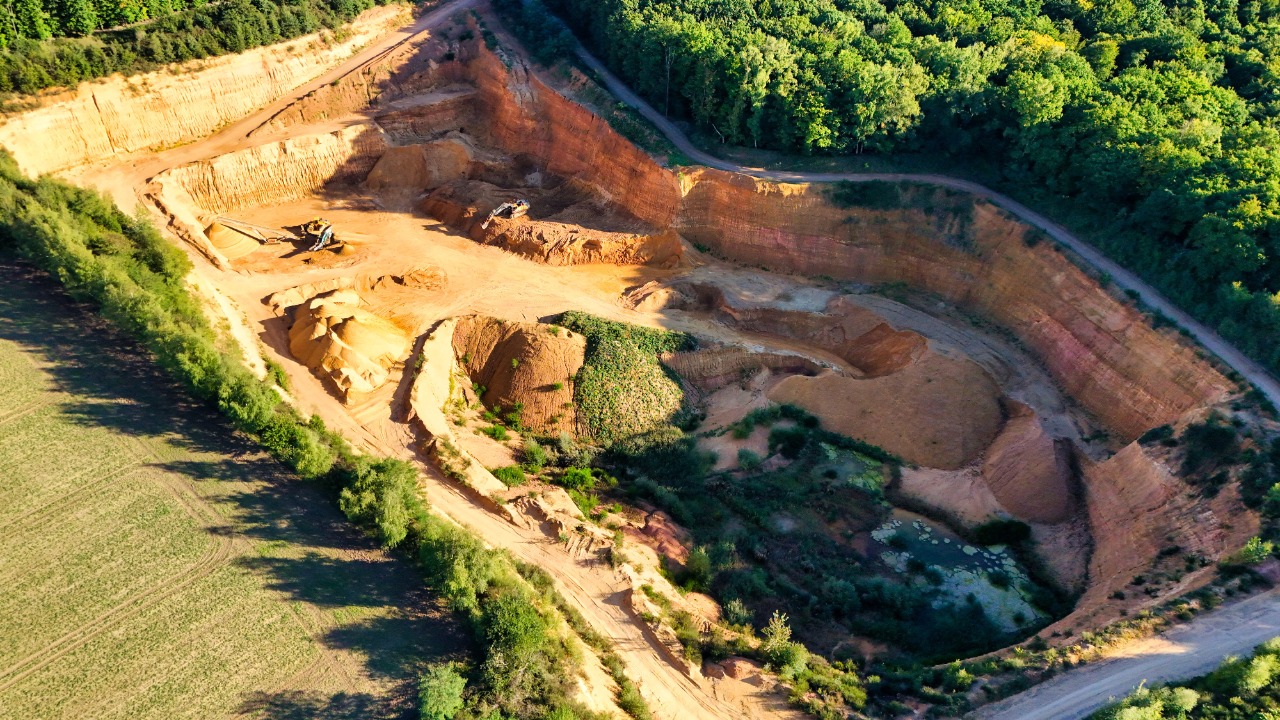
Researchers are now testing the process at the abandoned Cash Mine near Prescott, Arizona, with support from the Arizona Department of Environmental Quality. The field trial represents an important step toward determining whether a process already demonstrated in laboratory and geotechnical research can work reliably on real mine-waste deposits.
Read Arizona State University’s report on the mine-waste project
Abandoned Mine Waste Can Remain Dangerous for Decades
Mining does not end environmentally when extraction stops.
Processing ore can leave behind enormous quantities of finely crushed rock known as tailings. Depending on the original ore and extraction process, this material can contain substances such as arsenic, lead and other metals. Historic mining practices also created sites that lack many of the containment systems required at modern operations.
The U.S. Geological Survey notes that abandoned mine lands can continue producing acidic drainage containing elevated concentrations of metals long after mining has stopped. Tailings and other waste can contaminate surrounding watersheds as rain and groundwater move through the deposits.
The problem is not limited to water. Loose, fine material can be dispersed by wind, carrying potentially toxic elements away from the original waste pile. USGS research has identified both airborne and waterborne transport as important exposure pathways at abandoned tailings sites.
The U.S. Environmental Protection Agency consequently describes abandoned mine lands as potentially serious threats to human health and the environment.
Explore the EPA’s information on abandoned mine lands and cleanup challenges
The Enzyme Treatment Essentially Creates a Mineral Crust
The ASU approach does not attempt to remove an entire tailings pile.
Instead, it tries to make the material more stable.
The process relies on urease, an enzyme that accelerates the breakdown of urea. In the presence of dissolved calcium, that reaction creates conditions in which calcium carbonate can precipitate inside the spaces between soil or waste particles.
Calcium carbonate is the principal mineral found in materials such as limestone.
As it forms within a granular material, the precipitate can bond neighbouring particles together. Researchers describe this process as a form of biological or enzyme-assisted cementation.
Previous work involving ASU researchers has shown that EICP can substantially increase the strength of granular materials. Modifying the treatment can also influence where and how calcium carbonate crystals form, including around contact points between individual grains.
At a mine-waste site, the objective is not necessarily to turn the entire deposit into solid rock. Creating a sufficiently durable surface layer could make it harder for wind and running water to dislodge individual particles.
Cutting Dust Could Be One of the Immediate Benefits
Dust control is particularly important in dry mining regions such as Arizona.
Tailings can consist of extremely fine particles. Once exposed to strong wind, disturbed by vehicles or allowed to dry extensively, that material can become airborne.
The ASU team is evaluating whether EICP can create a protective crust strong enough to limit both wind erosion and dust production at the Cash Mine. Researchers have already been measuring dust generation after applying the treatment in the field.
Hamed Khodadadi Tirkolaei, the ASU assistant professor leading the Mining Innovation Initiative, says the process uses natural mineral bonding to stabilize the surface while potentially avoiding more chemically intensive treatments. His research broadly examines how enzymes, microbes, biopolymers and geochemical processes can solve problems in mining and geotechnical engineering.
Previous peer-reviewed EICP research has also demonstrated that carbonate precipitation can reduce the erodibility of granular materials, providing scientific support for the mechanism now being tested at the abandoned mine.
The Treatment May Help Keep Contaminants Out of Water
Controlling erosion could deliver another important benefit.
When rainfall flows across exposed mine waste, particles and dissolved contaminants can be transported downhill and eventually enter streams. Water moving through waste can also mobilize metals into groundwater.
Research summarized by the EPA has shown that precipitation can leach metals from abandoned tailings and potentially transport them into surrounding soil and surface water.
ASU says its enzyme treatment can immobilize environmentally harmful substances and reduce their movement toward nearby waterways.
The exact effectiveness will depend on site chemistry, contaminant concentrations, rainfall, mineral composition and how durable the treated crust remains over time. The ongoing Cash Mine field work is therefore important because performance under natural weather conditions can differ from controlled laboratory experiments.
Remote Mines Could Be an Especially Useful Application
Many abandoned mines are located in places where conventional remediation is difficult.
Transporting heavy machinery, large quantities of construction material or specialized treatment systems to a remote mountain site can make cleanup prohibitively expensive.
One advantage claimed for the ASU treatment is its relative simplicity.
Tirkolaei says the solution can be prepared at the site and applied without specialized equipment or heavy machinery. That could make EICP particularly attractive for abandoned mines where access is limited.
A technology that can be sprayed or otherwise applied directly onto problematic waste deposits could potentially allow environmental agencies to stabilize locations that would otherwise remain untreated for years.
However, field durability will be critical. A treatment that works for several months but rapidly breaks down after repeated rainfall, freeze-thaw cycles or extreme heat would provide much less environmental value.
Longer-term monitoring at Cash Mine should help answer that question.
Heavy Metals Can Also Interfere With the Enzyme
The technology has limitations.
Mine waste is chemically diverse, and some sites contain extremely high concentrations of metals. Those conditions can interfere with enzyme activity and reduce the effectiveness of EICP.
ASU researchers have therefore developed a separate plant-based biopolymer treatment for situations where heavy-metal concentrations inhibit the enzyme process.
That flexibility could be important because no single remediation technique will work across every abandoned mine.
The chemistry of a copper tailings deposit can differ substantially from waste left by gold, lead or uranium extraction. Weather, particle size, acidity and water availability also vary widely.
Another technical consideration is that conventional urease-driven EICP involves urea hydrolysis and can produce ammonium-containing byproducts. Earlier EICP research has specifically investigated treatment chemistry and the need to manage residual products.
Future large-scale deployment will therefore need to evaluate the complete environmental footprint of the process, not only its ability to strengthen tailings.
Mine Waste Could Eventually Become a Resource as Well
ASU’s work extends beyond stabilization.
Researchers involved in the Mining Innovation Initiative are also investigating whether old mine waste contains economically valuable critical minerals that previous generations of miners left behind.
Copper tailings, for example, can still contain elements that were not economically worthwhile to recover when the material was originally processed. Rising demand for minerals used in batteries, electronics and energy technologies has changed that calculation.
ASU teams are studying ways to quantify and recover valuable minerals from tailings, geothermal brines, industrial wastewater and electronic waste. One project uses microorganisms in membrane biofilm reactors to transform dissolved mineral ions into recoverable nanoparticles.
See ASU’s broader research into recovering critical minerals from waste
The longer-term possibility is particularly interesting: abandoned tailings might first be stabilized to reduce their environmental risk and eventually be reprocessed to recover valuable materials.
That could turn some historic mining liabilities into resources.
Field Testing Will Determine Whether the Idea Can Scale
The enzyme treatment should still be regarded as an emerging remediation technology rather than a proven universal solution.
Laboratory studies provide a strong scientific basis for EICP. Research has demonstrated calcium-carbonate formation, improvements in granular-material strength and reductions in erosion under controlled conditions. Other researchers are now studying related EICP approaches for stabilizing mine tailings and incorporating mining waste into useful engineering materials.
The Cash Mine trial moves the concept into a harder environment.
Researchers will need to determine how evenly the treatment can be applied, how deeply it penetrates, whether the crust survives extreme Arizona weather and whether contaminants actually remain immobilized over extended periods.
Cost will matter as well. An environmentally effective treatment will have limited impact if the enzyme, calcium source or repeated applications make it more expensive than existing remediation methods.
Still, the potential is substantial.
America has thousands of legacy mining sites, and many will require some form of environmental management for decades. A treatment that uses enzyme-driven mineral formation to stabilize loose waste without massive earthmoving could add a valuable option to the cleanup toolbox.
Rather than hauling every contaminated pile away or covering it with enormous quantities of imported material, scientists are testing whether chemistry inspired by natural mineral formation can persuade the waste itself to stay in place.
At the abandoned Cash Mine in Arizona, that idea is now being tested outside the laboratory and the results could determine whether enzyme-assisted mine cleanup can move from an experimental technology to a practical environmental solution.